
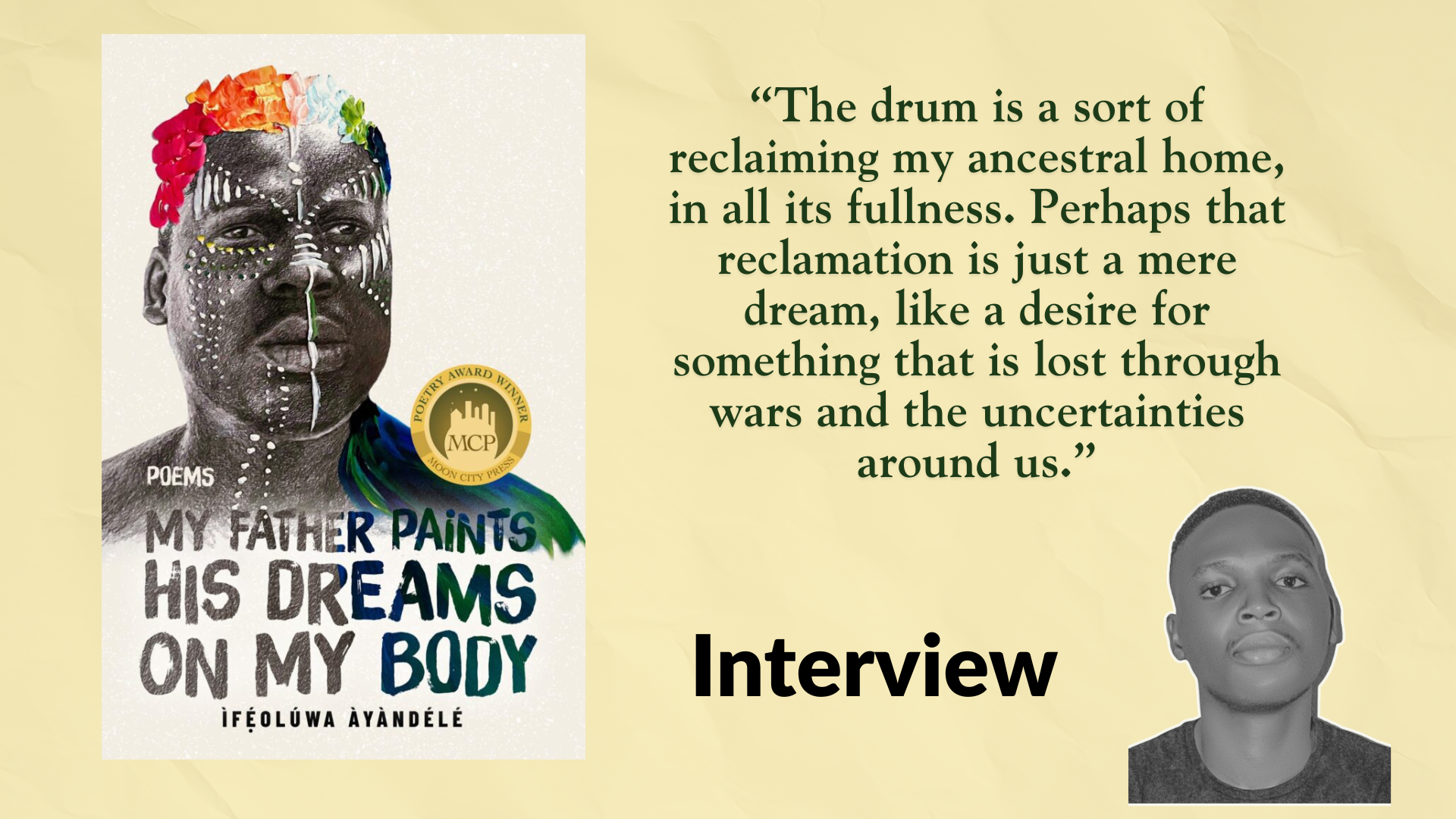
“Playing Bàtá in My Poetry”: A Conversation with Ifeoluwa Ayandele
Born in Tede, Nigeria, Ifeoluwa Ayandele is a poet with work in Callaloo, Poetry London, Magma, Michigan Quarterly Review, among other publications. Besides being shortlisted for the Wisconsin Poetry Series’ Brittingham & Felix Pollak Prize and the 2024 Autumn House Rising Writer Prize in Poetry, he has received the 2026 Pink Poetry Prize from Great River Review (at the University of Minnesota) and a fellowship from the Obsidian Foundation. He has an M.F.A. in poetry from Florida State University, where is currently a doctoral student, and serves as Assistant Interviews Editor at Southeast Review.
The first time I encountered Ifeoluwa Ayandele’s work was in 2021. We were co-contributors to the McNeese Review (Volume 58). His poem in the issue was titled “Say Bones & Blood Litter the Communion Table.” That poem is now in a book, Ayandele’s debut poetry collection, My Father Paints His Dreams on My Body. In manuscript form, it won the Moon City Poetry Award in 2024. An anticipated title since the announcement, it was published by Moon City Press in January 2026.
The poems return to a number of preoccupations: grief, dreams, lineage and a certain indebtedness, and the filial links that bind (father to son, son to father), and also the longing that comes with being far from “home.” The most important theme in the book might be the poetics of intertwined relationships shaped by his familial background, especially the paternal: “my father’s sins are mine and they have opened / a shop in my heart,” he writes in the first poem, “Psalm for My Father’s Sins.” Lines similar to that recur throughout the book.
I recently reached out to him to discuss the book: its themes and the symbols he uses (i.e., the bàtá drum), the process of collecting the poems, how he found and how one might find a good publisher.
Congratulations, Ifeoluwa, on your debut poetry collection, My Father Paints His Dreams on My Body. The first thing one notices reading the book is the recurrence of paternal figures: father, grandfather. In “Stranded by the Roadside,” you write: ‘I am in my grandfather’s dream and his dream is melting / into mine.’ But there’s also your father’s dream. So, in a sense there is an intercourse of dreams, and your dream appears to be the culmination of both paternal figures.’ Was this ‘intercourse of dreams’ something you set out to explore when you began thinking about this book? Or did you find yourself in the tangle when you began putting the poems together?
Thank you so much for the question. To be honest, I didn’t set out to write about the intercourse of my father’s and grandfather’s dreams. At first, I was interested in writing about my grandfather as a soldier who fought in the Nigerian-Biafran War, and my relationship with my ancestors. But as I wrote, the dream motif became a recurring thing in many of the poems, so I found myself in a tangle. In fact, the poem you are referring to is a direct rewriting of my grandfather’s personal dream, which he shared. In his dream, he found himself always riding a bicycle after the civil war, and each time he had that dream, he was always faced with disappointment in whatever he set out to do. I decided to write a poem using the image of a bicycle to describe how my grandfather’s experience may have rubbed off on me metaphorically.
In the same poem, you have lines where you describe how your grandfather taught you to ride the bicycle: ‘He teaches me to ride my bicycle against the coming / civil war, he held my hands straight on the rusty handlebars,’ which may represent how his life “rubbed off on [you] in a metaphorical sense.”
Another motif in the book is the drum—the bàtá, “the mother of drums,” as it is known and as you call it in “Carved in Ìyáàlù Bàtá.” You write in the same poem, “My dreams are carved in ìyáàlù bàtá.” One can tell from your name (‘Ayandele,’ which means ‘the drummer gets home’?) that you probably come from a lineage of drummers. What significance does the drum have for you as a poet and as an individual? Was the motif intended to serve as a way to bring home that “relationship with my ancestors”?
The bàtá drum carries the essence of my ancestral lineage, though I didn’t grow up playing the drum. The bàtá drum is a form of reconnection to my roots, to my making, even as a poet. The music in my poetry is attuned to the melody of the bàtá drum, and the spiritual significance of the drum is intentional throughout the book. Besides, the bàtá serves as a rediscovery of myself, and the metaphysical connection to my ancestors who have journeyed through this road called life, and their journey is my journey, and my journey is their journey too, and as drummers, we are constantly seeking home, new homes perhaps. And the quest for home is in the music of the bàtá, because when you listen to it intently, you will never lose your home, in a figurative sense. The drum is a sort of reclaiming my ancestral home, in all its fullness. Perhaps that reclamation is just a mere dream, like a desire for something that is lost through wars and the uncertainties around us. Since I couldn’t play the bàtá drum, I could play it in my poetry. That is why there are lots of musical qualities in my work.
By ‘as drummers, we are constantly seeking home, new home perhaps’—are you referring to the experience of living in the diaspora?
I am not only referring to the experience of living in the diaspora, because there is intra-migration within Nigeria. I left my ancestral home in Tede (though I was born in Ago-Are, my mother’s hometown) to live in Lagos, an urban city, seeking a better life, especially a better education, which itself disconnected me from my source and my ancestral family. There is an intra-displacement even within the Nigerian context. Then the experience of living in the diaspora kicks in, and the quest for a new home sets in.
The concept of a home is always changing for me, and even now, I am still searching for that place that truly welcomes me. But in all of these, I carry my true self across the Atlantic, and the music of my being is heard in bàtá through my poetry, and as my last name suggests, I will get home, but the home may not be where I was born or where I grew up, but where the rhythm of the bàtá leads me to.
That ‘search’ is one of the preoccupations in My Father Paints, which is something you share with several other Nigerian poets writing today. The affair with home is slightly complicated (though one does not often see the ‘complications’ in the texture of the art). In “First Spring,” you look back to Lagos, longing for your father. In “Drowning,” the longing is grief, that of a friend who has just lost his father and can’t come to bury him, because he is ‘studying far away.’ How has poetry helped you to cope with being away from Nigeria? Did you envision some poems in this book as a way to bridge that distance?
Maybe the poems are a bridge, or maybe the poems aren’t a bridge. I am not sure. The poems, at the time I wrote them, were just written from a heart that was longing for something that was lost permanently. It is an outcry for what is lost, for what we cannot hold anymore. My friend lost his father during COVID-19 and he was grieving, away from people who mattered to him, and I shared in his grief, in his loss, and in his helplessness. The poem, “Drowning,” didn’t bridge that distance; it was a consolation for a friend who was drowning in loss. I was trying to pick him up, or maybe sit with him in his grief. I think nothing can ever bridge that distance, but maybe my poems may look back in reimagination and reconstruction of the home that I have left, like how I describe my relationship with my father in “First Spring.” Also, I think distance could be a vital tool in looking back, and those things I didn’t consider as important, like sitting with my father on the bench and talking with him, have become significant things for me. But it would be great if my poetry could bridge that distance from home for my readers.
The collection opens with two epigraphs. One is from Langston Hughes (“Harlem”). The other is from the Israeli poet, Yehuda Amichai—his poem, “Ibn Gabriol” (‘My father was a tree in a grove of fathers / covered with green moss.’). I am curious to know which other poets / writers / books you held close while you worked on My Father Paints. Could you share some of them?
I was reading lots of poets at the time of writing this collection. Some of the writers or works I was reading at the time were: The Selected Poetry of Yehuda Amichai, Tade Ipadeola’s The Sahara Testaments, The Wild Iris by Louise Glück, Deaf Republic by Ilya Kaminsky, Owls and Other Fantasies by Mary Oliver, The Trees Witness Everything by Victoria Chang, Christophor Okigbo’s Labyrinth, Warsan Shire’s Bless the Daughter Raised by a Voice in Her Head, Niyi Osundare’s The Eye of the Earth, Blessing the Boats: New and Selected Poems 1988-2000 by Lucille Clifton, Forest Primeval by Vievee Francis, The Gold Cell by Sharon Olds, Langston Hughes’s Weary Blues, etc. It’s an endless list for me because some poems, like Kofi Awooner’s “Song of Sorrow,” J.P. Clark’s “Agbor Dancer,” Leopold Senghor’s “I Will Pronounce Your Name,” A.E. Houseman’s “To an Athlete Dying Young,” and David Rubadiri’s “An African Thunderstorm” were some of the poems that forged my dream as a poet.
Making a book is a rough endeavour—there’s the labour of writing, of putting the poems in a book, and then launching the thing out into the world trusting it to the winds. One waits patiently for the rejections to be dispatched, and maybe an acceptance comes. What was it like getting a publisher for My Father Paints? Did it click with the first press you sent it to? What advice would you give to a writer putting a collection together and maybe finding a publisher?
I submitted my book to at least fifteen presses (I know there were more than fifteen rejection slips) before Karen Craigo picked up my book as the winner of the 2024 Moon City Poetry Award. Karen Carigo was a two-time poet laureate of Missouri. I was stunned when she called me to inform me that I had won the book prize. I didn’t believe in my work at first when I started sending it out to presses. I felt it wasn’t that good. Until the book started hitting semifinalist and finalist in some book prizes. Those little miracles strengthened my faith in the book, and I continued to send it out after every revision.
I think sending a book manuscript out is like fishing at sea; you just have to keep throwing your net out until you catch the big fish. Don’t get tired, and don’t get discouraged, don’t ever think you aren’t worthy of the big prizes. Submit to every book prize, whether first book or not, submit, submit again, keep fishing. With every rejection slip I receive, whether for a poem or a book, I learn perseverance in the face of disappointment, and over time, rejection letters no longer move me. In fact, I receive them with joy, knowing that at least I cast my net into the sea.
Now that My Father Paints is making its way in the world, to its readers, what are you currently working on? What should we look out for from Ifeoluwa Ayandele?
Ifeoluwa Ayandele: I am currently working on another collection of poems about my mother, who passed away last year. The book is still in its early stage, and I don’t have much to say about it yet because I am still in grief.
I am sorry about your loss. May healing come.
Ernest Jésùyẹmí is the author of A Pocket of Genesis (Variant Lit, 2023) and the poetry editor of EfikoMag.