
Demagoguery and Patriotism
Idi Amin once promised to “make Uganda move once again.” The slogan never caught on like today’s political catchphrases, but the ambition feels familiar. In a moment when strongman politics is resurgent around the world, historian Derek Peterson asks a simple but unsettling question: why did so many ordinary Ugandans believe in Amin – and work so hard to make his vision real?
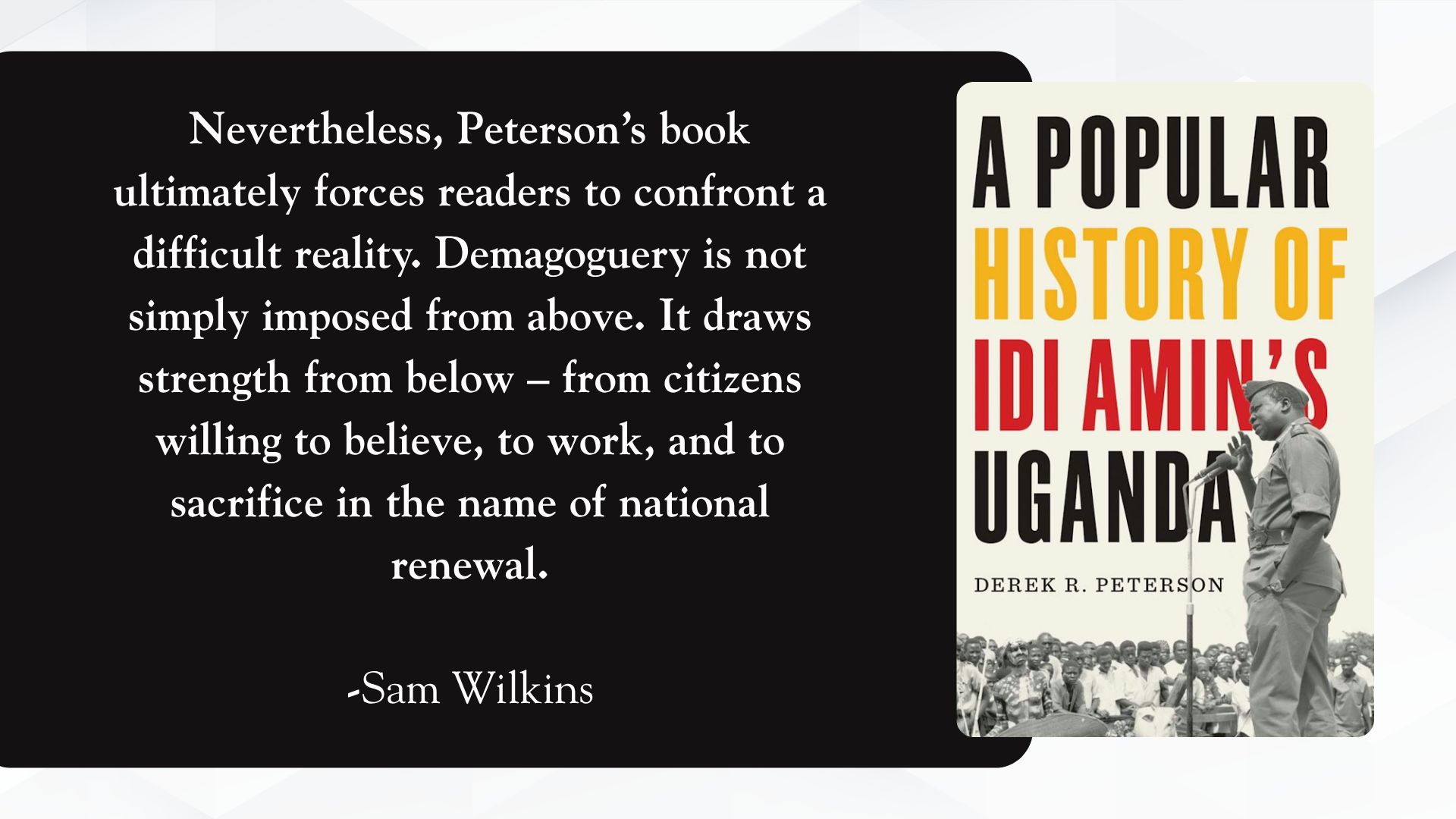
In A Popular History of Idi Amin’s Uganda, Peterson shifts the focus away from Amin himself and toward the citizens, civil servants, and true believers who sustained his regime. The result is a striking reinterpretation. Rather than portraying Amin as an irrational tyrant presiding over senseless violence, Peterson shows how his rule was rooted in a powerful – if deeply destructive – political project that resonated with many Ugandans.
This is not a story that excuses Amin. The killings, expulsions, and dispossession that defined his rule remain within Peterson’s account. But they are reframed as part of a system that many supporters saw as purposeful: an attempt to remake Uganda as a proudly African, anti-imperial state. For those who believed in that project, Amin appeared not as a buffoon or a monster, but as a leader pushing the country toward long-denied sovereignty.
Peterson’s A Popular History arrived concurrently with Mahmood Mamdani’s Slow Poison: Idi Amin, Yoweri Museveni and the Making of the Ugandan State. Like Mamdani (who is now perhaps best known as the father of Zohran Mamdani, New York City’s new Democratic Socialist Mayor), Peterson highlights Amin’s enduring popularity. After all, Amin’s downfall came at the hands of a foreign military invasion, not an internal revolution.
With prose that is sometimes cutting and sometimes drearily repetitive (try to count how many times he writes “set the pace of life” and you will quickly run out of fingers), Peterson highlights the individual citizens who strove earnestly in Amin’s campaign of “liberation.” This focus on ordinary people effectively illuminates the immense paradoxes of the Amin era. How can a murderer be a champion of freedom? How can someone who expelled all South Asians from Uganda and expropriated their property lead efforts to fight racism? How can a Pan-African leader annex the territory of their neighboring African state?
The “one-way medium” of radio facilitated these actions. Radio enabled Amin to cut through bureaucracy, bypassing those normally responsible for running the country. Over the airwaves, Amin set goals and even issued orders on topics as minute as women’s dress. These pronouncements left his eager but under-resourced subordinates – to say nothing of regular citizens – scrambling. American bureaucrats, many of whom have set alerts to notify them of President Trump’s tweets or Truth Social posts, would surely sympathize with their Amin-era Ugandan counterparts.
Amin’s ambitions extended well-beyond Uganda’s borders. Through radio broadcasts and theatrical diplomacy, he positioned himself as a global figure – championing anti-colonialism, racial justice, and Palestinian liberation. Uganda, he claimed, was a frontline state in the struggle against imperialism. In practice, this vision was often disconnected from reality. Uganda lacked the resources and geographic position to play such a role.
Much of Amin’s foreign policy was performative, even absurd. Amin’s diplomacy was more about trolling (a term that didn’t exist in the 1970s) than material action. Notable instances included a faux campaign to raise funds for Britain’s poor amidst England’s economic crisis in 1972, having a group of white men carry him atop their shoulders in a chair during a conference in Kampala (a humorous nod to Richard Kipling’s poem “The White Man’s Burden’), and declaring himself “the Last King of Scotland” in official correspondence with the British government.
Yet these gestures mattered. For many Ugandans, they signaled that their country had a place on the global stage. The rhetoric of liberation and racial equality inspired genuine commitment. People worked harder, sacrificed more, and invested emotionally in a regime that promised dignity and transformation.
This is where Peterson’s account is most compelling – and most controversial. Peterson focuses on the ordinary Ugandans inspired to serve in Amin’s “government of action,” but ignores detailed examinations of those in the military and security services – the men with blood on their hands. This is not to suggest that Peterson looks away from the horrors of Amin’s rule. He dedicates a late chapter of the book to a western Kingdom of Rwenzururu, whose mountain-dwelling citizens waged a long-running insurgency against Amin’s rule. Nevertheless, by focusing the majority of his “popular history” on earnest public servants, Peterson draws his reader’s attention towards the most sympathetic components of Amin’s rule and away from its violent characteristics. To use a contemporary American analogy, this would be like trying to explain Trump’s America through the stories of tariff collectors and social media managers while abstracting the role of ICE agents.
Nevertheless, Peterson’s book ultimately forces readers to confront a difficult reality. Demagoguery is not simply imposed from above. It draws strength from below – from citizens willing to believe, to work, and to sacrifice in the name of national renewal.
Uganda’s causes – from national economic rejuvenation to Pan-Africanism to anti-colonialism – all deserved a better champion than Amin. Extreme devotion from the masses can beget both incredible acts of service and unspeakable acts of horror. Seen through this lens, the violence of the Amin era “made too much sense.” Demagoguery and patriotism sadly went hand in hand. The task of untangling them remains with us today.
Sam Wilkins is a PhD Student at Yale University, where his research focuses on how American foreign policy elites thought about the Cold War in Africa during the Ford and Carter administrations. Previously, Sam served as an Assistant Professor of International Affairs at The United States Military Academy at West Point. The views expressed are those of the author and do not reflect the official position of the Department of the Army or Department of War.