
Curses, Cycles, and Wounds in Cursed Daughters
What happens when a family believes so deeply in a curse that the belief itself becomes so indistinguishable from the curse? The result of such an occurrence is a devastating yet thoughtfully written portrayal of generational trauma, one in which the shadow the characters spend their lives running from, is as much inherited as it is supernatural. I finished this book in tears, and I mention this because of how deeply moving and honest this story is.
Cursed Daughters is a multigenerational Nigerian family saga that follows three Falodun women across timelines spanning the 1990s to 2025. Monife, Ebun, and Eniiyi each carry the weight of a curse passed down through their bloodline: No man will call your house his home. And if they try, they will not have peace. The story opens with Monife taking her own life after a devastating betrayal involving the loss of a love child and a man whose family refused to accept her because of her ethnicity and perceived class. On the day of Monife’s funeral, her cousin Ebun gives birth to a daughter, Eniiyi, who bears a startling resemblance to the dead woman. As Eniiyi grows into her own life and her own love story outside of Monife’s shadow, the entire family must confront whether the curse is real and whether the past can ever truly release its hold on the living.
Braithwaite’s narrative moves across three timelines: the 1990s, the 2000s, and 2024 into 2025. The structure is not linear, and this is deliberate. It reflects a deeper truth about the past and the impossibility of its reduction to something that simply happened, or something we must neatly make peace with and move on from. The past is convoluted. It does not seek to be resolved. It seeks to be understood.
The way Braithwaite layers the timelines is masterfully done. As we navigate the present, we gain a richer understanding of how it is shaped by everything that came before it. We are taken through a turgid terrain of emotions, love stories, and tragic events, feeling the weight of each generation sitting on the one beneath it. Our reprieve only comes at the end, but it arrives at the price of having witnessed the heavy accumulation of different generations battling a curse they never engineered. By the time we reach the promise of love and a better future for the youngest Falodun woman, we breathe a genuine sigh of relief.
It is also important to understand how this curse manifests throughout the story. Each of these women lives under the shadow of something spoken against an ancestor they never met, a punishment carried through blood for something that happened long before any of them drew breath. This motif is the reality of generational trauma. Like in Femi Adebayo’s Seven Doors, where the main character, King Adedunjoye, holds on to a generational burden that was never his own to carry, the women of the Falodun household inherit pain they did not ask for. Generational trauma simply arrives and makes itself at home in the body of those whose blood is connected to where it first began.
A particularly poignant part of this story is how it starts. It begins with the end of a life. Monife, a young woman in her early twenties, takes her own life. When we first encounter her, we struggle to understand why she has sought solace in the depths of the sea. But as we read on, we begin to uncover the layers of young love, betrayal, loss, and deep emotional pain that contributed to her decision to find rest in the bosom of those waters. Those same waters would go on to appear symbolically throughout the story, most powerfully in the Falodun house itself.
Braithwaite presents Monife’s passing as a consequence, not a spectacle. The opening is written with such care that we empathize with this young woman we have only just met, even before we fully understand what brought her to this point. Her life shows us what it looks like when someone carries too much in silence. It shows us how women who are expected to absorb pain without reacting to it can reach a point where the only reprieve they can imagine sits at the bottom of the sea.
That opening is also one of the most important I have read in a novel in a long time because it sets the moral center of the entire book immediately. It calls us to witness what happens when we do not protect each other as a society. It shows us the cost of not taking mental health seriously, of allowing the people we love to carry impossible burdens alone while calling it strength. Monife’s death becomes a reckoning that reaches every character left to survive her: Ebun, Grandma West, Grandma East, Kalu, and eventually Eniiyi.
The house in this story is a powerfully written symbol. The Falodun house is a place of secrets. It is a place that has witnessed pain and trauma across decades and holds all of it within its walls. Each woman has their own room, holding a section of the pain and secrets they have held onto over the years. In this house, there are maps and patches of water that seep through the concrete, acting as a reminder of the permanent stain of unresolved grief. They also represent Monife’s presence, her lingering sorrow, a constant physical reminder of what was lost and what has never been fully faced or released. The house is your quintessential Gothic setting. It is a silent horror and mold that eats up its inhabitants just like the looming curse. The negative energy that looms over this family becomes architectural. It is therefore symbolic that to heal from this generational burden, Eniiyi must leave that space and chart her own path outside of its constraints.
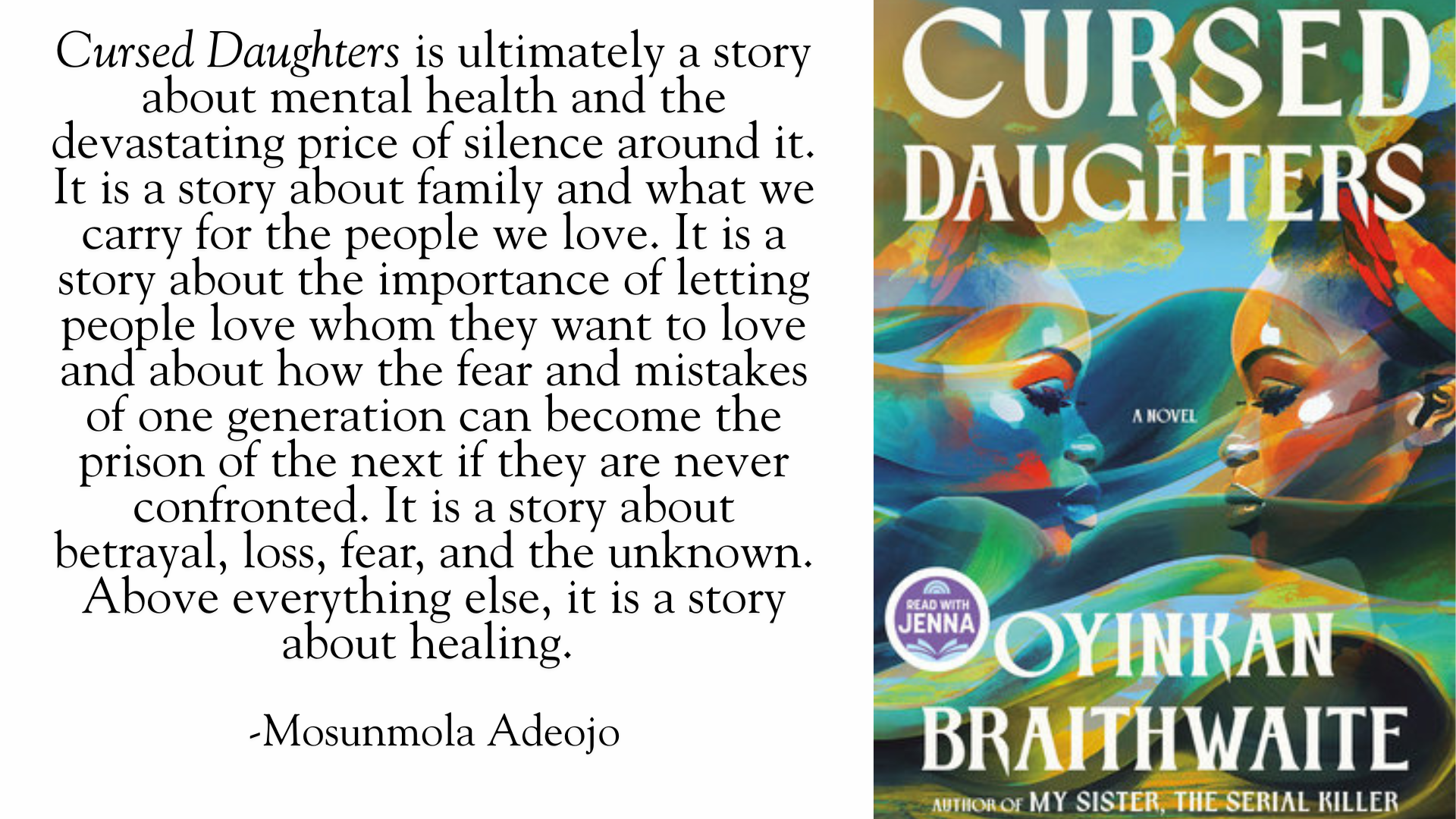
Cursed Daughters is ultimately a story about mental health and the devastating price of silence around it. It is a story about family and what we carry for the people we love. It is a story about the importance of letting people love whom they want to love and about how the fear and mistakes of one generation can become the prison of the next if they are never confronted. It is a story about betrayal, loss, fear, and the unknown. Above everything else, it is a story about healing. About what healing truly requires, not just for one woman, but for an entire lineage of women who have been living under a shadow that was never theirs to begin with.
But this book is also about young love. It is about Monife being bold enough to fall in love fully and completely with a boy who would go on to define the shape of her entire existence. And in that love, in its beauty and its cost, lies the seed of everything that follows.
What Oyinkan Braithwaite does throughout this novel is to locate the origin of generational trauma, move beyond the curse, and isolate the specific experiences of vulnerable women who love in a world that punishes them for it. Monife’s story is more than a tragic love story or a young love cut short. It is a feminist indictment of the social and familial structures that failed her, the silence around her pain, the expectations placed on her body, and the ease with which the systems around her disappear in her time of need. In this way, the curse then becomes structural. It is what happens when women are not protected, heard or seen.
In addition, the way the novel explores generational trauma also hints at the subject of epigenetics. Epigenetics tells us that trauma transcends memory or historical narratives. Trauma lives in the body, it is carried through cells, it is passed down from one generation to the next and becomes a part of the family’s DNA. In this story, the narrative reshapes how women in the Falodun household respond to stress, love, fear, and loss, long before they are even conscious of the wound they inherited. They feel the curse and embody it. Their nervous systems and choices are defined by it. In fact, their capacity for trust and intimacy is quietly shaped by something that was passed down in their DNA. In this way, the curse shifts from being supernatural and structural to biological.
The novel does not end on a sad note. There is hope for reconciliation and return, even if it is miles away from the Falodun household. There is also the promise of a love story that was never truly finished. Kalu’s return to the palace that once housed his long-lost love is one of the most memorable moments in the story. His request for forgiveness from the Falodun women and their household suggests that healing is inevitable, no matter how long it takes. The novel ends with hope, and that’s a strong message that Oyinkan Braithwaite leaves us with.
Mosúnmọ́lá Ọmọ́wùnmí Adéòjó is an avid reader with a PhD in English and a Certificate in African Studies from the University of Florida. In her research, she specializes in African and African diasporic literature, digital humanities, and cultural studies. She also reads different genres of fiction and nonfiction, such as travelogues and memoirs. When she is not reading, reviewing books, or collecting books by new writers, she is watching African football, listening to an audiobook, or cooking. She posts about books and book reviews on her Instagram page: @readwithmossiestorch.