
The Sacred Mystery of Ikorodu
“The Alase can’t bow down to the king as others bow to the king,” the current Alase, Mr. Taiwo said as we walked through the Ajina community, a vibrant marketplace square in Ikorodu, Lagos State. We were heading to meet with two chiefs of the Osugbo, and I was accompanied by a friend to this community because he could speak Yoruba and translate conversations for me.
The Alase went on to explain his role in the community and how he helps make it peaceful, united, and stronger. In his hands, he held a sacred vestment that he explained was the Ipo Owo Alase Agemo, a symbol of authority and a bearer of blessings. As we walked, everyone who approached him bowed their heads and stretched out their hands while he used the Ipo Owo to touch and bless them.
He further explained his involvement in the Osugbo, shedding light on the court’s legislative power during his coronation and the performance of Etutu, a traditional rite to cleanse the community after transgression. This right ensures that the society remains in harmony with the ancestors and the spirits of the land.
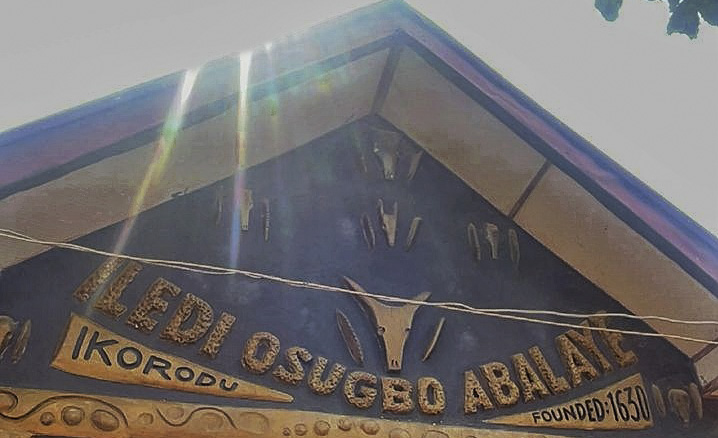
The mystery of the Osugbo isn’t merely etched in history; it is a living, breathing force. It became tangible as we arrived at the Iledi, and it showed itself when we reached the building where the chiefs gathered. The building was a small storey building; its structure is a testament to the enduring weight of Ikorodu traditions. We ventured up the narrow stairs and approached the chiefs’ door. Shaking the Ipa Owo in his hands, the Alase made his way inside. We followed suit, lowering our heads in the requisite gesture of respect as we entered the room.
The Alase uttered some prayers in Yoruba, and the chiefs responded in deep unison before beckoning for us to sit down. The room was quite traditional and filled with furniture that spoke of another era. The building windows were made of wood, and on top of the center table were cowries that signify the Yoruba tradition.
“Outsiders do not know the magnitude and nature of our work,” one of the chiefs said, his voice carrying the weight of absolute certainty. “What we say inside the Iledi, that is the law. There is no one who can change it”.
The Iledi was formulated by the forefathers of the people of Ikorodu in 1630, long before colonization. The historical depth of the place does not only reside in the structure of the building but also in the lips of the chiefs. The chief also mentioned that the work of the Osugbo is a deep, sacred mystery.
Every community has a traditional court that settles disputes. There are many courts in Ikorodu, but three are traditional courts: Osugbo, Liwe, and Eluku. Although other Osugbo groups exist as traditional societies, the Iledi Osugbo Abaleye serves as the supreme court because of its influence over community decisions. It is also called the kingmakers by the custodians of the sacred law since they are behind the success of the Kabiyesi (the king).
“Without the Osugbo, there is no Oba,” the chief explained, his words firmly underscoring how the decisions of the chiefs of Osugbo influenced the crown and the community.
In a 2015 article written by Ebun Sessou and Oghene Omonisa, the late Oba Aromire of Ijora was asked questions concerning the Iledi of the Ijora people and he explained the Iledi to be a superstitious and complex architectural creation, which I used as a point of comparison. This sparked further discussion about the architecture of the Osugbo building itself, which is said to be constructed from materials that signify and tie back to the powers of the earth. This highlights the spiritual aspects of the Osugbo that underlie their effortless settlement of disputes.
The Osugbo is known for settling disputes with ease that mirrors its absolute authority. “The genuine justice” is the exact phrase one of the chiefs used to define the court’s effectiveness.
He explained that the Osugbo operates much more like a modern court, but with a spiritual twist. Both parties (the complainant and the defendant) arrive at the Iledi and are made to plead their cases. Afterward, they are sent back home, while Iledi’s internal investigators are tasked with verifying what both parties said. These internal investigators return with the genuine truth, along with evidence to back it up, which forms the verdict passed down by the custodian of the sacred law.
Historically, it is also said that the Osugbo kills, as it has been seen in the years since it was founded. The saying that the Osugbo is the ‘genuine justice’ stems directly from this spiritual accountability, at least from my perspective. Before the defendant and complainant are able to speak their sides of the story, an oath is administered. This oath makes sure that there is absolute honesty, as lying under oath carries the ultimate consequence- death.
Furthermore, once a verdict has been passed and one party becomes victorious, sacred traditional items are used to bind both parties to a covenant of peace. The loser must promise not to secretly harm the victor; breaking this covenant, too, also results in death.
“Does the court still have importance among the people?” I asked.
A sudden burst of laughter filled the room. The chiefs stared at me like I asked a question with an obvious, undeniable answer. They weren’t entirely wrong to find my question amusing; every other question I have asked has been answered with the present tense, and I already knew I was meeting with the chiefs before I got there.
They didn’t reply to me with a direct answer, but their response sent a message stronger than that.
“I am one of the chiefs,” he was sitting opposite me, grabbing his drink from the table and gesturing to himself as he responded, “and despite the age, he is now our father,” he continued, speaking of the Alase and acknowledging the spiritual hierarchy that exceeds physical age.
I had walked into the room with little knowledge, but after the encounter with the chiefs and the Alase, it became clear why tradition was meant to be protected and why it must continue. The Iledi Osugbo Abaleye wasn’t just a place where history could be told, but also a living, present structure and traditional institution that serves the people of Ajina.
Bienose Goodness is a travel writer and storyteller focused on documenting culture, place, and lived experiences. Through his work, he explores destinations beyond surface-level narratives, aiming to capture the people, environments, and everyday moments that define them. His writing often challenges dominant narratives by presenting locations through fresh, experience-driven perspectives rather than generalized portrayals. Find him on LinkedIn.