
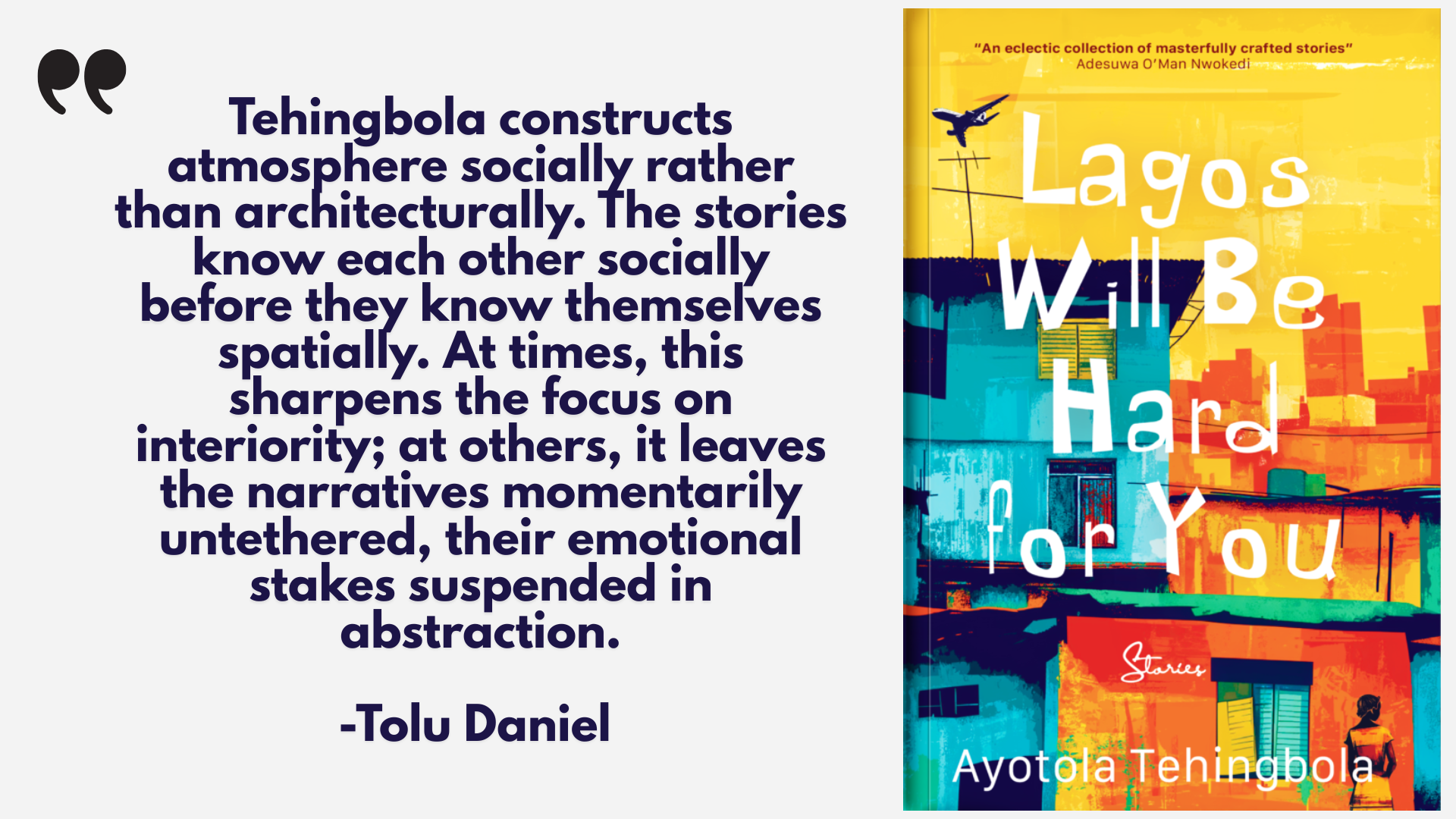
Beyond the Spectacle
Ayotola Tehingbola’s Lagos Will Be Hard for You, a short story collection, published in the UK by Jacaranda Books (2026) and in Nigeria by Masobe Books (2025), begins with a death that refuses to stay contained. In “abba father,” the opening story of the collection, Ibrahim Mohammed learns, by way of a curt text message, that his father has died in a butcher shop, slumped over a table of goat innards. The scene is at once visceral and oddly procedural, a body already slipping from intimacy into administration. What follows is a logistical crisis: a son, long estranged from the terms of his inheritance, must arrange an Islamic burial within twenty-four hours in a landscape that does not recognize the urgency of such rites. The story unfolds as a series of collisions: religion meets bureaucracy; memory meets habit; language itself falters. Ibrahim, who has spent decades smoothing himself into the expectations of American life, discovers that he cannot adequately explain why his father must be buried, why cremation is impossible, why time matters. The rituals remain, but their meanings have thinned. He performs belief without possessing it. And in that gap, between gesture and understanding, Tehingbola locates the quiet devastation of diasporic inheritance.
It is a striking opening because of its emotional force, and because it establishes the collection’s governing preoccupation, which is, what does it mean to live a life that, on the surface, works, even as its interior logic remains unsettled? Ibrahim is not destitute. He has a home, a family, a structure that holds. And yet, when confronted with something as fundamental as death, that structure proves insufficient. The question is not whether he will endure, he will, but what, precisely, endurance amounts to. This tension reverberates throughout the collection. Tehingbola’s characters, many of them middle-class and outwardly secure, inhabit worlds where the future, in its most basic sense, is not in question. Jobs exist. Migration has, to some extent, succeeded. The visible markers of stability are in place. One could, with a certain bluntness, peel back the layers of these stories and conclude that these women, and it is often women who anchor the collection, will be okay. The events that define them, however disruptive, do not foreclose the possibility of continuation.
But “being okay” is not the point. Tehingbola seems less interested in narrative catastrophe than in what might be called narrative residue: the ways in which past and present cohabit without resolving each other. Her characters carry generational trauma, emotional disarray, and private contradictions that do not necessarily erupt into decisive action. Instead, they settle into a kind of suspended state, moving through their lives with a composure that is both cultivated and fragile. This produces one of the collection’s most distinctive, and at times frustrating, features: a pervasive stillness. Again and again, characters approach the threshold of transformation only to hover there. One expects rupture, a declaration, a break, a reorientation, but what emerges instead is a quieter, more ambiguous form of endurance. The characters seem to wait, as though the knowledge required to act has not yet fully arrived. They are not passive in any simple sense, but neither are they propelled by urgency. The effect can feel like a withholding.
Olivia in “the water is not the faucet” for instance converts emotional crisis into prolonged maintenance. Faced with Dola’s psychic deterioration and eventual disappearance, she turns toward renovation, cataloguing, and domestic reorganization. Ibrahim similarly in “abba father” exemplifies this condition most clearly. Faced with the urgency of burying his father according to Islamic custom, he moves frantically through logistical tasks, calling funeral homes, negotiating burial plots, speaking to imams and funeral directors, yet remains emotionally and intellectually estranged from the very rites he is attempting to uphold. It is worth asking whether this stillness is an aesthetic choice or a limitation. On one hand, it risks diluting the stakes of situations that might otherwise demand confrontation. On the other, it mirrors a recognizable condition: the way many lives, especially those shaped by migration and aspiration, are lived not through dramatic pivots but through prolonged negotiation. Tehingbola’s characters do not always seize their positionalities; they inhabit them, sometimes uneasily, sometimes without fully articulating what that inhabitation costs.
Their recognizability is, in fact, one of the collection’s quiet triumphs. These are not figures arranged for symbolic clarity; they are unsettlingly proximate. One can imagine encountering them outside the page, in the aspirational circuits of contemporary life, professional spaces, social gatherings, carefully curated homes, without ever apprehending the density of what they carry. A character like Morountodun from the titular story, for instance, exists with a kind of social legibility that belies the complexity of her past. One can imagine friendship, intimacy, even a shared future, formed in partial knowledge.
Tehingbola sharpens this effect through a series of interlinked stories, particularly “Abnegation,” “because something no right, you no suppose sit down and look,” and “rape of paradise,” where recurring characters acquire new emotional dimensions across narrative boundaries. These recurrences do not function merely as connective tissue. They revise the reader’s understanding retroactively. A character glimpsed peripherally in one story returns elsewhere burdened by histories previously unavailable to us, and the collection begins to reveal itself as a study in the instability of social knowledge. People move through each other’s lives partially untranslated. Intimacy, Tehingbola suggests, rarely guarantees comprehension. This concern with opacity finds one of its most devastating expressions in “the water is not the faucet,” perhaps the collection’s emotional center. The story traces the slow deterioration of Olivia and Dola’s relationship through a structure built almost entirely from accumulation: index cards, renovation projects, medication regimens, labelled storage boxes, unfinished conversations. Early in their relationship, they attempt to formalize love into a series of mutually agreed principles: “Respect.” “Reciprocation.” “Patience.”
The scene initially reads with a kind of awkward tenderness, two people trying to engineer emotional safety through language. But Tehingbola quietly transforms these declarations into tragic artifacts. The relationship deteriorates gradually beneath the weight of mental illness, exhaustion, and emotional estrangement, while Olivia compulsively renovates the house they once imagined sharing. Domestic organization becomes a grammar for grief. The story’s long inventory passages are particularly striking. Faced with the possibility of disappearance, Olivia catalogs what remains – “Dola’s presents. Dola’s toys. Dola’s books. Dola’s sex toys. Dola’s clothes.” The repetition transforms cataloguing into mourning ritual. Naming becomes a way of resisting erasure. What makes the story so effective is Tehingbola’s refusal of melodrama. Dola’s deterioration arrives through gradual psychic erosion. His paranoia, depressive spirals, and emotional withdrawal unfold alongside luxury apartments, tech startups, carefully designed interiors, and expensive kitchen renovations. The story becomes a devastating study of how middle-class competence can coexist with profound emotional disintegration.
The title for Lagos WIll Be Hard for you initially situates the collection within a contemporary naming tradition in Nigerian popular fiction, recalling works like Damilare Kuku’s Nearly All the Men in Lagos Are Mad, where the title itself functions as social commentary, cultural shorthand, and marketplace invitation all at once. These titles often possess an immediate oral familiarity. They sound overheard, rather than invented. Drawn from idioms of social media, gossip, complaint and everyday wit. Tehingbola’s title participates in that linguistic register but ultimately unsettles the expectations attached to it. Where one anticipates a collection driven by the spectacle of Lagos, its romantic dysfunctions, and the performative abrasiveness of its city life, the stories instead moves inward, towards emotional inheritance, psychic dislocation, migration, and forms of private estrangements that exceed the city itself.
To read Lagos Will Be Hard for You as a debut is also to locate it within a longer tradition of African fiction attentive to the pressures exerted upon intimate life by migration, class aspiration, and social expectation. In this regard, Tehingbola’s work shares less with the spectacular ruptures or stylistic experimentation that characterize much contemporary diasporic fiction than with the quieter emotional architectures of Buchi Emecheta. Like Emecheta, Tehingbola is deeply attentive to the labor of survival: the ongoing negotiation within domestic, emotional, and social structures that rarely collapse outright yet continually exact psychic cost. Her characters endure marriages, migrations, illnesses, disappointments, and inherited silences while maintaining the outward coherence demanded by middle-class life. The tension animating these stories is therefore but how much private fracture can exist beneath public functionality. Even love itself often appears as a form of maintenance work, sustained through ritual, accommodation, repetition, and emotional improvisation.
Tehingbola constructs atmosphere socially rather than architecturally. The stories know each other socially before they know themselves spatially. At times, this sharpens the focus on interiority; at others, it leaves the narratives momentarily untethered, their emotional stakes suspended in abstraction. A related unevenness appears in some of the collection’s endings, where revelation occasionally arrives with a faintly engineered quality, as though the narrative has tightened suddenly toward disclosure. “Domi” exemplifies this tendency. By contrast, stories like “Not Equal To” achieve a steadier emotional crescendo because they trust accumulation over surprise. Still, even these unevennesses emerge from recognizable ambition. Tehingbola is attempting something difficult: to write characters whose lives extend beyond the formal limits of any single story, whose emotional realities remain partially inaccessible even to themselves. Her people survive beside one another in fragments, assembling coherence from incomplete knowledge, deferred conversations, inherited silences.
Late in “the water is not the faucet,” Dola asks Olivia: “Can you see me? Touch me. Can you feel me? Am I still here?” The question reverberates far beyond the story itself. It becomes, retrospectively, the question animating the entire collection. It asks whether these characters as we are coming to know them, could ever be fully known.
Tolu Daniel is a US-based Nigerian writer and scholar whose essays and short fiction have appeared in print and online publications. He holds master’s degrees from Kansas State University and Washington University in St. Louis. He is the recipient of the 2025 Isele Nonfiction Prize for his essay “Notes of a Nonresident Alien” and a 2025 Heartland Journalism Fellowship. His work has also been supported by the Monson Arts Residency, Writivism, and the Goethe-Institut Nigeria. He was longlisted for the 2018 Koffi Addo Prize for Creative Nonfiction. Daniel lives in St. Louis, Missouri, where he is completing a PhD in Comparative Literature.