
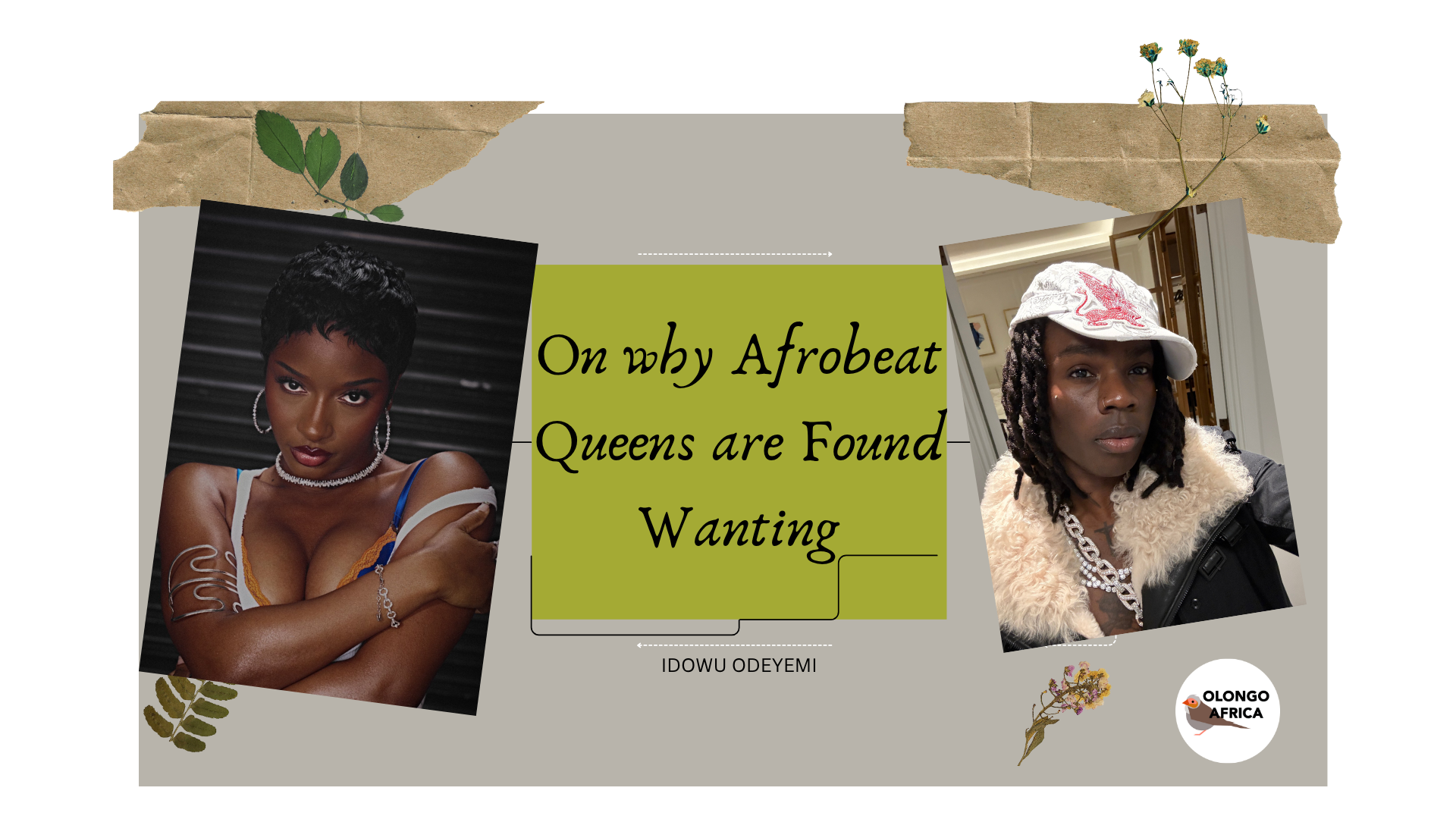
On Why Afrobeat Queens are Found Wanting
An honest witness does not lie, a false witness breathes lies. –Proverbs 14:5
“No more Big 3, there’s now a Big 4,” the Nigerian Afrobeats star Rema declared in his 2024 song “HEHEHE.” Rema’s statement, fans of Afrobeats are meant to believe, is declarative: the Nigerian music industry has had three main stars—Davido, Wizkid, and Burna Boy—on its stage for a long time, and he is not here to uproot them but to join them on that stage.
The youngster is a musical prodigy: he invented and pioneered what he calls “Afrorave”—a subgenre of Afrobeats that blends Afrobeat with Arabian and Indian influences, incorporating a sound and style that fuses melodic singing with trap-inspired backgrounds.
Rema’s self-praise is not a form of self-aggrandizement. In 2019, after his widely acclaimed debut EP was released under the imprint of Don Jazzy’s Mavins Record, his song “Dumebi” debuted at No.1 on the Apple Music Chart and several other platforms. He was young-handsome —twenty-hot— and the newest African prodigy in the music world. That summer, Barack Obama cosigned Rema’s rising greatness by including “Iron Man,” another track from the debut EP, on his Summer Playlist 2019.
The world was bound to be soon hit by the COVID-19 pandemic—the pandemic that would reshape geopolitical relationships. But Rema was bound to be one of Africa’s greatest music stars. COVID-19 would become indelible in world history; Rema, in the history of Afrobeats. When the pandemic led the world to lockdown with dullness and gloom, Rema’s introduction to Afrobeats offered electrifying music to help the world bear the pain of a lockdown world, where life swirled in slow motion.
And as COVID-19 receded from global attention, Rema solidified his place as a consistently impactful force in the music industry: he added more flame to his oven, shouted “Another banger,” and dropped his worldwide hit song “Calm Down” in 2022. By May 2023, the song had been streamed 388 million times on Spotify, while its viral remix with U.S. pop and Disney star Selena Gomez had amassed over 717 million streams on the same platform. Rema earned a Guinness World Record when “Calm Down” became the first-ever No. 1 song on the Official MENA Chart. It also reached an impressive No. 5 on the Billboard Hot 100.
Self-praise shows a person’s confidence and persona, and when there are facts to back it up, it is not taken as a statement of a person’s character modesty or immodesty; we are to take it as a fact: “Rema only made a factual statement.” But humans’ evaluative judgments are often clouded by perception or misperception.
When Rema was judged as self-confident and simply making a factual claim by proclaiming he had taken the step to become one of Nigeria’s four musical finest, his female counterparts —most notably Tems and Ayra Starr— were derided for making similar proclamations that dare suggest any form of self-praise. Their self-praise is seen as a form of self-aggrandizement.
Worse still, it is at its most bellicose: female singers’ self-praise is perceived as a form of ingratitude. They have been allowed to become music stars, and yet they dare to share the center stage with the very men who supposedly granted them that freedom. It’s a man’s world, and women —no matter how much freedom they are afforded— are expected to remain behind the backstage curtain.
Ayra Starr is precocious: at nineteen, her song “Away” from her eponymous debut EP spent two consecutive weeks at No. 4 on Nigeria’s TurnTable Top 50 chart and peaked at No. 17 on the Billboard Top Triller Global chart. When she released her debut studio album, 19 & Dangerous, the lead single “Bloody Samaritan” topped the TurnTable chart, marking the first time a solo song by a female artist had achieved such a feat. Shortly after, in August of the same year, the then-nineteen-year-old Afrobeats prodigy was ranked No. 3 on Billboard’s Next Big Sound chart.
Just like Rema, Obama also cosigns Ayra Starr’s musical agility. The sound production of the young artist was among the tunes the former U.S. president danced to in the summer of 2023. Her song “Sability” was featured on Barack Obama’s 2023 Summer Playlist. Previously, in 2022, Ayra Starr’s “Rush” appeared on Obama’s 2022 End-of-Year Playlist. If featuring on Obama’s playlist isn’t a yardstick for greatness—if it isn’t a sign that an Afrobeats star is making music worth listening to—it is certainly proof that jouissance is a feeling many experience when her tunes come through the speakers.
When the world praises men, it asks women to know their place. While the world praises Rema for proclaiming himself as part of the “Big Four” in Afrobeats, it chides or sneers at Ayra Starr when she merely suggests that she’s a star.
As a young woman in the secular music world of a conservative African country, Ayra Starr is chided for her clothing choices. Her clothing choice is perceived as a shade of coquetry. She often steps onto the stage or in front of the camera like a whisper turned wild—her bare midriff glinting under the lights, her low-slung jeans teasing the edge of social defiance. Her fabrics cling to her like a secret, stitched tight and unapologetic. Her crop top—sometimes merely more than a flirt of cloth—leaves little to the imagination of promiscuous-misogynistic men and everything to desire. It is, absurdly, for people who believe that male desire should police female clothing, the sort of clothing that dares you to look and dares you not to. For these social media rage-posters, Ayra Starr’s fashion isn’t just fashion—it is provocation wrapped in rhythm: a body not dressed for modesty, but for the desire of male libido. (Note, painstakingly, that it’s been a while since Rema last put on a shirt, but his is fashion, while Queen A.S. is just being flirty. Call it patriarchy clusterfucking!)
At exactly 2:13 p.m. on the 21st of June, 2021, Ayra Starr tweeted, “Guys I actually can’t stand straight (insert: “Woman Shrugging: Medium Skin Tone” emoji) it’s not my fault My waist is bent from carrying afrobeats on my back this year (insert: “Sign of the Horns: Medium-Dark Skin Tone” emoji).” That tweet came after many years of being bullied for her sexy back-ache posture. After that tweet, rage-posters decided to put her in what they considered her place. “Growing wings, eh?” one response said. “You don dey pass boundary,” another rage-poster sneered.
Rage-posters did not back down. On the 25th of September, 2022 when Ayra Starr tweeted a screenshot of the music chart where her song “Rush” was No. 1 with the caption “Sabi girl no Dey too like talk (insert: “Baby Angel: Medium-Dark Skin Tone” emoji and “White Medium Star” emoji), she was sneered at and chided. “Sabi girl” has become her nickname after the release of her hit song “Sability.” Yet, her benign tweet brought out the dogs. Daniel Ragha, Nigeria’s charm-coated social media tyrant, replied that Rush at No. 1 is due to “…massive PR… let ur songs gradually climb up the charts. D¤n’t c¤mpete.”
When Rema and Ayra Starr do the same thing, Rema receives praise; Ayra Starr receives abuse. There is something insidious about this contrasting reaction to these two youngsters: it has to do with how perceptions can be wrapped up in misogyny. Misogynistic perceptions, like perceptions themselves, are not merely a fact about our world, nor are they an act or a deliberate position people take; rather, as Merleau-Ponty suggests, “it is the background from which all acts stand out and is presupposed by them.”
There is a reason, after all, that the Afrobeats Big 3 and Rema’s Big 4 are all-male. We must confront the truth: It is not because the big boys of Afrobeats are better entertainers than the industry Queens. It is the misogynistic perceptions. It is something more insidious. This also helps to fashion something interesting: The success the “Afrobeats big boys” have garnered over the years has nothing to do with the probability of them having more talent than the Afrobeat Queens; it is because of the social capital that the world endows them with (just by being male!) when the world does not perceive or relate to them with contempt or prejudice.
Perceptions affect social standings. It is how we perceive a group that determines what they count for. In a way, misogynistic perceptions are comparable to racialized perceptions. In his 1968 appearance on The Dick Cavett Show, James Baldwin demystifies the latter. “When the Israelis pick up guns,” Baldwin laments, “or the Poles, or the Irish, or any white man in the world says, ‘Give me liberty or give me death,’ the entire world applauds.” Baldwin, with fierce eloquence, continues, “When a black man says exactly the same thing, word for word, he is judged a criminal and treated like one, and everything possibly is done to make an example of this bad nigga so there won’t be anymore like him.”
But the practice of gender exclusion, aided by misogynistic perceptions in Afrobeats, is not merely a Gen Z–contemporary issue. It is a long-in-the-tooth practice. When Tiwa Savage released “Ife Wa Gbona” in 2011, it immediately became a lovers’ anthem. Her debut single, “Kele Kele Love”, was on the lips of everyone caught in a so-called situationship when it dropped in November 2010. The song is Afropop, but it is also a cry to be seen by a player-lover with whom she found herself entangled. Tiwa Savage has consistently released hit songs since then, yet she has been relegated to the status of a great but not super-great Afrobeats star.
But what could explain misogyny so pervasive that it operates even on a perceptual level? Any real attempt to answer this question must acknowledge the fact that misogyny is enshrined in many Nigerian–as well as most global–cultural practices. If women have been normatively relegated to the status of the second sex, it becomes quite easy to interpret that status as one that functions primarily to direct both the conscious and the subconscious to assign lesser credibility to their talent and actions.
Even when we have come to acknowledge that women are human beings with equal personhood, our cultural practices still wrapped up in misogyny mean they suffer a credibility deficit due to the identity prejudice we have come to associate with them. This is why, for example, you often press the “next” button when a female singer comes up on your Spotify. Identity prejudice that functions on the perceptual level is cancerous: it shapes not just your wants, but what you desire to want. Of course, we might not have control over what we desire, but we do have control over the politics that shape our desires. If we agree that misogyny is bad, then such a normative understanding must necessarily require that we reorient our desirous politics into one that does not function primarily to undermine Afrobeats Queens.
So, when Rema proclaims himself part of the Big Four and the world applauds him, he—and the world that claps along—are engaged in something far more insidious. Where does that leave Tems? That very claim implies that Tems—the two-time Grammy winner and eight-time Grammy nominee, who was the first African artist to debut at No. 1 on the Billboard Hot 100—hasn’t done enough to deserve a spot. Why? The simple answer is that she is an Afrobeats Queen, not one of the big boys. The harder answer is that she cannot be part of the conversation because she’s a female singer.
If anything, this tells us that something is inherently wrong with what feminist and social philosopher Serene Khader calls faux feminism —such as white feminism— which restricts feminist commitments to the notion of women’s freedom. Afrobeats Queens have their freedom: they can sing all they want; no one is stopping them from doing so. But this overlooks the insidious nature of their freedom: it propagates their unfreedom in a social world were recognition is required for a person to garner value.
Misogynistic perceptions might not hinder their musical production (which, really, is what inherently determines their greatness), but these perceptions curtail the credibility they are given (which, really, is what determines their perceived greatness).
Since perception is necessary for recognition, and recognition is necessary for valuable social standing, it is not enough to ask Afrobeats Queens to keep producing music with the freedom we might have afforded them. We must change the culture and politics that shape our desires. So, while we might allude to our mistreatment of Afrobeats Queens and easily take the way out—“We cannot control our desires”—that easy way out does not exist, insofar as an obligation exists for us to reshape the culture and politics that form those desires.
Our old bad attitude has to stop.
Idowu Odeyemi is a philosopher, essayist, and critic. Right now, he is a philosophy PhD candidate at the University of Colorado Boulder. He has been recognized by Coloradan Magazine as one of the “Five CU Innovators Changing the World.” Colorado Arts and Sciences Magazine described him as a scholar challenging “rigid boundaries in African philosophical thought.” Afrocritik referred to him as “a young philosophical genius.” His essay “On Accent and Confidence” was recognized as one of the 50 notable essays from Africa in 2024 by Afrocritik.