

Beyond “Influence”: The Many Lives of Fuji in Afrobeats
In 2024, Asake released Active, one of the standout tracks from Lungu Boy. For many listeners, it was another demonstration of the sonic confidence that has come to define his music: log drums colliding with layered percussion, clipped chants giving way to melodic refrains, and a vocal performance that oscillates between swagger and supplication. Yet for others, particularly those who grew up within earshot of Nigeria’s southwestern musical traditions, Active carried a different kind of familiarity. Beneath the contemporary production was the unmistakable echo of another era. Adewale Ayuba’s voice, first immortalised in Bubble more than three decades earlier, resurfaced not as a nostalgic relic but as an active participant.
It is tempting to describe moments like this with the convenient language of “influence.” We often say that Fuji influenced Afrobeats in much the same way that American soul influenced hip-hop or Jamaican dancehall shaped reggaeton. The word is comfortable because it asks very little of us. It suggests a vague inheritance, a stylistic resemblance that somehow survives the passing of time. But influence is an incomplete description for what is happening here. It tells us that one genre came before another, yet leaves unanswered the more interesting question: how does a musical tradition remain alive across generations?
Following a lineage that connects Adewale Ayuba’s Bubble (1991), Jazzman Olofin’s Raise da Roof (2004), and Asake’s Active (2024), this essay argues that such moments are better understood not as isolated acts of borrowing but as evidence of cultural transmission. Rather than merely asking whether Afrobeats has been influenced by Fuji, we should also ask how Fuji continues to move through contemporary Nigerian music. This movement seems to occur across three interconnected pathways: performance, collaboration and archival transmission.
Fuji Was Never Meant to Stand Still
One enduring misconception about Fuji is that it belongs to the past. One school of thought even classifies the genre as dying. Such a narrative is convenient, but it might misunderstand both Fuji’s history and the nature of popular music itself. Fuji has not survived thus far because it resists change. It survives because change has always been part of its identity.
Fuji emerged in the late twentieth century from wéré, the devotional music performed by Yoruba Muslim youths during Ramadan. These processions were deeply communal, their chants carrying through neighbourhood streets before dawn to awaken people for sahur, the pre-fast meal. Although rooted in religious practice, wéré was never musically static. Performers constantly adjusted rhythms, vocal styles and lyrical content to suit changing audiences and urban environments. When Síkírù Àyìndé Barrister transformed these traditions into what became known as Fuji in the late 1960s, he did not simply preserve an older musical form. He reimagined it for the rapidly modernising social landscape of Lagos.
Oladele Ayorinde argues in his study of Barrister’s career that Fuji should be understood as an ambitious project of genre-making rather than the continuation of a folk tradition. Saheed Aderinto’s documentary on the genre’s progenitor explores this intention in more detail. Barrister deliberately positioned Fuji as modern music, capable of competing with jùjú, highlife and other commercially successful genres that dominated Nigeria’s entertainment scene at the time. The genre’s identity was therefore built on experimentation. New instruments were introduced. Recording technologies were embraced. Performance practices evolved. Rather than threatening Fuji’s authenticity, these transformations became evidence of its vitality.
The adaptability of Fuji extends beyond technology to performance itself. At the centre of Fuji lies a particular relationship between performer and audience. The singer is not merely delivering lyrics but directing social energy.
The adaptability of Fuji extends beyond technology to performance itself. At the centre of Fuji lies a particular relationship between performer and audience. The singer is not merely delivering lyrics but directing social energy. Through praise poetry, spontaneous improvisation and carefully timed vocal interventions, Fuji musicians acknowledge patrons, celebrate communal identities and maintain the emotional momentum of performance. This tradition draws heavily on oríkì, the Yoruba practice of praise poetry that, as Karin Barber posits, functions as both artistic expression and social action. To praise someone publicly is not simply to describe them; it is to affirm relationships, status and belonging within a community.
This performative logic has proven remarkably portable. Even when contemporary artists no longer perform conventional oríkì, many retain its underlying principles. The repeated invocation of names, neighbourhoods, affiliations and personal triumphs that characterises much of today’s Afrobeats echoes Fuji’s understanding that music is a social encounter before it is an aesthetic object.
Equally important is Fuji’s rhythmic architecture. The genre is propelled by dense layers of percussion that create movement without depending on harmonic complexity. The groove is cumulative, built through the gradual interaction of talking drums, sakara, agidigbo, gángan and other percussive textures. Rhythm functions less as accompaniment than as the organising principle around which vocals, improvisation and audience participation revolve. This emphasis on groove over harmonic progression remains one of the most recognisable threads connecting Fuji to many contemporary Afrobeats recordings, even when the instrumentation has changed notably.
Seen from this perspective, the relationship between Fuji and Afrobeats becomes less surprising. Rather than inheriting isolated stylistic features, Afrobeats inherits a philosophy of musical construction. It adopts Fuji’s understanding that songs are living performances capable of accommodating improvisation, collaboration and reinvention.
Three Songs, Three Decades, One Conversation
If Fuji’s resilience lies in its capacity for adaptation, then the most convincing evidence is not found in broad historical claims but in the lifespan of individual songs. Music carries memory in ways that history books rarely can. A rhythm, a vocal inflection or a familiar phrase can collapse decades into a single moment, allowing listeners to encounter the past without necessarily recognising it as history. The relationship between Adewale Ayuba’s Bubble (1991), Jazzman Olofin’s Raise da Roof (2004), and Asake’s Active (2024) offers precisely such a history. Taken together, these recordings reveal that Fuji’s afterlife in Afrobeats is neither incidental nor nostalgic. It is cumulative.
The chronology itself is significant. Bubble belongs to a period when Fuji had firmly established itself as one of Nigeria’s dominant popular genres. Raise da Roof emerged at a time when Nigerian hip-hop and urban pop were beginning to reshape the country’s musical landscape, bringing together artists from previously distinct traditions. Active, released two decades later, arrived in an era when Afrobeats had become a global commercial force, sustained by streaming platforms and international audiences. On the surface, these songs belong to different musical worlds. Yet listening across them reveals an unbroken thread of cultural continuity.
Bubble and the Performance of Musical Authority
To understand the significance of Bubble, one must first recognise that Fuji has always been as much about performance as it is about sound. Unlike many studio-centred genres, Fuji developed within live performance cultures where the relationship between artist and audience remained central. Songs were rarely confined to concise radio-friendly formats. They unfolded over extended durations, allowing performers to improvise, acknowledge patrons, respond to audience reactions and gradually build rhythmic intensity.
Adewale Ayuba’s performance on Bubble exemplifies this tradition. His voice does not simply carry melody; it commands attention. The song opens with an imperative: “Listen attentively, I am going to Bonsue Fuji Chambers”. Before a story is told or a melody unfolds, Ayuba establishes a hierarchy between performer and audience, asserting the authority that has long characterised Fuji performance.
Melismatic vocal runs weave through dense percussion, praise-poetic passages interrupt linear narration, and chant-like declamations blur the boundary between singing and oratory. The music continually negotiates between individual virtuosity and collective participation. Listeners are not positioned as detached consumers but as active witnesses whose attention, acclaim and responses are integral to the performance itself. It is precisely this performative logic, more than any particular rhythmic or melodic feature, that later reappears in Afrobeats artists such as Asake, demonstrating how Fuji has been transmitted through embodied performance practices rather than merely through stylistic imitation.
Raise da Roof and the Politics of Collaboration
By the early 2000s, Nigeria’s musical landscape was changing rapidly. Hip-hop, R&B and urban pop increasingly dominated commercial attention, particularly among younger listeners. It would have been easy for Fuji to retreat into its established audience. Instead, it entered into conversation with emerging genres. One of the first notable collaborations was Pasuma’s collaboration with The Remedies on Jealousy.
Jazzman Olofin’s Raise da Roof, featuring Adewale Ayuba, is another notable marker of this transitional moment. The collaboration was more than a guest appearance; it represented a meeting between two musical ecosystems. Rather than asking Fuji to imitate hip-hop or requiring hip-hop to imitate Fuji, the song allowed each tradition to retain its own identity while discovering new points of convergence.
Ayuba’s contribution functions as both sound and symbol. His unmistakable vocal presence immediately carries the authority of Fuji into an urban pop context. Listeners familiar with the genre recognise not only his voice but the performance tradition it represents. His appearance legitimises the collaboration without overwhelming it, demonstrating that continuity can be achieved through dialogue rather than absolute assimilation.
In retrospect, one could posit that Raise da Roof, alongside a handful of other songs from the period, helped establish a pattern that has since become increasingly prominent in Nigerian popular music: The routine crossing of genre boundaries through collaborations. The fluidity noticed in most of these collaborations reflects the realities of Nigeria’s musical life, where genres have always been porous despite the industry’s tendency to classify them as distinct categories.
Active and the Archive That Sings
When Active appeared in 2024, many listeners immediately recognised Ayuba’s sampled vocal. Others simply experienced it as another compelling musical hook. Both responses are important because they reveal two different ways in which musical memory operates; as nostalgia for older audiences who recognise the source, and as a fresh introduction for younger audiences encountering it for the first time. After all, cultural inheritance does not depend on conscious recognition. A listener need not identify the historical source for that history to continue shaping the present.
Sampling has often been discussed as a technical production technique or as a legal question concerning copyright and ownership. Yet it is equally a practice of historical imagination. In Everything Is Sampled, Akin Adesokan explores how African cultural production has long been shaped by the appropriation, adaptation and transformation of existing media forms. Sampling, from this perspective, is not merely the reuse of existing material but a means of placing different cultural moments in conversation. Every sample proposes a relationship between past and present.
In Active, Ayuba’s voice is not reproduced only as an act of nostalgia. It is recomposed, reorganised and integrated into a musical environment that belongs unmistakably to twenty-first-century Afrobeats.
This transformation illustrates the profound effect of digital archives on cultural transmission. Earlier generations depended upon physical media, personal collections and live performance for access to musical history. Today’s producers inhabit an entirely different landscape. Vast catalogues of recorded music are instantly searchable, endlessly reproducible and technically malleable. Recordings no longer function merely as historical documents; they become raw material for new acts of creation.
Active demonstrates precisely this transformation. Ayuba’s voice is no longer confined to the historical moment in which it was first recorded. It acquires a second life within a global Afrobeats economy, reaching audiences who may never have knowingly listened to a Fuji album. The archive does not preserve the past unchanged; it enables the past to continue evolving.
Taken individually, each of these songs tells a different story about Nigerian popular music. Together, they reveal something larger. Bubble preserves a performative tradition rooted in embodied musical practice. Raise da Roof shows how collaboration lets cultural knowledge move across genres. Active demonstrates how digital archives transform recorded sound into reusable cultural memory.
The Fuji Transmission Model?
For decades, discussions of African popular music have relied heavily on the language of influence. Mapping the trajectory from Bubble to Raise da Roof to Active unravels where the language of “influence” finally reaches its limits. Influence suggests that one song leaves traces upon another. These recordings point instead to something more dynamic: a continuing process through which musical knowledge moves between bodies, collaborators and technologies. To understand that movement requires a different framework altogether, one that treats transmission, rather than influence, as the central story of how Fuji continues to shape the sound of contemporary Afrobeats.
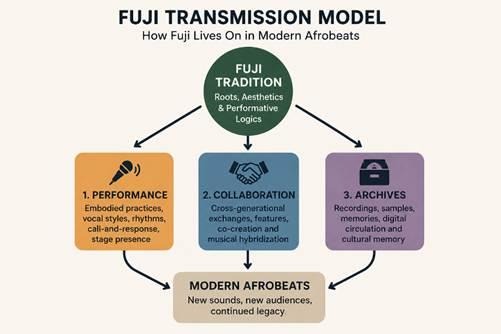
The model proposes that Fuji continues to shape contemporary Afrobeats through three interconnected pathways: performance transmission, collaborative transmission and archival transmission. These are not successive stages that replace one another. Instead, they operate together, overlapping and reinforcing each other as music moves through time.
Taken together, these three pathways reveal why Fuji has remained one of the most enduring influences on contemporary Nigerian popular music. Performance ensures that embodied musical practices continue to circulate within communities. Collaboration enables those practices to migrate across genres and generations. Digital archives preserve earlier recordings while simultaneously making them available for creative reinvention. Each pathway performs a different function, yet none operates independently of the others. A sampled recording carries the memory of an earlier performance. A collaboration often introduces future archival material. Every live performance may eventually become tomorrow’s digital artefact.
The question, then, is no longer whether Fuji influenced Afrobeats. The more revealing question is what this model of transmission tells us about African popular music more broadly. If Fuji has travelled so successfully across bodies, collaborations and archives, might the same mechanisms explain the afterlives of jùjú, highlife, apálà or palm-wine music?
’Joba Ojelabi is a Nigerian poet, writer, cultural critic, and marketing communications professional. He is the author of The Ones Before You, a poetry collection exploring memory, identity, and the textures of contemporary African life. His essays and cultural criticism have appeared in The Republic, The Lagos Review, and elsewhere. His interests include popular music, human behaviour, cultural memory, cultural patterns, and media. He lives in Lagos, Nigeria.