
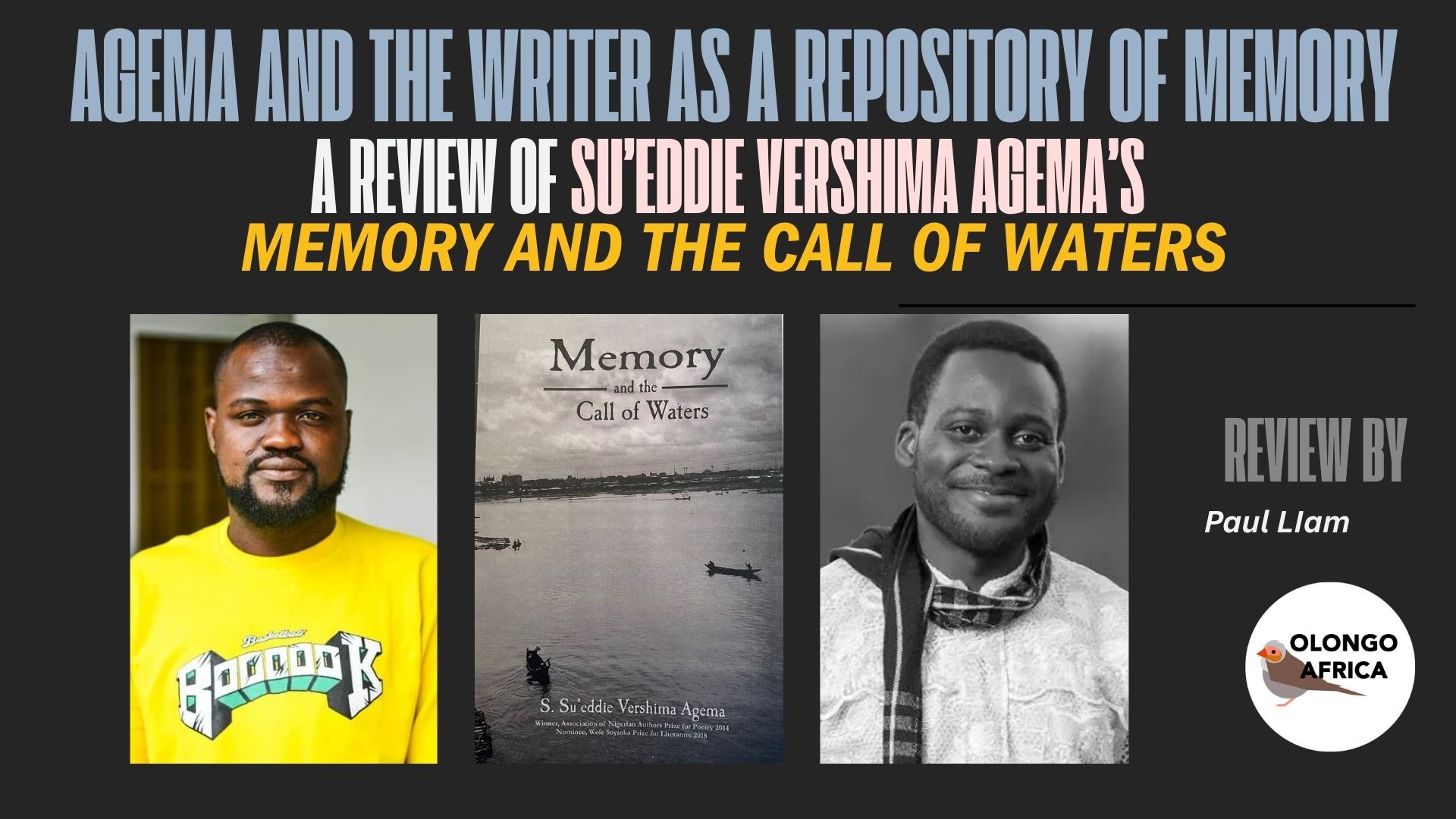
Agema and The Writer as a Repository of Memory
E. E. Sule, the renowned writer, critic, and scholar, in his instructive keynote address titled “BM Dzukogi as an Archive: Literature, Activism and Mentorship,” delivered at the national literary colloquium in honour of BM Dzukogi’s 60th birthday celebration in Minna, in January 2025, postulated that the “Nigerian writer must necessarily be an activist. Given the socio-political dysfunction of Nigeria, writing-activism—the instrumental use of writing to pursue a social goal—is critical to the socio-political transformation required for a developed society.” He further asserted that writers, rather than simply functioning as mere commentators on the dystopian state of society, ought to partake in activities capable of engineering practical change. He enthused: “One way to do that could be that the writer takes leave of imaginative writing to jump into the street as a vociferous rabble-rouser that enables social change, even if that will cost her/him her/his life.” As egalitarian as Sule’s proposition sounds, it negates the primary obligation of the writer as a persuasive chronicler of the collective experiences and evolution of society, which is no less valid than the citizens’ instruments for expressing dissent against leadership failures, such as protests in the street. However, it is the writer who documents the gallantry of the protesters and perpetuates their myth of valor for the education of future generations.
The writer’s utmost fidelity is to the word; it is to the documentation of events, reality, and the preservation of memory. Suffice it to say that the writer, beyond representing real or imagined realities, performs a core service to society through the preservation of the collective memory of a people, especially in times of unprecedented social upheavals like what we have been witnessing in Nigeria in the last 16 years. The Boko Haram war in the North East, the banditry in the North West, the ethnoreligious conflict on the Plateau, the Fulani Herders massacres in the Benue Valley, the Unknown Gunmen murderous killings in the South East, the killings in the South West and the North Central, among several other insecurity crisis around the country, more than ever before necessitates the documentation of our collective sufferings, the existential calamity and dehumanization in which we have found ourselves as a society, and who is better qualified to undertake this noble responsibility than the writer? As it were, street protests, though useful in creating awareness and steering policy conversation, have not been able to serve as a solution to the carnage and hopelessness being experienced in every part of the country. Even the military, whose sole responsibility is to protect the citizens, has been unable to end the needless wars. So, rather than a writer losing his/her life in a lost cause, he/she can serve society better by committing to the preservation of our collective memories.
The social function of the writer as a repository of memory and preserver of our collective hopelessness has been succinctly theorized by the French Scholar Antonia Wimbush in her seminal work “BUMIDOM (1963-1982) and its Afterlife” in which she argues that books, films, TV shows and music perform “a memorial function for communities whose collective memory has been marginalized, overlooked, or silenced.” She further notes that writers, filmmakers, and artists “become memory activists, bringing silenced memories of forgotten groups into the dominant collective memory” (The Writer as Memory Activist; euppublishingblog.com). Wimbush’s postulation affirms the underlying argument of this article about the imperative of the writer as a preserver of the memory of society. Edward Said, the revered scholar and critic, reminds us in his seminal work, “Representations of the Intellectual,” that the intellectual’s role is to act as a public critic who “speaks truth to power.” In other words, the first and most important task of the writer is to speak for and represent society in his/her works.
The foregoing premise is critical to the appraisal and understanding of S. Su’eddie Vershima Agema’s most important work of poetry thus far, Memory and the Call of Waters (2022), published by Sevhage. It is not surprising that it was nominated for the NLNG Nigeria Prize for Literature in 2022; it is a remarkable illustration of the important contributions of literature, and in particular poetry, to knowledge production and social consciousness. Agema, in this work embodies the dual roles of a witness and chronicler of history, through the evocative powers of poetry, he assumes the role of a “memory activist” in ensuring that the memories of pain, deaths, despair and dysfunction occasioned by the terrorism, Fulani herders’ invasion of the Benue valley and the annihilation of the helpless farmers and citizens of Nigeria doesn’t go undocumented. Thus, he fulfills the core function in both Wimbush and Said’s treatise on the function of the writer as a “memory activist” and “speaker of truth to power.” By poeticizing the carnage in Benue and other parts of Nigeria, Agema not only mainstreams the plight and memories of the collective anguish of the people but also ensures that these memories will never be erased from the annals of history. Future generation of Nigerians would one day look back and remember the dreams and histories of people who became slaves in their own homeland, they will remember the innocent children murdered with AK47 riffles and other machine guns, they will remember thousands IDPs whose humanity was bastardized by arsonists, they will also remember how the government compromised by its dubious dealings and inefficiency watched in silence as scores of villages were burnt down in broad day light.
Most importantly, by preserving the memories of these hopeless years, Agema gives agency to the millions of people murdered by terrorists. It is an honour no street protests or death could surpass. There is no gain in reiterating the already stated fact that Memory and the Call of Waters is an ode to memory and water, evocative symbols that are at the heart of carnage in Benue State and other places. Both memory and water perform functions essential to the experience of man. Memory is an instrument of perpetuity; to be bereft of memory is to never exist. Thus, memory is evidence of our existence as humans, and even when we die, we leave behind our memories, and even in the afterlife, our access to heaven is premised on memories created while alive. So, memory is the representation of our lived experiences, without which we are but a void.
Water, on the other hand, is the source of life; it is the fundamental element upon which humanity exists and thrives. All living things, both humans and animals, depend on water to subsist. Consequently, the scarcity of water begets famine, hunger, and conflict; hence, humans turn on one another because of access to water. At the center of the conflict and killings in the Benue Valley, aside from the covert jihadist agenda, is the quest for control of the rich agricultural land and access to the River Benue, which is also a visible metaphor in the collection. While the terrorists in the Benue valley are on a mission to erase the memory of the original inhabitants of the valley and elsewhere through murder and dislocation, the poor farmers are fighting to retain the memories they have cultivated through the years, and which are tied to their ancestral lands and villages. Whether in Zamfara, Katsina, Southern Kaduna, Plateau, Niger, Taraba, or elsewhere, the struggle is the same. Agema’s work embodies these discourses in subtle but lacerating poeticity.
Agema’s sense of duty to society, as exemplified by the high level of conscious social aesthetics and the problematisation of the collective state of anarchy in the country, invalidates the now rested debate about the lack of social consciousness in the works of contemporary Nigerian poets. While the text cannot be totally exempt from the overarching confessional leitmotif characteristic of the major works of this generation, it stands out as a blend of the new and older orders. However, the focus of this review is not the debate about the preoccupation of contemporary Nigerian poetry, so I shall now quickly return to the task at hand, which is the exploration of the social reality and reconstruction of memory represented in the text in the context of the national despair in the country.
In the poem, “Muted moos in their moans,” the arson perpetuated against farmers by Fulani herdsmen is illustrated in such detail that it allows for a mournful reflection of the extent of the destruction of life and the privileging of cows over human lives. The poem casts light on the “Tiv, Benue, Plateau, Taraba, and South-West” killings. The poem opens with a symbolic metaphor of cows trampling on fields heralded by gunfire and deaths. The stanza is represented below for emphasis:
Cows trample fields, mooing to the cackle of gunfire herders spray
Like pesticides on villages harvesting heads as they milk skulls for blood (p.52).
In the second stanza, the persona offers more explicit details on the layers of the destruction occasioned by the herders’ murderous attacks. The persona asserts:
Muted moos in their moans, farmers become animals
Eternally stung by a silence—
{…
of destinies punctuated to a stop by herding shots and swords
of memories hanging in huts where love once reigned
of security lords who watch from towers, stuffing ears with hate of
government watching from the stands how history is written in
bullet wounds from the rivers to the hills & the lands in-between
of a nation sighing to the dying wails of an endangered tribe
…}
— that spreads a poison that drowns a unity of aged love (p.52).
The above stanza speaks to the dehumanisation of a tribe of people and the complacent hypocrisy and ineffectiveness of the security and government that doesn’t care about the annihilation of its citizens. The poem paints a picture of a society without a functional government that is accountable to the people. It describes the presidential villa as an “arsehole rock”, implying that it is as useless for arse, only useful for passing excreta and fart. The poem is self-explanatory; it is a sturdy representation of the ugly state of decay in the land.
In “Close Your Eyes for a Second,” the persona illustrates the fate of children in the land who are uncared for and who only live to die the next minute because of the irresponsibility of the political and social systems that cannot protect their young ones. It is a traumatic x-ray of the hopelessness in which children have found themselves in a functionless society. The two stanzas are presented below for emphasis:
Close your eyes for a second
Hear harmattan winds howl
It is the sound of several children
Shouting silently from mounting despair
Their voices echo in the pain of silence
From others who live that they might die
Starving while several scribbles define charters
Without action that seal their sustainable demise (p.55).
Though the neglected children have no future, one thing is certain: their deaths and only that is assured them. Hence, the irony in the last line of the second stanza is that the children are assured of “sustainable demise” for death is the cloak that every human must wear, including children. In “Nightmares raised on the fringes of pain where the vulture becomes our emblem,” the person speaks of the overwhelming despair and dystopian atmosphere under which the country operates without a solution out of the chaos it is engulfed in. The persona expresses the sense of emptiness lucidly in the second stanza, thus:
In our nightmares, lived through dawning dusks
Existence is governed by devils that tune evil
Owls hoot trumpets that resound doom
Bullets refine the state of our union
Bunkers are permanent holdings
Grenades the shot put used to pursue glory (p.57)
The above stanza depicts a lawless society overrun by violence, a sort of apocalypse. When a society is governed by devils, owls hoot trumpets of doom, and bullets refine the state of its union, with bunkers as permanent holdings and grenades are everywhere, it implies that the country is at war, and anarchy is the order of the day. This is a symbolic portrayal of the reality in Nigeria today. In “The Waiter of the Skull,” the persona reflects on the conflicts in Nigeria, Ukraine, Russia, and beyond. The poem highlights how the world has become infested with wars, so much so that death and strife have become meals served by waiters. The third stanza of the poem buttresses this point more succinctly:
bombs are the firecrackers
celebrating pieces
blown for breakfast
bullets riddle bodies for lunch
dinner a potpourri of disaster none can say
hunger is served as the meal in-between
grief the plate on which these are served (p.60)
In “Mbalom, Benue and the lambs” the persona pays tribute to catholic priests killed and Naka by Fulani herders. The persona wandering thoughts once again regain home where graves outnumber the living. The poem accentuates the instrumentality of memory as a repository that preserves all the atrocities and realities of the present. The second stanza of the poem is represented below:
Elsewhere, memory raises the pain of the transgressions
of suspicious herders turning River Benue’s waters to rich crimson (p.61).
The persona’s precious “River Benue” and source of water is turned into rich crimson, which suggests the river has turned into blood. The poem is a gory depiction of a deadly situation in which “a suckling baby” licks the blood that drips from his mother’s head and “elsewhere, a child crawls from a bunker that is his father’s bulleted body/…and becomes a million scattered pieces shattered by a bomb” (p.61).
In “Perdition and grace,” the persona introduces us to an endemic nature of depression-induced suicide and the many historical literary figures whose deaths were ascribed to suicide. Fear as the driving force of depression is explored in the poem, and the poem’s allusion to “Hemingway, Plath, Sexton, Sello Duiker and Berryman” highlights the global dimension of suicide, especially among creatives. Written in two parts, the second part of the poem bears allegiance to memory as the persona reflects on the life and happenstances surrounding the death of a beloved relation, as he also contemplates ending his life. The poem reads in part:
Now I stand at the banks, watching dusk kiss filled lands in spaces
Your memory is a spirit of the earlier unease that keeps me company in
sounds that echo silence.
I tie a million regrets to my back and get ready to make my plunge to these
Beds where hugged pains would be forgotten
A final thought comes in—are we simply the blink of a dying deity?
I ask for a sign to keep me alive, then the skies open in rains (p.44).
We see in the last stanza of the poem the desire of the suicidal person looking for a reason to live. This portrayal explores the doubts and hopelessness that often overwhelm the victim who, like all of us, wants to live but is overwhelmed by the feeling of despair. Depression is a product of social, cultural, or psychological factors, and the poem attempts to highlight the intricate layers that are often ignored or unknown to everyone else.
In conclusion, Agema in this collection does a great service to memory by bequeathing humanity with a concrete piece of its battered self so that when the future generation reads about the follies of their forebears, they will be wise not to tread the path that will yet again injure humanity and the world. Memory and the Call of Waters is a brilliant thematization of the wounds, pains, and silence we would rather deafen our ears to, an evocative reminder of the fragility of humanity. Though a significant percentage of the poems are overwhelmed by the drowsy prose style, they nevertheless serve the purpose for which they were created. It is a brilliant collection with many brilliances.