‘We Are Absurdities’: An Interview with Tares Oburumu
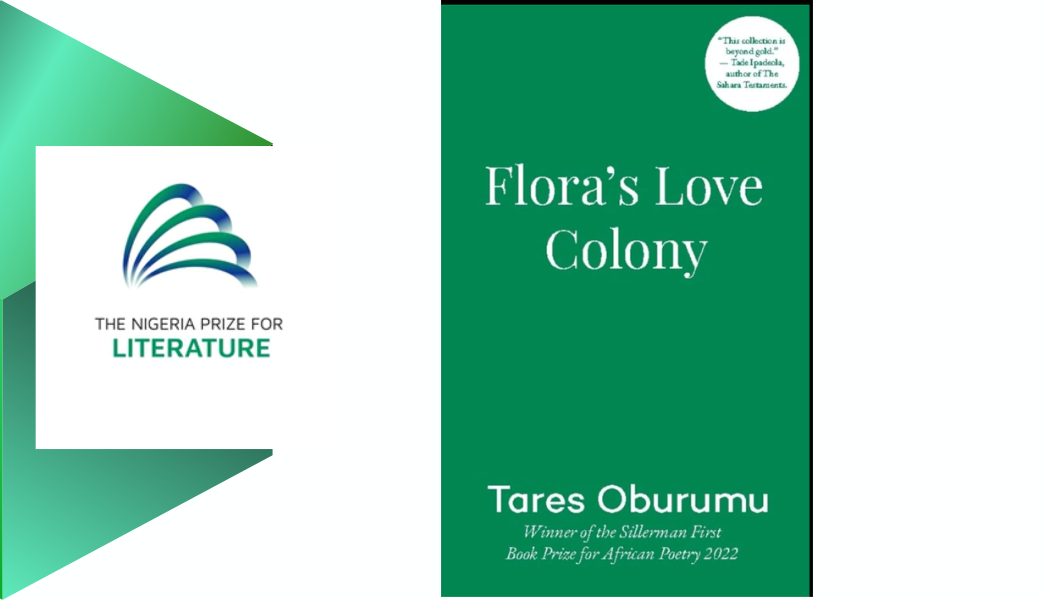
Tares Oburumu is a Nigerian poet born in the creeks of Bayelsa and raised amid the socio-economic and cultural tensions of the Niger Delta region. His poetry is marked by formal and structural elegance; through it, he affirms his humanity and interrogates the illusions of post-independence Nigeria. His work has appeared in international journals that serve as living archives of his distinctive voice, including African Writer Magazine, The Dawn Review, The Loch Raven Review, Yaba Left Review, Afapinen, Agbowo, Konya Shamsrumi, Connotation Press, Bluepepper, Woven Tales Press, Eunoia Review, and others. A graduate of Philosophy and Religion from the University of Benin, Oburumu won the GAP Poetry Prize in 2014. In 2022, he received the Sillerman First Book Prize for African Poetry for his collection Origins of the Syma Species. His work has been nominated twice for the Pushcart Prize (2023 and 2024). His most recent collection, Flora’s Love Colony, is currently shortlisted for the 2026 Nigeria Prize for Literature. It advanced from an initial pool of 223 poetry submissions to a competitive longlist of 11 books and then to the final shortlist contending for the $100,000 prize. Professor Nduka Otiono has described the collection as evoking Derek Walcott’s Omeros, transforming history’s wounds into petals of resistance. In this interview with the literary critic Tope-EniObanke Adegoke, Oburumu’s creative journey is brought into perspective, shedding light on the style and recurring motifs in his work, black-on-black racism, the Sisyphean absurdity of Nigerian life, amongst other things.
The immediate thing that struck me about your poetry is that it is highly stylized, with winding, complex syntax reminiscent of J P Clark. Yet I read somewhere that you started your poetic practice almost late.
I had no access to books until I was fourteen years of age. My father had a small bookshelf, which looked like a cupboard. I didn’t know it shelved a few dog-eared books until I was of that age. The man rarely came home. And my mother wasn’t a book person. So no one told us what the cupboard contained. When I think of how I got myself reading, I owe all of it to providence. Perhaps, something nudged me on. Some book-loving force. Suddenly, my impulsive personae grew, like flowers hidden in a vase, reaching toward the light. At fourteen years of age, I am already grown. A young man, determined and curious, to know what powers books hold. I was a slow reader at first. That changed when I had the paperback of Labyrinth, Okigbo’s stellar work in my hands. I didn’t buy it. It got to me in a hard-to-believe way. Quite mysterious. We, given to historical tendencies, were in the library at the time, turning over the pages of the British encyclopedia when he, a friend, picked up the work of Okigbo. I had read a few works on poetry and had fallen in love with verse. He too was some kind of poet himself. We took the book home against library instructions. Opening the first page to the poem “Mother Idoto” closed a lot of doors and led me into the magical world of a man, a poet, and a soldier who became a personal god, legend and canon of good poetry. I read that book more times than I can remember. I was fascinated, petrified, modified, stunned and hallucinated by it. Before Okigbo, there was a teacher who took interest in me. Who introduced me to some remarkable works. Comparatively, I couldn’t be separated from the poems I found in the labyrinth at the time. The separation came years later. It surprised me when I couldn’t make my unusual returns to Labyrinth. I had found T S Eliot, Derek Walcott, Seamus Heaney and Tomas Transtromer. In them, I found the beauty of language, depth and complexity. I got stuck.
I still want to hang on this line of conversation. Because Clark was an Ijaw, as you are, and is considered one of the masters of the craft. I am sure critics won’t miss the beat of comparing your work to his, by virtue of your birthplace and style. How would this make you feel? I mean, would you consider yourself to have come full circle then? I have read interviews with some authors who were privileged to be on the NLNG Prize shortlist with authors they studied with at school, and they said that alone was enough validation for them.
At the CORA/NLNG Book Party, I sat a seat away from Ogaga Ifowodo and I felt I am only getting close to something grandeur. Like a lowborn seeing the king for the first time in a span of decades. Watching Tanure Ojaide from where I sat, was more like a newborn in the presence of a father. It was an extraordinary feeling but I wasn’t pretty sure of the moment. We feel validated only when we write solely to be recognized in that sublime fashion. I write because my life depends on it. It is the one gift God has given to me and I am grateful. And I am showing my appreciation by not giving up on it. Whatever comes in my pursuit of finding myself is a blessing I can only be thankful for. I remember the letter a Sudanese man who read my poetry wrote to me. He expressed the affinity between himself and my art and recounted in detail how one of my poems saved him from self-immolation. This is all I know about validation. The crux of comparative learning is not placement as purely intended with validation, and critiquing my works side by side with J P Clark’s wouldn’t make me feel different from what I have always felt about myself.
Your descriptive ability in Flora’s Love Colony is remarkably tangible, sometimes commanding a painterly quality. I like this very much. You’ve clearly mastered imagery as a literary device. While I was thinking about this, I read in your interview that paintings actually influence your work more. And I thought, obviously.
Van Gogh has a tremendous personality. In my first collection of poems, you will read about him more times than necessary. I was a painter in my pre-teen, not up to adult life but painting featured prominently in my formative years. It’s life living in colors. It’s not abstract. It breathes. I had enrolled in a painting class for young children without the knowledge of my mother. I saved a little sum and dared the consequences, because the days of lessons fell on Saturdays when the house needed to be neatly kept. I was the only one absent and I had to choose between supper and painting. I chose painting. When my mother found out that I had a friend who shared his meal with me on my way home, she gave up. She was amazed when I took my first painting home. It was a portrait of General Sani Abacha. We hung it proudly on the wall at the opposite end of the door, so anyone who stepped through the door would be welcomed to our home by the beauty of the painting. Folks advised me to study Fine Arts. I could, using clay, create images of friends. I almost turned the veranda into a small museum. I abandoned the gift at some point, but it stayed with me. It resurfaced when I started writing poems from paintings done by the masters of the art: Rembrandt, Picasso, Van Gogh and the lot. How this second gift (I had thought I had only one gift) got mixed up with my poetry is astonishingly unbelievable.
That’s quite interesting to know. To shift the focus from style now – we might come to that again. There are mentions of places like Ugep, Ikom, Oloibiri, and Duke Town in the first part of the collection – all in Cross River State, all having colonial history or involvement. Yet these are places less frequently encountered in contemporary Nigerian poetry, I think. I remember I visited Ikom during a road trip and particularly like the cultural and natural beauty of the town. What do you hope readers take from encountering them?
I visited the places mentioned because I read about them in the few pages of the scattered Nigerian history, not because I wanted them to take up spaces in Flora’s Love Colony. The poems came, and I had no option but to allow them the deserved spaces. Even if I had expunged them, the poems would still be poems. But it was quite inevitable not to give them the spaces, and it kind of made me feel fulfilled having visited the places. I took a particular interest in Duke Town; I had to revisit it. It had a rich colonial history; the lived moments, the branding irons, the spiked collars were all reminders of a tortured ancestry. It only surprises me that I am yet to read about these important places in my ten years of reading Nigerian poetry. Meanwhile, I have read about Elmina Castle, Freetown and such places that carried the emblem of the slave trade. It would be meaningful to record such places in the form of poetry too, so we could build a robust conversation around those towns which signify a common heritage we cannot ignore. It’s disheartening that the contemporary Nigerian poet finds in his or her obsession the American example. Bad enough.
One of the thematics in the volume is the dysphoria of postcolonialism, how Nigeria has failed woefully as a nation despite her promises and potentials. I think you best sum it up as ‘geographical grief’ in one of your poems.
It is what the book is about, the nub of the naming and the events that followed. We were named by Flora Shaw and not by a native, It could have been Funmilayo Ransome-Kuti. It would have been different perhaps. It wasn’t just a naming. A projection, which was a misjudgement on the part of the colonizers, defining the people merely by geography. Beneath that simple act of naming, there was a false hope and a deliberate blueprint to perpetuate control. You see this clearly in the early sixties in what the oligarchs, after stepping into the shoes the British left behind with purpose, called regions. Each region, as it turned out to be, was a direct consequence of the naming. In that naming, there was no thought on the people’s distinct spirituality, their psyche, metaphysical leaning, culture, dreams, fears and aspirations in their own distinct spaces of existence. What were the terms of coexistence? Here’s the analogy. The constitution till date is an offshoot of the colonial experience. Nigeria is a constitutional embarrassment. They refused to pay attention to the magnificent diversity. Within the tribes, there were smaller units of unique people, identical to the larger group, who, they thought, wanted to be part of a shared existence. The naming was only interested in the expanse of land the natives occupied and the promise it held for the British. When you define a people by geography, you divide them. The idea of the State and the zoning of the States perpetuates the naming and the Empire. Unlike the centre of the British Empire, ours was an extension of the principles of divide and rule, which the British would not exert on the Englishmen and women. What do you think Gowon was doing when he created States and marched on with his army to the Eastern Region? Decolonization wasn’t part of the British plan, even when thousands of defenceless people were slaughtered because of their identity, fears, aspirations and dreams. They deliberately ignored these constructs to exercise control. Just a few days after the faux independence, or the Trojan horse was offered, the lies besieged the country. It didn’t take long years for the election crisis, monumental corruption, and a civil war to rock the natives. We are Nigerians by the hills, mountains, deserts, rivers, and oceans that surround us, not by the most beautiful constructs and ideas, and that we lie to ourselves is the reason we have come this far in a hoax.
This is why the volume interrogates history throughout. Re-enacting this in a nation that once removed history from the secondary school curriculum is an act of erasure, don’t you think? You must agree we need truthful reckoning with our past in order to move forward.
History is not entirely a thing of the past. It’s an evolving process that holds both the past and the present in a line of action, or events. It stands not to be obliterated, however chaotic it progresses along social structures or political movements. It is a series of amazing experiences in a circle of origins. It flows and should not be disrupted. Colonialism disrupted or discontinued that ancient African that was quietly evolving into a spectacular human being. Before colonialism, I believe we were at the peak of a remote civilization far ahead of the people who thought the world began with them. Our past didn’t start with the terms “the precolonial times and the Christian God.” We had our own beginning not found in any of the religious or history books brought from across the Atlantic Ocean or the Sahara Desert. Our history was written for us, not by us. Before the Mesopotamians or the Greeks learnt how to write, we had mastered the art of translating voice into words. That history is lost. All that we know now is what the colonizers taught us. That attempt to erase history from the school curriculum was a juvenile move. I often ask myself: does history live only in books? How can anyone make progress without being accountable to the past?
I would like to dwell on this a bit more. Because the way you’ve told snatches from the Biafran war is instructive. As a vanquished brother. There are still denials about certain events from the war despite the growing literature around it. Is this the reason some of your poems feel like monuments to this history?
The war is history. The point where the past and the present continually meet. In the absence of cannonballs, the battlefield shifted to the psyche. There are reports of genocide, and they are increasingly dialectical in nature. And the Nigerian State, habitually inclined to their nonchalant response to volatile national issues, ignores the tripwires by redlining them. You do not quell a people’s demand for redress with violence. Violence only breeds violence. And in this case, skirmishers. This is not about Biafra anymore. It’s about a war that has not ended. There’s a need to put an end to it by addressing the variable, intelligently, in saner spaces within. We keep failing in this. This is why we are not a country yet. We are absurdities. A mix of hills and rivers, landscapes and cities, quite haphazardly.
I am a partaker of that war by birth and by being human enough to know how it has evolved over the years. Either way, I am fighting it. Every Nigerian is still fighting it. Sometimes, emotionally. What ends is almost absolute in itself. The war has not ended because of denials, untold stories, and the existence of the same illusions that led to it. It finds expression in everything. The poems you talk about are my own way of expressing my disappointment with that history.
In the poem, ‘The Gift, The Curse’, for instance, I could see the subtle allusion to Wole Soyinka’s ‘Telephone Conversation’. But what is different is that the location of racism in your poem is not England or any of the Western world, but Nigeria, which is quite demonstrative that racism can also be experienced on the soil of the most populous Black nation in the world.
I wrote that poem as an eyewitness to events that almost traumatised me, so I am going to skip details and be brief. The people of Ebonyi State, existing among the Igbos within the East are often subjected to ridicule because of their nature. I met a few at a farm in Awka, Anambra State. During the heavy work on the farm, we were paid to prepare for planting, the other Igbos who were not from Ebonyi State, who recognised them by merely looking at their skin and hearing them talk, began to call them out with derogatory remarks. It took a different form in a man calling out a very dark-skinned girl as the devil. Subtle incidences of this nature occur here and there in a country composed entirely of black people. One can only be utterly speechless. It was courageous to have written “The Gift, The Curse.”
That looked like colourism, black-on-black racism. Sorry about that. One Igbo proverb in Nigerian literature today, popularised by Chinua Achebe says ‘Until the lions have their own historians, the history of the hunt will always glorify the hunter.’ Do you think it is possible to write as the lion when you have, in some way, benefited from being closer to the hunter?
I am convinced that it was the slave traders and the slave owners, or the children of the slave traders, who wrote about the slave trade. Who were the Nigerians brilliant enough to have documented the events of the pre-colonial era? If there are books written by the natives, I believe they are fewer than the thousands written by the Europeans. Was it not this shortage of historians that misinformed us into believing that Mungo Park discovered the River Niger until recent times, when we questioned the veracity of that flaw in history? You can easily imagine such faults going unchallenged by our intelligence. The story of the naming of the country by Flora Shaw, the wife of Frederick Lugard, appeared in a British newspaper. You cannot find that story anywhere in a Nigerian book. Are we sure about what was written about us? When I started writing this book, I did research about the naming and unfortunately, all the research pointed to the British newspaper that Flora edited being a journalist by profession. Isn’t that an insult to the people already? What are we to believe, a Nigerian story that is not found anywhere? Or the British newspaper Flora Shaw was a contributor? The lion wasn’t there. It was the hunter’s history all along.
I find a persistent question on theology in some of your poems, on whether God is West African or White, for instance; on how God could allow the slave trade and racism. These poems don’t necessarily offer any resolution or provisional answers, or do they deliberately leave the question open-ended?
In a country where no one listens, where they merely appear to have paid attention, proffering solutions is as good as preferring none.
How do you imagine your Sisyphus? I am interested because you used it as a classical allusion a couple of times.
I am simply fascinated by Albert Camus’ creation. Even more fascinating is that you find that character in the quotidian life of the average Nigerian, watched over by those who think they are far ahead in the climb up the mountain, only to be stymied by that stone, as the poor are. It’s ironic and laughable.
Quite laughable, truly, and it captures the schadenfreudic nature of the average Nigerian. This also interests me, so maybe we will continue chatting about it informally later. Thanks for your time, Tares, and congratulations on making the 2026 NLNG Prize for Poetry shortlist. I understand you also graduated from the University of Benin, so I guess I should feel proud if you go on to win it, as the university is also my alma mater.
Oh! Thank you. It’s interesting that we are sired by that institution. I feel great. I am excited.
Tope-EniObanke Adegoke is an editor and critic, a playwright and dramaturg living in Ibadan, Nigeria. He is a fellow of the Berliner Festspiele Theatertreffen 2025 International Forum.