
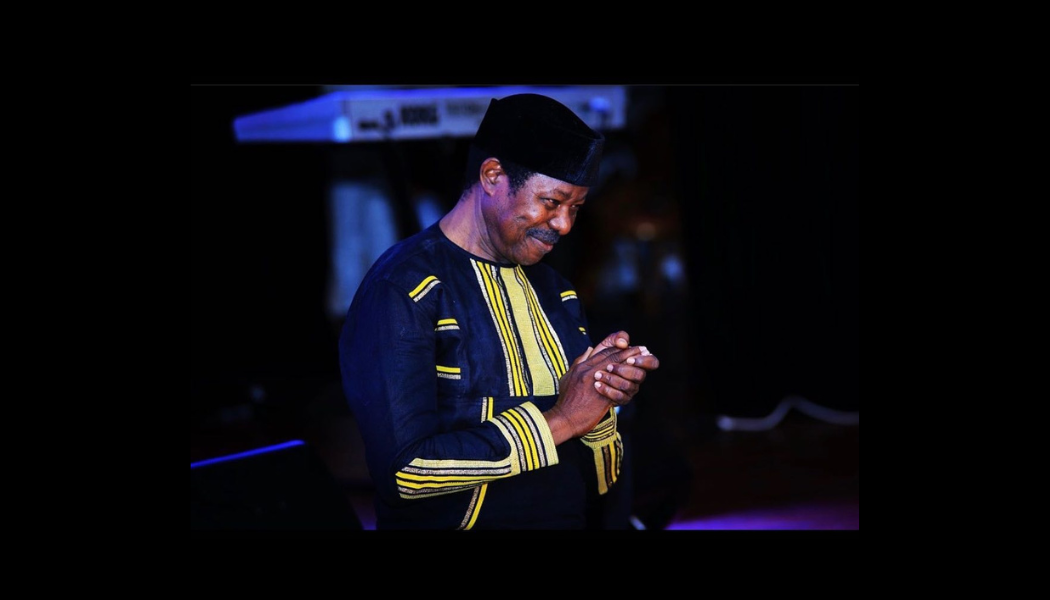
The King of World Beats at 80
On the second day of September 2026, the U.S. Mission in Nigeria, through their official X (formerly Twitter) handle, published a hashtag-led tribute to a historical signpost in US-Nigeria relations. For archival accuracy, the post in part:
“#ThisWeekinUSNigeriaHistory in 1983, America’s Billboard 200 welcomed a groundbreaking sound from Nigeria: King Sunny Adé’s Jùjú Music spent 29 weeks on the U.S. chart, introducing his innovative sound to American audiences. For 40 years, it stood as the longest-charting album by a Nigerian artist.”
The main character of that triumphant moment in US-Nigeria cultural relations is none other than Prince Sunday Adéníyì Adégẹyè, born 22 September 1946. The U.S. Mission X post thus came exactly twenty days to the official 80th birthday of King Sunny Adé, and not a day too soon. KSA, as he is known for short, has lived a long artistic life full of productivity, landmarks, instruction and intrigue in almost equal measure.
Long before the US Billboard charts recognized his unmistakable sound, King Sunny Ade’s records had been a feature of the World Music scene in Europe and Asia. A consummate live performer, fans sold his albums as well as bootleg ‘live’ cassettes at London Tube stations and even on trains in Europe (that these were among the preferred sales points deserves some study).
At the height of his powers, KSA’s prowess with Yorùbá lyrics in song
(Mo m'ẹmu m'ẹmu mo dàbí ẹmu
Mo mògùrò títí mo dàbí ògùrò…)
found the perfect setting in his lush musical arrangements. These, combined with the electrifying choreography of his 15 to 20 piece band, provide the ultimate atmosphere for what the Yorùbá call Àríyá or Fàájì, words with no exact matches in the English language but which can be loosely translated as lavish enjoyment.
His assured and talismanic personality apart, KSA is a performer with palpable star power oozing through his every gesture, and his original sense of musicality. Like most of his contemporaries, he felt the need to append an authoritative honorific to his name. His generation of Nigerian music artists across the genres, including ‘The Black President’ Fela Anikulapo Kuti, relished these appellations. It was the era of ‘Emperors’, ‘Commanders’, ‘Princes’, Admirals, Generals, and Barristers (yes indeed, barristers).
Over six glorious decades, and with an incredible work ethic, KSA has risen in stature and dexterity sufficiently to play in front of crowds across the world and for select audiences at home, especially on the Lagos social scene. His brand has stood firm all through the years without diminution, growing in standing and allure, continuing to command global recognition. Right from the beginning, his donnée has been the triad of song and chant and spectacle. That last element was probably first encouraged by his time with Moses Olaiya, popularly known as Baba Sala, anchoring the music section of the famous comic actor’s ensemble. Some will recall that Baba Sala was also a musician. KSA’s first language is Music; his second, Yorùbá; his third, English; and his fourth, a certain visual verve. It is no surprise that Sunny Ade had his own groupies, just as The Beatles did, just as The Rolling Stones, just as The Beach Boys.
But King Sunny Ade and His African Beats were never just about besotted women, adoring crowds or irresistible presentation. There was always a core that the dance steps and the lights barely touched. To really understand the man and his music, one has to have an understanding of the world in which his ideas and ideals were formed. A world at once physical and spiritual—the food and drinks, the apparels—indeed every element required for psychic and physical sustenance is accounted for in that milieu. KSA’s is a world of ancestors and the unborn; a world in which the rites of passage—from boyhood to manhood, girlhood to womanhood—are encoded and embedded in the music and songs of the people. KSA chose his path at age 16, putting all his savings into the purchase of a box guitar; and he’s never looked back. He taught himself to play the instrument without picks, his right thumb now forever imprinted by guitar strings, his ears attuned to their frequencies. Being differently dog-eared in his self-taught school of music, there are pictures of a young KSA listening with utter concentration and seriousness to the sound emitted by his guitar as he practiced.
He was no doubt influenced by musicians in the Juju and Highlife genres – Ayinde Bakare, Victor Olaiya, Tunde Nightingale, Seni Tejuoso, Fatai Rolling Dollar, J.O Araba; not forgetting I.K. Dairo and his Ijesa precursor, iGlory. Notwithstanding the influences, KSA went into the soundforge and didn’t reemerge until his distinct Juju sound had been hammered out.
King Sunny Ade has said in various interviews that his music draws from Yoruba ritual tradition (the shrines) and rhetorical practices, from wordplay and wordploy. Take his long play album, Ògún, consisting mostly of chants, as well as various other devices such as the truism, the pun, and the double entendre. Quite apart from the ample panegyric to the demiurge.
The maestro and his technique
KSA is a master of tempo. If Eri Okan is on one end of his musical spectrum, his rendition of Kini Mba Ro/Easy Motion Tourist is on the other. His metronomic measure naturally maps his growth and musical maturity. Young KSA was partial to faster beats, the grand elder KSA leans towards softer, slower beats. Growing with his patrons in age and influence, his sense of occasion is flawless. For those that witnessed the command performance that President Olusegun Obasanjo laid on for visiting President Bill Clinton in year 2000, one that KSA anchored with a particularly voluptuous rendition of Easy Motion Tourist, the rapture on the face of the American leader as he took the dance floor was genuine. It was on this occasion that it dawned on some of us that Clinton can really, really dance.
From its beginnings, Juju music has relied heavily on intricate guitar lines in conversation with talking drums, tambourines, sẹ̀kẹ̀rẹ̀ and vocal harmonies.
Between 1963 and 1973, KSA transitioned from the box guitar to the electric guitar. His decision to not adopt the plectra in plucking the strings was something he had in common with many other Nigerian musicians of the time. As though adopting the pick might get in the way of his reputation as the “ànjọ̀nú tí n ta wáyà” (the genius that plucks/trades strings). He wanted a direct connection with the string and has not once expressed regret at his callused right thumb. That said, his refusal of one aid was by no means a rejection of other means of strengthening his musical output. By 1982, a technological choice in aid of his sound proved to be a force multiplier for the instrumental clarity of his band. It also charted a new path for Juju music, with reduced background noise, allowing all the elements—percussive, string and vocal—to shine.
The first KSA record to be mastered using Dolby Noise Reduction technology was Juju Music (1982), a watershed of the genre. It is worth noting that the Synchro System album of 1983 was a reworking of the earlier Synchro System Movement originally recorded in 1974. The reboot was aimed at an international audience and it did not fail, earning King Sunny Ade his first Grammy nomination in 1984. Always distinctive, the world-conquering Juju sound was, for the first time, available on international flights (KLM was an early champion of KSA), as part of the World Music audio loop. Other Juju artists would soon get in the Dolby Noise Reduction line, hearing for themselves the huge qualitative leap in the sound. KSA can be credited with pointing the way for others in diverse genres across West Africa. Among these were Salif Keita, Youssou N’Dour and others who would become big players in the World Music category.
1983—the year King Sunny Ade and His African Beats embarked on their historic tour of the United States—was an interesting one on the global music scene. The Police released Synchronicities, the last album of the rock group that had Sting as its frontman. The British Pop group Culture Club released their monster hit, Karma Chameleon. And it was the year a Nigerian musician spent 29 incredible weeks on the US charts. No mean feat.
A king’s game theory
Kóńkó jabele, kálukú ló mí ṣe tìrẹ… so goes a coda in one of KSA’s most beloved songs—a musical exposition of his game theory. Placed side by side with mathematically rigorous theorems of game theory such as by the inimitable John Nash, Nobel laureate in Economics, the intersections are striking.
For KSA, an individual’s strategy is a ‘best response’ to the strategies of everyone else. For Nash, it is very much the same. What’s more, this is true whether the individuals are allied or in competition. And though the veritable Gayatri Spivak warns against trying to live the theory, KSA has lived his musical game theory into some splendid outcomes. Through the traditions he draws from, and by his individual talent, he has shown that the skies are wide enough for all manner of birds to fly – kites, eagles, guinea fowl, geese, black swans, even bats.
In a poignant interview with Molara Wood published in 2004, KSA recalled his relationship with Afrobeat legend Fela Anikulapo Kuti. KSA noted that Fela was a genius through whose music one could recognize Nigeria; and he expressed the hope that his own music could also be a compass whose true north would be Nigeria. This is another aspect of what I like to call KSA’s game theory. Having lived in the limelight while doing his fair share of the work to give Juju artists a decent living from their earnings, the maestro set his sights on something more ethereal, as true musicians should.
But perhaps the ace up his musical sleeve is his ability to set the pace. KSA celebrated his first decade as a recording artist with a double album, 10th Anniversary Special Vols. 9 & 10, released in 1973. Here was a musical diarist, celebrating audiences from his roots in Ondo Town and all through West Africa. In truth, his influence was already spreading into Central Africa, from the Cameroons to The Congo. That first decade saw raw KSA performances heavy on Yoruba idioms/chants/incantations/truisms captured by analog studios but mostly by live audiences. Ibi Wọn Rí O is an example of chant/incantation/acapella vocals (as found among acolytes of the Ògún deity) fused with modern electronic instruments and vocal harmonies. The song points to its cultural source in the intro and closing lines. Such works, emblematic of KSA’s first decade, channel the priests of his local shrines.
In keeping with Yoruba tradition, the first decade also saw KSA performing ìjúbà, paying homage to masters past and present. In later years, other musicians would pay obeisance to him too. Fuji maestro Sikiru Ayinde Barrister riffed on Tẹní Bẹ́gi Lójù, from Vol. 10, in a tribute titled, Senior Leader King Sunny Ade, released in 1983.
KSA’s second decade saw him boldly experimenting with new instruments and collaborating with artists across genres (including Tony Allen and Manu Dibango). It was the era of FESTAC ’77, the epochal event where KSA performed and connected with a literal host of musicians of African descent. The roster of collaborators wasn’t limited to Africans – Paul Meissonnier, Godwin Logie and Paul ‘Groucho’ Smykle would all leave their mark on Sunny Ade’s music around this time. The KSA of this period is less given to the homage/hommage, leaning more into asserting his singular talent, with the accompaniment of his band.
The sound in the next decade pointed to a more expansive and laicized KSA (remarkable, for a professed Ògún devotee), his musical ecumenism and sonic syncretism in full flow. In came the celebrated collaborations with Onyeka Onwenu (Choices and Wait for Me). That experimental leap inflects KSA’s musical production right up to the present. In Arts of Being Yoruba, Adeleke Adeeko noted that other Yoruba artists have also done this, Ògúndare Foyanmu being a case in point. Foyanmu—steeped as he was in the Ijala chant tradition of the hunters guild—nonetheless waxed lyrical about the Christian God, using Ijala.
The fourth decade found Sunny Adé keeping up with social and communal developments, like most Yorùbá music artists do. He sang to mark the transition of important personages, the elevation of new kings and chiefs, performing at the events of captains of industry and other major figures. While the older, laid-back Lagos/Ogun/Oyo elites stuck to the classic Juju sounds of Ebenezer Obey, younger upwardly mobile crowds went with the more energetic and fast-paced Afro-Juju of Shina Peters. Sunny, to his credit, picked a boulder and stood somewhere in the middle of the music stream. He kept his home base onside, with patrons like Elizade and eastern Yoruba music fans always behind him. At any rate, the skies were wide enough to accommodate all; and, in any case, KSA’s music was now global.
KSA and his contribution to Nigerian jurisprudence
A true artist and a consummate businessman, KSA fought for the control of his intellectual property early in his career. In his corner was the legendary lawyer, Gani Fawehinmi. Sunday Adeniyi v. Chief Bolarinwa Abioro—decided in 1975 by Justice L.J. Dosunmu (known in legal citations as Dosunmu J.— brought the law of contract and copyright law to the fore in Nigerian jurisprudence. The interplay of private law (contract) and public law (copyright) came up for close interrogation, and the result of the verdict is a much fairer music publishing landscape in the country today. KSA had signed an onerous contract with Abioro’s African Songs Limited (ASL), but later kicked against an arrangement that paid him and his band only 20 kobo (or 3.33%) out of every N6.00 album sold. The verdict by Dosunmu J. ought to be required reading for every judge at the Federal High Court in Nigeria, as well as students of the law of contract. KSA’s sense of the feud is worthy of remark. Once, as a dare to music rivals wanting to join issues with him, he deployed the Yoruba idiom: “Ká jọ gbé pẹ́rẹ́gi kaná”. That legume, no longer in fashion, is typically cooked overnight. This was young KSA’s way of saying: If you don’t want a vendetta, don’t throw down the gauntlet. That this is no mere rhetoric is reflected in the fact that, up till 2017, his tiff with ASL was in the appellate court system.
His musicianship and the inner lives of children
KSA wasn’t all serious business all the time. Juju music is three parts fun out of four. For some reason, his artistry held a special appeal for children. It certainly marked some of us whose coming of age had Juju music as one of the main soundtracks. King Sunny Ade’s musicianship was a passage, almost a ritual passage.
My earliest recollection of a critic’s circle to which I belonged, had three of us as founding members: Túndé Àjàyí-Ọ̀pẹ, now an artist in his own right; Gòkè Dábírí, now a petroleum engineer in Scotland and me. Our school, Saint Andrews College Demonstration School in Ọ̀yọ́ Town was something of a scholastic oddity. Without putting INTERNATIONAL in its name—in the manner of educational institutions of today’s Nigeria—Saint Andrews was truly international, with Sierra Leonean, European, Egyptian, Pakistani, Indian, Sri Lankan (we said Ceylonese in those days) students, among others. As a result, those of us for whom Yorùbá was our primary language of communication bonded during lunch breaks, where we would discuss the musical interludes on television as it was in 1978. Gòkè, whose contemplative nature even as an eight-year-old boy made him lean towards Ebenezer Obey, stood in one corner, while I pitched my tent permanently in the Sunny Ade corner. Interestingly, the only true critic among us was Túndé, then seven years old. His musical pendulum swung this way today and that way tomorrow. In one of his more astute comments during one of those critical sessions, he correctly lampooned my KSA fandom for being overly partial to the choreography rather than the music itself. And even now, in our fifties, Túndé still taunts me for substituting spectacle for sonic substance. The moral of the story, I think, is that these artists found their way into the inner lives of children, and that is something worth pondering.
With adults, KSA has had to negotiate his place in the modern world with a certain savvy. As a proud son of Ondo, a city-state historically renowned for lookili, the canine culinary treat, for example, elderly KSA has toned down the cultural specifics in this respect. Not so in his younger years. The Ondo are not alone here; all over the world, people of various ethnicities have at different times in history fed on the domesticated wolf. Well, in Ondo, where Ògún is still the patron deity in the common consciousness, folks put their town special on the front burner still, as they blast various Sunny Ade licks on the speakers.
Now that advanced age compels his once nimble feet to rest awhile during live performances, we have come across some true gems of the kind of musicality and amity that KSA’s Yoruba world furnishes. In one recent example, illustrating what the scholar, Akin Adesokan, terms “live sampling” in his book, Everything Is Sampled, Queen Salawa Àbẹ̀ní—whose original genre is Waka—serenades KSA with samples of his songs rendered in a Waka medley. A seated KSA hands over the microphone to Queen Àbẹ̀ní who kicks the singing into a higher key, always only referring to the Juju music legend by his honorifics, Alade, Isola, and so on. And when the medley ends, KSA reciprocates, also only regaling the Queen with her honorifics. I am glad that these artists lived long enough to give us these live sample performances, unrehearsed. These are not ‘duets’ in the music industry sense. They are sui generis.
Age has indeed mellowed the maestro. The older King Sunny Ade, whose smiling face onstage is only rarely inflected with irritation at any mistake from his band members, wasn’t always so even-tempered. The younger maestro didn’t always suffer mid-performance errors gladly. The seriousness with which the King of World Beats practised with his band, the unforgiving nature of analog studio technology and the necessity of catching a subject’s ears mid-panegyric made it so.
The many colours of the songbird
KSA named and renamed his band several times over the course of his career. It was The Green Spots in 1966/67, the name under which he recorded his early hits. The name changed to African Beats in the early 1970s, for commercial reasons. This is the name under which he attained international fame: King Sunny Ade and His African Beats. Another era brought another change of name: Golden Mercury. He subsequently renamed the band New African Beats. Who knows what he will cook up next?
KSA is a visiting lecturer at the music departments of The Polytechnic, Ibadan; and at the Obafemi Awolowo University. He is a patron of the Musical Copyright Society of Nigeria (MCSN), and has served in many advisory roles over the years. It’s all in line with the Yoruba model of stardom, which is for life and good behaviour. With a massively impressive haul of songs in tow, King Sunny Ade has attained both critical and commercial success in music, home and abroad. His place in the pantheon is assured. Let the good times continue to roll for the King of World Beats, whose spirit of joy and song continues to soar into his eighth decade.
Tade Ipadeola is a Nigerian poet, essayist, translator and lawyer. He writes in both Yoruba and English. He has published three volumes of poetry – A Time of Signs (2000), The Rain Fardel (2005) and The Sahara Testaments (2013). His collection
of North American poems, Cold Brew, is due for local release in February 2027.