
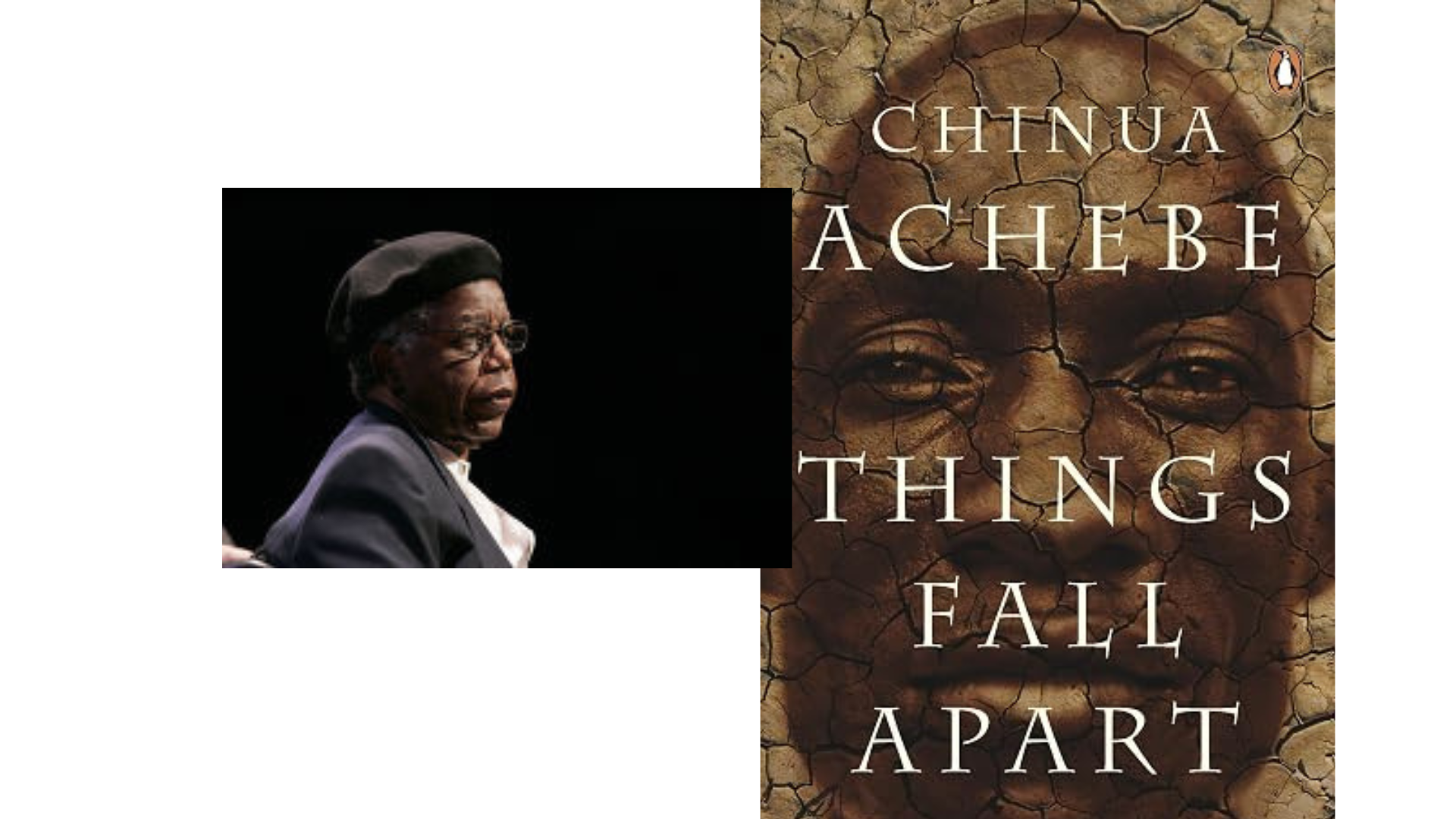
On Speech and Gender Relations in Achebe’s Things Fall Apart
“Among the Igbo the art of conversation is regarded very highly, and proverbs are the palm-oil with which words are eaten,” says the narrator of Achebe’s Things Fall Apart (TFA). Here is the place of speech (and its absence) in Umuofia, the fictional Igbo community where TFA is set, since conversation is the art of speechmaking and exchange. This implies that the proverbs provide values to understand the issues that TFA portrays. The Igbo world that Achebe constructs through Umuofia registers Achebe’s feminist politics. Reading TFA again, I am drawn to the fact that proverbs raise a lot of questions about African literature and the image of women. Therefore, to understand how masculinity and femininity are constructed and perpetuated in TFA, it is necessary to mine through the words and silences in the novel, and what better way to start than through “the palm-oil with which words are eaten”?
“Nwata a tụọlụ ilu kọwara ya, Ị mara na ego e jiri lụọ nne ya nara n’iyi,” is an Igbo proverb that questions the usefulness of the bride price paid for a mother for whose child a proverb has to be explained. As is the nature of proverbs, this is more about what is unsaid than what is said. It maps gender relations among these people in a complex and complicated way. It places the education of children—at least as it concerns the learning of proverbs—within their mothers’ huts, where they are told folktales and the moral lessons as proverbs whose meanings and wisdom the mothers draw out from the tales. The concept of Matri-Archive as theorised by such scholars as Laura Grillo is relevant here for its framing of mothers as repositories of cultural norms and values, wisdom and sensibilities, and practices that have sustained the community, including the accounts of wars that ensured the survival of the community, and the warriors whose heroism distinguished them. These matrilineal repositories go beyond just containing knowledge, but also play a vital part in its oral transmission to the future generation—their (grand)children—through such means as the narration of folklore.
In this regard, the maternal nurture of the future of Umuofia comes not just from breastfeeding and cooking, but also in the form of intellectual enlightenment. If we ignore the presentation of the bride price as money paid in exchange for a product and service (which is why the usefulness of it is questioned when the mother cannot provide the educational service that is considered part of the package), the proverb in question paints an empowering picture of women as the moulders of the future of the community. But can we really ignore it?
Maybe we could if, throughout the novel, we do not see Okonkwo, the protagonist, degrade the Matri-Archive by constantly dismissing folktales as women’s and children’s stories, unfit for real men who must only recount tales of valour and might, tales of war, and of blood, of sorrow and deaths. The proverb presents women as indispensable educators, but for Okonkwo, “womanish wisdom” is cowardice; he uses the descriptive “womanish” as an undesired which, when added to the desired “wisdom,” makes it less desirable; womanish, thus, qualifies wisdom negatively. Femininity is by such a frame rendered incompatible with wisdom, an indictment on a society that expects women to train their kids into adept conversationalists.
Okonkwo considers the orator Egonwanne the opposite of the singer, Okudo. Okonkwo admires the latter and despises the former. These two men, for whom words (spoken or sung) are their primary tools of operation (and even weapons), present examples for examining the place of speech in Umuofia. Okudo is not a fighter but is considered one for his voice raised in a war song “turned every man into a lion.” Egonwanne, on the other hand, has a “sweet tongue [that] can change fire into cold ash. When he speaks he moves our men to impotence.” Driven perpetually by “the fear of failure and of weakness,” Okonkwo does not see complementarity in these men. Maybe he should have paid more attention to those nights in his mother’s hut when she told him folktales, for he would have learnt that, “Ife kwụlụ, ife akwụdebe ya.” The law of complementarity demands that if Umuofia has (or had had) a singer whose songs flame the passion of men to unsheathe their machetes, it also needs a man whose measured words can douse those flames so that disputes can be solved without drawing blood, when possible. Umuofia needs its Okudo; Umuofia also needs its Egonwanne.
Okudo’s position in the masculinity discourse of Umuofia further shows the complicated and complex nature of speech and gender relations in Umuofia. Okudo was not a fighter, yet the warriors regarded him as an equal for his songs, which they consider as much a weapon as their guns and machetes. These same words are viewed differently when used by women to recount and document tales of these exploits, not minding that without such stories told, the collective memory of Umuofia suffers, and the warriors will be most affected since the younger generations will have no reason to revere them, for they are ignorant of what these warriors have achieved. When the proverb “Nwoke nụchaa ọgụ, nwaanyị e nwere akụkọ” is used, it is to suggest that a man is driven to action while a woman is driven to words. Words, otherwise elevated amongst these people, are here trivialised and considered frivolous. Maybe the only words to be considered as art are words spoken by men in support of violence. And was Okonkwo a violent man!
“[Okonkwo] had a slight stammer and whenever he was angry and could not get his words out quickly enough, he would use his fists,” the narrator says in the opening page of the novel. Here, Achebe begins the complication of silence and strength in TFA. Okonkwo’s speech impediment leads to an unintentional creation of silence on his part, and is a weakness. But Okonkwo must never be thought of as weak. He seeks “strength” in his fists. (An earlier complication of silence and strength in the novel is when the story of Okonkwo and Amalinze’s iconic wrestle is recounted. The arena is so quiet that “one almost heard them stretching to breaking point.” Strength is trying to burst through silence, to break through it, but is also enhanced and amplified by the same silence).
Throughout the novel, speeches and silences are sites where masculinity and femininity, agency and its lack thereof, are contested, (re)negotiated and (re)affirmed. In his family, Okonkwo subjugates and strips his wives and children of the strength that comes with speech, denying them the agency to self-define: “They dared not complain openly.” When Okonkwo thunders “a hush fell on the compound immediately,” a form of silence active with fear. To break this hush, to bring forth speech, is to court danger. That was the case of Ekwefi, one of Okonkwo’s wives, who Okonkwo almost shot dead for speaking up.
The infantilisation of women is rife throughout the novel, especially in Okonkwo’s household, where no matter their age and position, they are still regarded as children. They are to be controlled and a man’s strength measured, in a significant part, by how effectively he brings his women under his absolute control. The highest insult to be given to a man, therefore, is to question his manhood, to call him a woman. When Okonkwo challenges a kinsman, Osugo, by saying “This meeting is for men,” the unspoken words are that Okonkwo had called the man a woman because he has no titles, thus lessening him. When Okonkwo says, “I will only have a son who is a man,” he furthers that narrative, rejecting Nwoye’s alternative (receptive) masculinity, enthroning the type of masculinity where “To show affection was a sign of weakness; the only thing worth demonstrating was strength.” Crude, raw, visceral strength.
In Masculinities in Nigerian Fiction: Receptivity and Gender (2025), Peter Umezuruike argues that Nwoye is a fully masculine character, even though his masculinity may differ from that of his father, Okonkwo. Nwoye’s is an alternative masculinity, one that makes him, having been on the receiving end of the sort of masculinity Okonkwo espouses, more receptive and understanding and thus, out of empathy, seek to undermine norms that impede the “viability of every life.” One therefore expects to see in Okonkwo this alternative masculinity, but Okonkwo’s own childhood humiliation as the son of a lazy poor man seems not to be strong enough to engender an alternative receptive masculinity. His contempt for his father is the stronger driver. He tries everything to not be like his father, Unoka, just like Nwoye tries to not be like him, Okonkwo. I suspect that Nwoye’s rejection of Okonkwo’s type of masculinity does not just come from the empathy of one who has suffered under the regime of that masculinity, but also from contempt–the determination not to be like the father, something father and son share.
The gender formulations are in some cases fluid. The fluidity is more noticeable in the spiritual realm, where Ani is a goddess, but the priest who serves her is a man, and the priestess of Agbala, the Oracle that must be consulted before Umuofia can embark on any war, “was a woman called Chika. She was full of the power of her god, and she was greatly feared.” It is only Chielo (who took over from Chika), who as a woman can scream Okonkwo into submission: “Does a man speak when a god speaks?”
The night and its darkness “held a vague terror for these people, even the bravest among them,” such that the night was “always quiet except on moonlight nights,” yet Chielo habitually (“There was nothing new in that”), “with a loud and high-pitched voice,” breaks “the outer silence of the night.” There is also Nwayieke, a woman unbothered by the terror of darkness. The sound of her wooden mortar and pestle has become part of the “vibrant silence” of the night in Umuofia. What is generally considered a bad habit of late cooking becomes an act of bravery, an act of resistance. Chielo, empowered by her spiritual position, and Nwayieke, by (maybe) just sheer choice, challenge the auditory composition of moonlight-less nights in the community, a challenge to societal, cosmological, and maybe even cosmic conventions. Two women showing strength where even the bravest of men cannot, by not being silent. (Interestingly, the narrator says that every woman in Umuofia knows the sound of Nwayieke’s mortar. One wonders if the men are deaf on these nights, or there is something that comes with being male that prevents them from recognising the source of a noise, once it is a kitchen utensil—an object that belongs to a space Okonkwo’s sort of masculinity insists no man has business with).
However, Chika presents a case of internalised misogyny. When it is said that Chika, like all Agbala priestesses, while possessed by Agbala, becomes a “half man, half spirit,” it is taken for granted that man here substitutes for humans. But it may as well mean that she sees herself partly as a spirit, and partly as a man, in the masculine sense. If not, what informs her charge to Unoka, “Go home and work like a man”? Work like a man, as against working like a woman? This is a (slight?) case of the (privileged?) marginalised reinforcing their marginalisation to maintain the status quo (think of all the instances of mothers telling their daughters, “Don’t you know you are a woman,” which carries with it the unspoken never think yourself equal to a man).
This reinforcement of the status quo is clearer in how Ekwefi got married to Okonkwo. It is easy to read that silent divorce by Ekwefi who left her husband’s house “early in the morning” and went to Okonkwo who wordlessly “carried her into his bedroom and in the darkness began to feel for the loose end of her cloth,” as a feminist act, especially considering the current reality where Christianity has made divorce a dirty word—mostly on the part of women—amongst the same Igbo people (which means more women silently suffer in their marriages for they cannot walk away). But if we pause to consider why she had married Anene (“Okonkwo was too poor then to marry”), and Anene whose wife just up and left like that (an act that could only be read as irresponsibility should it be done by a man), the problems with such a reading emerge. One might argue that Ekwefi is a product of her society, a society that makes man the provider, but it is the same society where Unoka’s wife was, at least before their son’s maturity, his provider (“She could not be expected to cook and eat while her husband starved”).
In its complications of gender relations through its deployment of speech (and silences), Things Fall Apart urges us to rethink gender relations, not in terms of superiority/inferiority, or as a war (as we are wont to in our interactions on social media today), but in terms of complementarity. And solidarity. Nwoye’s mother takes care of Ojiugo’s children in the latter’s absence, and even lies “trying to minimise Ojiugo’s thoughtlessness.” In that sisterly solidarity that exists between co-wives, Achebe presents a model of cooperation that we must today adopt in our relations. It is a model that exists because Nwoye’s mother sees Ojiugo as a co-equal and collaborator and not as one with whom she competes for the affections and love of a man. This model thus requires the genders to see one another as co-equals, faced with the task of surviving (and conquering?) the(ir) world as against manipulating and controlling one another. Makana ife kwụlụ, ife akwụdebe ya. Egbe belụ, ugo ebelụ. Nke sị ibe ya ebela, nku ama kwaa ya. For every yin, our Chinese siblings teach us, there is a yang.
Ugochukwu Anadị is a volunteer contributor at The African Theatre Magazine and has undergone editorial and publishing internships at Narrative Landscape Press, Counterclock, and Griots Lounge Publishing, Canada. He also served as an associate editor at Iron Horse Literary Review and is currently an African Liberty Writing fellow.