
Bongo Fleva: A Love Story
CW: Depictions of violence
The first time I hear Cinderella, Mother is crying slow, deliberate tears that gather at the corners of her eyes before releasing themselves down the steep ridge of her cheekbone. Each one catches the fractured afternoon light like something briefly precious before vanishing into the collar of her kanga, which has a viscous blackish-red smear that mars the fabric. It is a hot afternoon in 2006. The sun pokes at us through the gaps in our roof, a flat, tyrannical white of midday that presses down without apology. It comes through in thin, surgical blades, illuminating the dust we have long stopped trying to fight, settling on the cracked cement floor, on the fraying edge of the curtain that cannot decide whether it is blue or grey. There is no protection against the relentless heat. And no protection against anything, really. I am around seven years old, and I am learning something about the world: that it does not move for me, that it does not soften, and I learn it primarily by watching my mother cry in it.
I am painfully conscious of her tears. I do not look at them directly. I have already developed the instinct that looking directly at mother’s grief does something irreversible to me, so instead I study the wall behind her, the crooked nail with nothing hanging from it, the brown water-stain, the place near the baseboard where the paint had once been red and has since faded to the color of an old argument. The room holds the silence of things that have already been said. The heat makes it heavier.
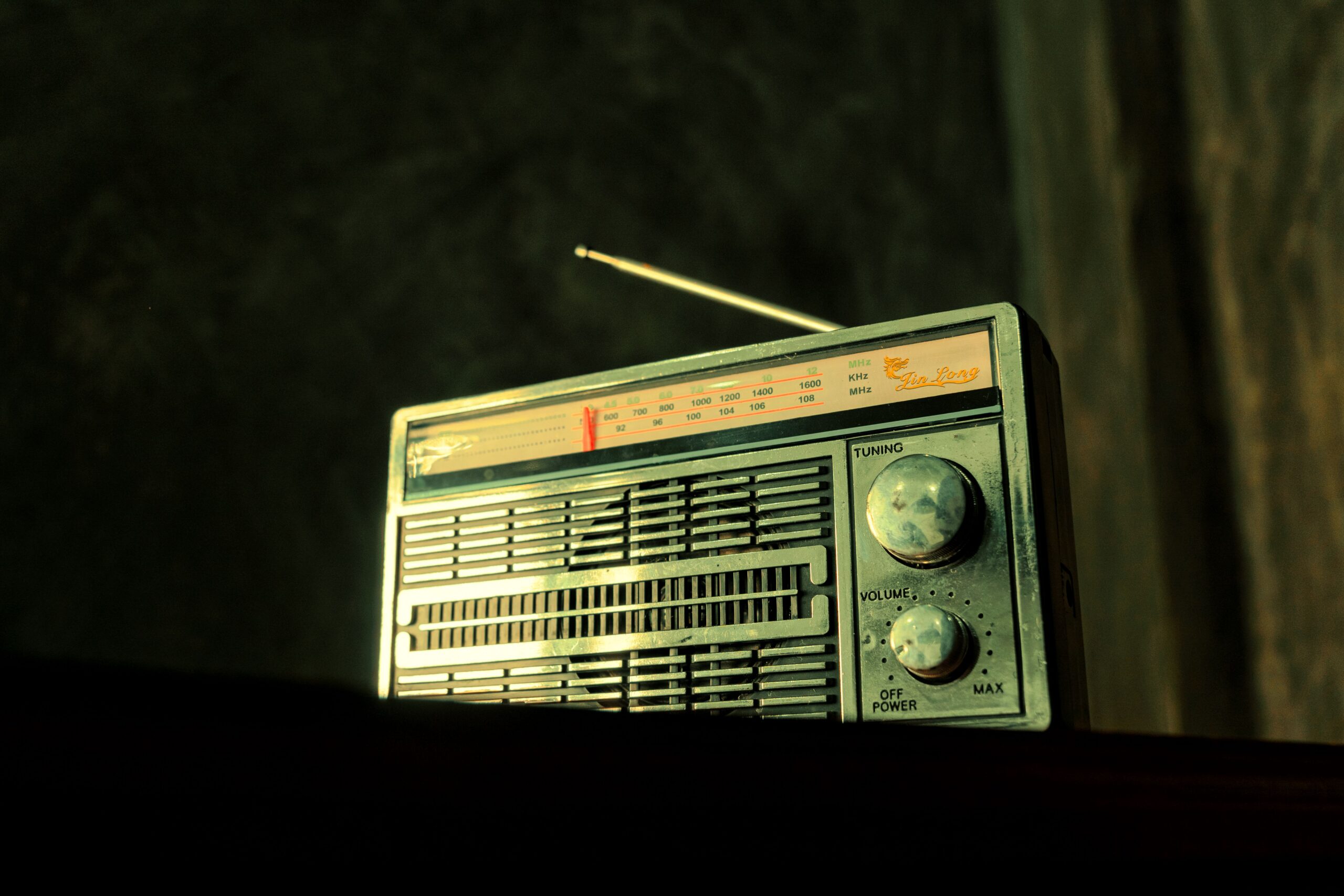
And then, from the small transistor radio on the wooden shelf, the one with the bent antenna that only works if you tilt it seventeen degrees toward the window, a sound arrives. It arrives with a slow, certain settling. The rhythm sways before it commits to anything, a gentle heartbeat that carries the patient architecture of another era. If I were old enough, I would have known it is from the Tanzania of gramophones and open-air dance halls and men in pressed shirts who believed music is a matter of dignity. Wire-plucked strings cascade in a sequence that rises and falls like Lake Naivasha just a few miles from our house, finding the shore and retreating, indifferent to urgency. Over a canvas of wooden clicks and soft, snapping thuds, which are clean, uncluttered, and precise, a voice arrives. It is the voice that undoes everything.
It is the voice of a man, pure velvet. It does not rush. It seems to choose a slow, smooth geometry. And beneath it, holding the whole structure in place, comes something else entirely in a heavy, synthesized bassline that anchor-drops into the room from a different world altogether, carrying the digitized knock and hard-hitting snare of Black American street beats, the sound of cities I have only seen in the static of satellite channels. Yet just as that harder pulse asserts itself, it softens. It refuses the rigid, mechanical grid, unlike American music. It begins to sway, adopting a rolling, acoustic looseness that intertwines, gradually, with accordion-like loops and cascading string patterns that weave two worlds together until you can no longer find a seam between them.
The song sounds like a melody engineered to cradle the weight of an unforgettable heartbreak, designed, it seems, for this precise room, this precise afternoon, these precise tears.
The heat does not leave. Mother does not stop crying. The sun continues its blunt excavation of every gap in our roof. But for four minutes and twelve seconds that voice lives inside that room; something shifts in the quality of the suffering. It does not lessen, exactly, but holds. It is as if the music has become a blanket thrown over the afternoon, not to conceal it but to make it bearable, and to give the grief a shape it can rest inside. I sit very still, the only way a kid can sit when something is happening to you that you do not yet have the vocabulary for, and I let it happen.
I do not know, then, what to call what I am hearing. I only know that I need it. That I have, without choosing, already chosen it.
****
Hanif Abdurraqib, the poet, essayist, and one of the most necessary cultural critics writing in the world today, has a thesis that a song can be a livable sanctuary constructed from melody, a provisional shelter you can claim when your true dwelling has become uninhabitable. That there is a country made of sound, and some of us have needed its citizenship more urgently than we have needed almost anything else.
I believed him before I read him, which is the particular grace of discovering a writer who has spent years articulating the very thing you exhausted yourself trying to say in solitude. My own half-formed thought returned to me fully grown.
There is a word that the young men and women who built this genre of music used to describe the world they were building it in. The working-class corridors of Dar es Salaam, and the dense neighborhoods where the streets were bright and the margins were thin, and the government’s concern arrived late, if it arrived at all.
I think of Naivasha, where I grew up, and the difference is both everything and nothing. The sun was the same, that equatorial insistence, but the lake made our air heavy, wet, while Dar es Salaam breathed dry and salt-adjacent off the Indian Ocean. Where Tanzanian youth navigated the collapse of socialism’s promises and the cruel shrug of structural adjustment programs, we in Naivasha were learning a different arithmetic: flower farms that paid in shillings that bought less every week, the volcano Hells Gate brooding on the horizon like a god who had stopped listening. The government’s concern arrived late there too. Or perhaps it arrived precisely on time, if the schedule was written by people who did not consider us urgent.
What later became known to the wider world was born and forged in those streets, by young people who possessed something the times they were living in had not managed to take from them: bongo. The word means brains. That’s why the music became Bongo Fleva. More specifically, it means the particular intelligence that emerges when survival is the daily curriculum. The street wit and the ingenuity, the ability to construct something from almost nothing and make it not just functional but beautiful.
As a kid, we had a word like that in Naivasha, though I cannot remember it now. Or perhaps we never had a word for it at all. Perhaps that was the difference: they named their survival, and we just lived ours.
These songs were testimony. They were the sound of an entire generation of Tanzanian and perhaps larger East African youth translating economic neglect, displacement, and daily, unspectacular grief into melody and into something that could be shared, that could travel through a transistor radio’s bent antenna and arrive, whole and full of intention, into a room it had never been designed for, to hold a kid it had never been designed to hold.
Greil Marcus, American author, music journalist and cultural critic, has a core philosophy that is embodied in the idea that certain recordings carry a secret history inside them, a shadow archive of everyone who has ever needed them, a record of all the private moments into which a song has been invited and changed. That transistor radio in our home was, by any reasonable measure, a modest object: plastic casing gone slightly yellow at the edges. A single speaker that rendered the low end as something approximate rather than precise. And yet what moved through this particular childhood afternoon was the entirety of a genre’s survival intelligence. Every crackle was a ghost. Every frequency drift might have been a border crossing, as somewhere in Tanzania, Ali Kiba, who perhaps had never seen our lake before, was singing about a girl named Cinderella, and his voice arrived in Naivasha as if it had always been coming.
The first time I heard Cinderella, the afternoon continued being what it was. The dust continued settling on the windowsill. But for those four minutes and twelve seconds, we were somewhere else entirely, somewhere constructed of sound, held up by Bongo Fleva, furnished by the particular genius of people who had learned that when the world will not give you shelter, you build your own, and you make it beautiful enough to survive inside.
****
The first time I hear Cinderella performed live, I am twenty-two years old, standing in a crowd at Lake Naivasha Resort on a December night that is cold enough to make you remember that Naivasha is altitude, not tropics, that the lake gives with one hand and takes warmth with the other. It is December 11, 2021. Ali Kiba has come home, not his home exactly, but where I have claimed him, the East African belt that has made him a kind of shared inheritance. And something in the air feels, as it always does at the end of a difficult year, like both grief and defiance wearing the same outfit.
He steps out and the crowd becomes one animal, they roar. I feel it in my sternum before I process it with my mind. Kiba is dressed in a heavy statement jacket over a graphic tee, distressed denim relaxed at the knee, a snapback worn backward, a silver chain catching the stage light with a restraint that costs money to achieve. This is also Bongo, I think. The particular intelligence of knowing exactly how much to show and how much to withhold. The crowd closest to the stage is generating its own weather. You can see the heat rising off people’s bodies in the lakeside cold, this small convection of collective joy.
When the opening notes of Cinderella come through the speakers, it is not the modest, approximate low end of a transistor radio, but bass that displaces air, that you feel in your chest cavity as a second heartbeat, and for a moment I am nowhere. Not at the lakeside. Not twenty-two. Not in a body at all. I am in the gap between the song I had first known and the song the song had become, and the gap is immense and also no distance at all.
He strips the jacket off mid-set, hands it off, and performs in a lightweight tee while the sound detonates off the surface of the lake behind us, and I stand there understanding something I hadn’t had words for before: the song has grown. Not changed, grown. The way a person who was once a child in a leaking-roofed room becomes a person who stands in a crowd of thousands, and neither version cancels the other out.
The music has grown too, and not always comfortably. By 2021, what had once been owned by the province of Dar es Salaam’s working-class streets is now a continental industry with its own gravitational pull. WCB Wasafi, Diamond Platnumz’s label, has become arguably the most powerful recording operation in East Africa, with arms in television, radio, and even sports betting. Harmonize has his own imprint, Kondegang. The artists who have inherited Bongo Fleva are now charging six figures for international shows, flying private, collaborating with Nigerian Afrobeats stars and South African Amapiano producers, engineering their sound for viral TikTok algorithms and Spotify playlist placement. The gentle coastal sway of the early genre, its patient acoustic heartbeat, has been replaced by something harder, which is syncopated polyrhythms, the thick log-drum growl of Amapiano landing in the chest like a mechanical fist, Swahili vocals chopped and auto-tuned and woven into a hyper-kinetic, club-driven architecture designed to detonate across stadium speakers.
The critics have noticed. Some have mourned. There has been talk, in the East African music press, of an identity crisis, of Bongo Fleva having reached too eagerly toward what is globally fashionable and lost something irretrievable in the stretch. In trying to sound like everyone else, the argument goes, Bongo Fleva has lost its voice. It has dwindled in some markets, and fans who once wholly belonged to it have begun fragmenting toward Afrobeats, Amapiano, Gengetone, or toward whatever feels more like itself.
I understand the critique, but I also think it misses something.
Bongo Fleva was never a fixed genre. It was, from its origin, a practice of deliberate borrowing and transformation. It had absorbed late-nineties American RnB (and Hip-Hop) and rendered it in Swahili, seasoning it with East African coastal sounds and pressing it until it bore no fingerprints but its own. The appropriation was the point, not copying but localizing, taking a foreign form and pressing it into the shape of a different survival. In the 2020s, the same logic applies: Swahili artists incorporate the rhythmic complexities of Afrobeats and Amapiano not as surrender but as a continuation, a constant sonic shape-shifting deployed to keep the language and its stories globally relevant. The form changes. The function doesn’t.
What the gleaming music videos and the designer clothes and the stadium-filling bass lines are doing is the same thing a leaking roof and a yellow transistor radio were doing for a child decades earlier: building shelter. The armor is louder now, sleeker, engineered for a world that moves faster and has less patience for slowness. But underneath the luxury cars and the club-ready tempo, underneath seven-figure endorsements and flawlessly produced visuals, the structure is the same. It is people who came from places forgotten, using sound to construct something the world has not offered them. The modern gloss is not a betrayal of the genre’s origins, but it is what Bongo looks like when it has had twenty more years to practice.
When the world will not give you shelter, you build your own. And if you build it well enough, and loudly enough, eventually the world comes to you.
I stand at the edge of the lake in the cold December air and watch Kiba work a crowd of thousands with a song that has once floated through a modest room to hold a child it has never been designed to hold. The song has not forgotten where it came from. Neither have I.
When the set ends, the crowd holds the last note a moment past the silence. Then it releases. We become separate people. The cold comes back. The lake is still there, dark and patient and enormous, doing what lakes do while we construct our little shelters of sound above them.
I walk back through the crowd with the song still sitting in my chest, warm and insistent, refusing to be just memory.
****
The first time I hit my father, I am twelve years old. Mother is crying again.
It is another afternoon when the sun comes through the rusted iron sheets. The hour is wrong, not light so much as a verdict, blood-orange and total, and the kind that makes the inside of our house feel like the inside of something held too long in a fist. Everything that afternoon is that color. The walls. The floor. The particular shape my father makes when anger takes full possession of him. There is a flush rising in my own face, with a heat to it, not embarrassment but something less manageable, the blood saying things the mouth does not yet have language for.
My younger sister is in the corner. She is small. She is making herself smaller, folding herself down to almost nothing, a child learning to survive an adult world that has broken its agreement with them, and there is nowhere to go. Her knees pulled to her chest, her hands pressed over her ears, her mouth open in a silent sob that has not found its sound yet. She is trying to disappear, and something in me cracks open.
The Discman is on the table. Mother had bought a secondhand player from a neighbor, and it has become a secret she turns to after the house goes quiet, when she thinks we are asleep. I have seen her, many nights, lying with the earphones in, her chest rising and falling to rhythms I cannot hear.
I cross the room. My father’s voice is a roar underwater. I hear it, but it has stopped meaning anything as it has become noise. I pick up the Discman, my fingers finding the play button by memory, and I kneel beside my sister. She flinches when I touch her.
I lift her hands from her ears. Gently. Gently. The way you handle something that has already cracked. I place the earphones over her head, adjust the cushion around her small ears, and press play.
Ali Kiba’s Cinderella begins.
I turn the volume up. All the way. Not because I want her to go deaf, but because I need the music to be louder than my father and louder than Mother’s crying.
And it works.
I watch it happen in real time, the way the soothing chords reach her first, the wire-plucked strings of that unmistakable production wrapping around her like a rope thrown to someone drowning. Her shoulders lower. Her knees uncurl, just slightly. Her mouth closes. Her eyes, wide, terrified, animal eyes, begin to focus on something other than the violence in the room. She is looking at me. And then she is listening to Bongo Fleva.
I turn to face my father. He is a grown man with the smell of alcohol on his breath.
I hit him.
The music never forgets. Whatever room you are in when the walls begin to fail, the brass sound, the plucked string, the Swahili lyric arriving from somewhere further than you can see becomes enough for the moment.
It is the only roof I have ever known that holds against every kind of rain.
Frank Njugi is a writer, poet, and journalist from Naivasha, Kenya. His accolades include a nomination for the 2023 Pushcart Prize and recognition as a runner-up in the 2023 ILS–Fence Fellowship. He has also been awarded the Sevhage-Agema Founder’s Prize, the Jay Lit Prize for Nonfiction, and was shortlisted for the 2025 Rajat Neogy Editorial Fellowship. Njugi is an alumnus of The Lolwe Academy and the Nairobi Writing Academy, a 2024 African Writers Trust Residency Fellow, and a 2024 and 2025 International Literary Seminar Fellow. He was selected for the 2026 cohort of the Macondo Literary Festival’s TBI Residency.