
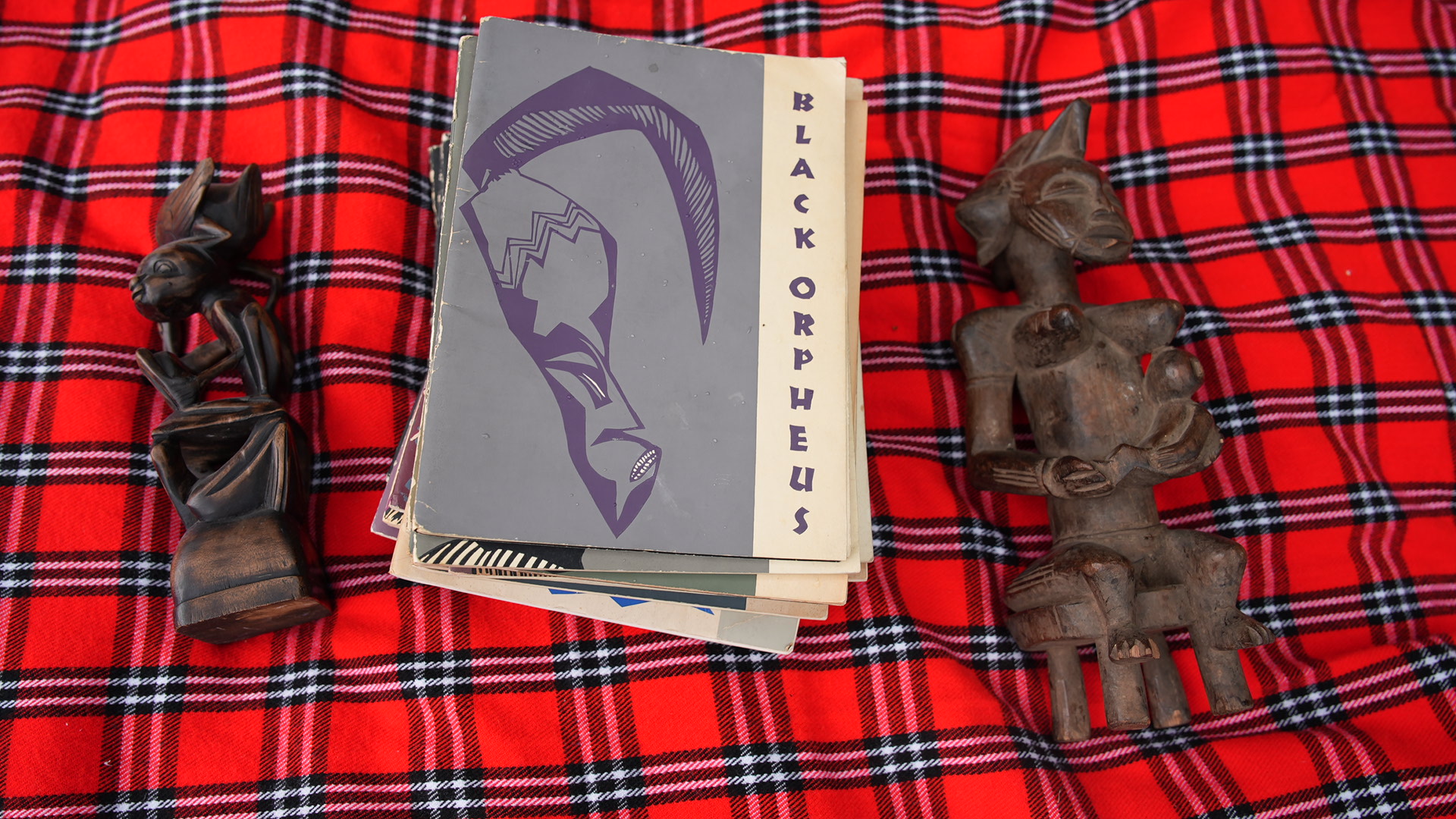
Black Orpheus Dispatch: On Re-Using History
On re-usiting history 68-sh, 50-sh years later
I
The moment you use something, you initiate its death.
II
The most significant threat to historical work is not its inevitable decay (which is often how it appears in academic and public discourse), but the fact that said interventions become dated and fall out of use. In fact, it is in the very nature of historical labour that the objects it brings to life will once again be exposed to time and to competing priorities. However, the bigger problem is disinheritance: what happens when the labour of historical recovery fails to get passed on because no one is present or primed to receive it? This is a deeper crisis that speaks to how we conceive institutional memory and the relationship between knowledge and care. For a project to continue to have life beyond its initial moment, it requires return. Someone must circle back and take the work in hand to interpret its relevance afresh. Without this recursive engagement, the work becomes a sealed document because it is no longer part of an active conversation. Hence, absence.
Several factors account for this absence, and they cannot be attributed solely to indifference. Some are structural in nature. Take, for example, the ‘publish or perish’ culture which has created strong disincentives for young scholars to pursue archival or revisitation-based work. Extended engagement with existing materials—or unresolved questions—is frequently perceived as intellectually conservative or lacking in productivity. Early-career researchers, in particular, are incentivised to differentiate their work and to foreground innovation. The continuation of incomplete scholarly projects is seldom recognised as an accomplishment in itself; instead, academic culture often presumes that significance lies in disruption or the introduction of ostensibly original perspectives, even when such ‘newness’ amounts only to minor reformulations of prior arguments. As a result, substantial bodies of historical scholarship remain underexplored or unfinished, in part because the institutional structures governing research tend to devalue sustained engagement with antecedent work. The importance of continuity is thus systematically minimised, interrupting the extended intellectual discourse that meaningful historical inquiry requires.
What complicates this even further is that historical work, by its nature, is not self-renewing. It does not possess the mechanisms that biological systems do, where growth and decay are internally managed through cyclical reproduction. Historical scholarship is entirely dependent on human interest and collective will. A book does not reproduce itself. An archive does not interpret itself. Without the deliberate work done, crucially, by people, the past becomes mute.
III
For the past six months, I have been immersed in the task of recovering and presenting the history of Black Orpheus. It has been an intensive project requiring travel, archival research, interviews, long hours of reading and rereading documents. Now, that work is coming to completion. In a matter of weeks, everything would have been made publicly available. With that release will come, I expect, some shift in the discourse. People will say—and some already have—that the story of Black Orpheus has now been ‘documented,’ and that its place in literary history has been ‘restored.’ This, of course, is not wholly untrue. Something has been recovered, something has been made that much more visible, but it is not—and cannot be—complete. I am saying this not out of some sense of false humility, but because I am acutely aware of the limits of what I have done.
To be thought of as an ‘expert’ is, I confess, an uncomfortable position, because the notion of expertise suggests a kind of finality, and a certain comprehensive possession of the subject, that I neither claim nor desire. Six months of focused research, however intense, cannot substitute the multigenerational work that Black Orpheus requires. I have not read every issue cover to cover. I have not interviewed every living contributor (and, even living contributors are not immune to the failings of memory and lapses in the archive). I have not reconstructed the entire network of editors, funders, readers, and cultural actors who were part of the story. I have not mapped the full arc of the journal’s reception. And even if I had done all this, the question would remain: by what authority could I claim to have exhausted everything? To accept the label of ‘expert’ would risk turning a living piece of history into a closed narrative that cannot be reinterpreted. That is not what I want. I do not want Black Orpheus to become a ‘solved problem.’ I want it to continue raising questions, not only about who wrote what and when, but about what it meant to write at that time, in that place, under those conditions. I want others—-especially young scholars, artists, and cultural workers like myself—to take up the work, not in repetition of what I may have done, but in expansion. My work is, at best, a foundation.
Here is the thing. When something long-forgotten or half-remembered is recovered in a concentrated form (either through a fellowship like this, a publication, documentary, or public exhibit), it acquires a sense of completion by default. It becomes ‘the’ account, not because it was exhaustive, but because it arrived in a vacuum. And this is often how intellectual inheritance is lost. I have seen this happen before. A figure is profiled, an archive is digitised, and then the conversation stops. People cite the new work but do not interrogate it. Institutions circulate it but do not teach beyond it. The public registers it as knowledge secured, and moves on. This, to me, is a far more dangerous kind of forgetting than the absence of documentation. When something is undocumented, there is always the impetus to search, but when it is half-documented and framed as complete, the conditions for further inquiry are quietly foreclosed. This is what I fear for Black Orpheus: that this brief recovery, however well-intentioned, will be mistaken for closure, and that someone will say, “The history is there,” and use that as a reason to not look again. I do not want to be the cause of that forgetting, so I am saying here, as clearly as I can: this work is not the end. It is an effort to open the conversation. Yes, I have gathered interviews. Yes, I have published essays. Yes, I have offered a structure through which the magazine might be re-read. But I have also made choices about who to foreground, what to emphasise, and which voices to privilege. These are not neutral decisions. They reflect my positioning, my limits, and my interests. They are historically informed, yes, but they are not historically exhaustive. There is more to be done. Much more.
That ‘more’ will not be by doing exactly what I have done. It may involve reading Black Orpheus, but not necessarily through critical theories. It may require comparative studies with other journals, or oral histories from readers whose engagement with the magazine was informal or undocumented. It may involve attention to material culture: the paper quality, the layout, the circulation paths. It may look beyond the journal itself to the institutions it’s associated with such as the Mbari Club, the Goethe-Institut, the University of Ibadan, the University of Lagos, the old Ministry of Information, and so on. The field is vast, so much so, my intervention barely scratches the surface. If this research output is to have any value beyond its moment of publication, it must be taken up by others. I do not wish for my research to become the reason someone else feels they cannot begin. If anything, I hope it becomes a springboard, the reason someone must begin—because they see what was possible in six months, and they imagine what could be possible in six years.
IV
What follows from all of this—logically, not sentimentally—is that the value of any historical intervention must be measured by its capacity to remain open, not by its ‘completeness.’ The idea that a historical narrative might be ‘definitive’ rests on the mistaken premise that history is a body of information waiting to be discovered and archived once and for all. But in fact, history is structured more like a series of problematics. The moment a historical account is treated as closed, either because of its comprehensiveness, its author’s authority, or its institutional backing, the discourse around it begins to contract. Future engagement is discouraged by the suggestion that there is nothing more to say. In the case of Black Orpheus, this would be a category error. Any history of the journal must remain provisional and contingent on future discoveries. To mistake a temporary synthesis such as mine for finality is both intellectual laziness and historical incoherence. The most productive historical work is not the one that claims to have covered the most ground, but that which renders further inquiry both necessary and possible. This is not a lowering of standards. On the contrary, it is a demand for a higher level of methodological self-awareness that requires the researcher to be explicit about what their account does and does not do. When these limits are acknowledged rather than obscured, the work becomes a point of departure rather than closure.
The stakes of this model are particularly high in contexts marked by archival disruption where physical archives are endangered, and many histories are already difficult to access. In such contexts, historical effort cannot afford to be a terminal point. The conditions demand a collective logic of return, in which no single account is allowed to stand for the whole, and no intervention is permitted to close the conversation. Without this ethos of return, we risk producing beautiful fragments that gain applause and then disappear; and once these fragments decay, their reactivation becomes more resource-intensive. This, again, is why the distinction between ‘decay’ and ‘abandonment’ is central. Decay is natural, but abandonment is a structural choice that is made or unmade by what we build around the historical work in terms of intellectual culture. Expertise is useful, but what matters more is the steady accumulation of attention and the willingness of new readers and researchers to re-enter a set of available materials. The life of Black Orpheus and of any historical object depends on this model of circulation.
V
If we accept, as we must, that all historical work decays, then the only question worth asking is: what kind of decay are we willing to allow? Will we permit histories to vanish through neglect, under new trends and institutional amnesia? To expect history to remain accessible and immediate without effort is diabolical. History by its very form is temporal; however, ‘temporal’ is not a synonym for ‘failure.’ ‘Failure’ is to allow one act of recovery to stand in place of all future engagements. Continuity does not come from permanence but from responsiveness. We owe the histories we study a repeated, intentional re-entry. It is an ecological function, distributed across generations. Each person, in whatever capacity they stand (researcher, reader, teacher. etc.), contributes a piece of the cycle: recovery, articulation, fading, and return. The goal is to produce accounts that leave enough behind for the next person to begin again. That is the condition under which history becomes sustainable. The point is not to write history that lasts forever in its original form. That is never going to happen. Things, even the best of them, evolve. The goal is to leave behind just enough for someone else to pick it up again later. If someone finds my work, shrugs, and says, “Hmm, not bad, but I think I will do it differently,” that is a win. That is the point.
I hope that someone is you.
VI
If that’s you, I see you.
___
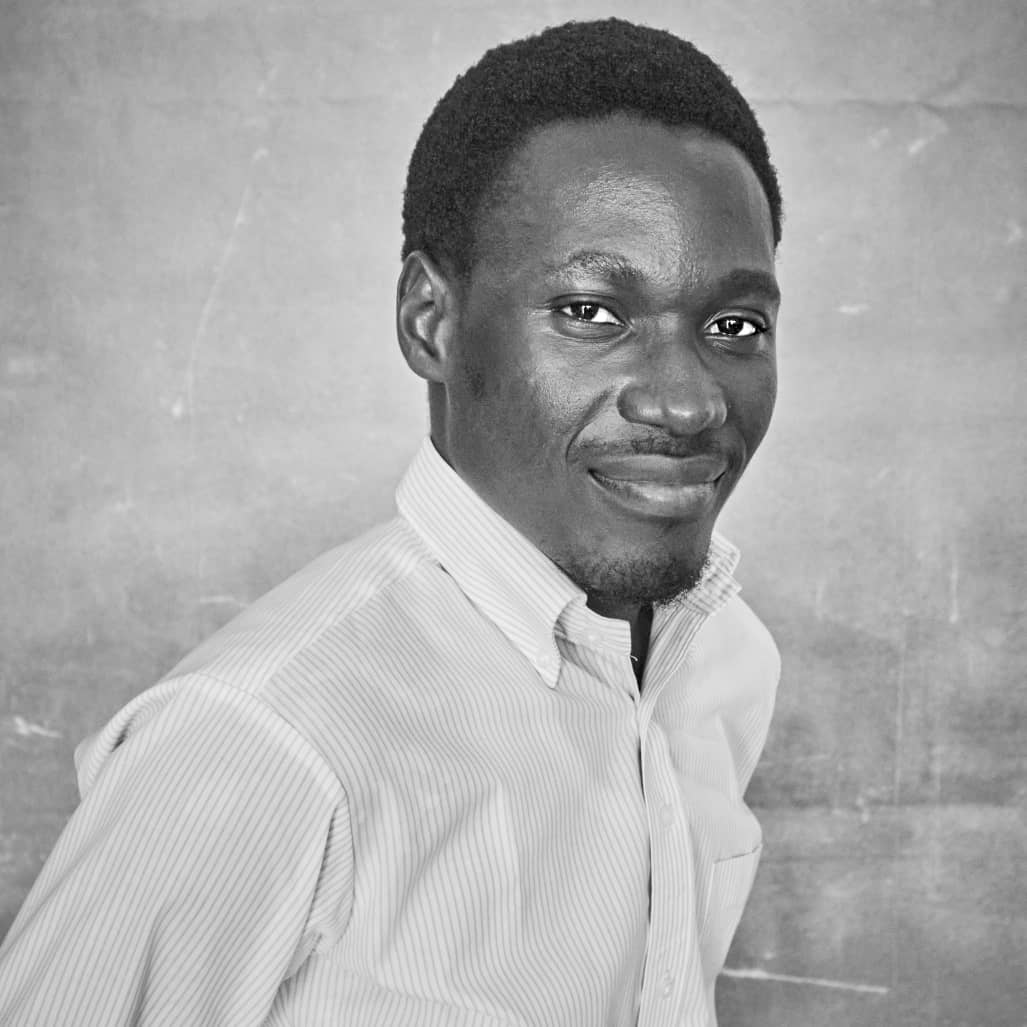
Kasim is the Managing Editor of Mud Season Review and lives in Jos Plateau, Nigeria. He is a fellow in our Black Orpheus Exploration Project, chosen in collaboration with Archivi.ng. This is the final of his monthly dispatches; you can find the earlier ones here (February), here (March), here (April), here (May), and June. The names of other selected fellows from our application were announced in February. You can read more about the project here.