
A Poet and His Nation in Flight
A poet and his nation in flight. First, the poet’s country, Uganda – an ill-fated Icarus – flew with delirium, overreached itself mid-flight, and plunged into the abyss of postcolonial chaos. The other, the poet – a reclaimed Icarus–is pulled into exile by the instinct for survival and escape from state victimhood. This is the liminal world that Nick Makoha creates with lavish inventiveness in his fantastic new collection, The New Carthaginians (Penguin Books, 2025).
Set against the backdrop of Operation Thunderbolt hostage rescue operation in Uganda – when, in 1976, an Air France flight from Tel Aviv to Paris was hijacked after a stopover in Athens and diverted to Entebbe Airport in Uganda by terrorists. Hungry for global renown, Idi Amin, who was at the height of his dictatorship at the time, was welcoming of the terrorists. He supported and helped them to frustrate diplomatic moves to free the hostages unharmed and without collateral. Although no formal sanctions were imposed on Uganda by the UN Security Council, the daring rescue dealt a severe blow to Idi Amin’s regime leading to further international isolation. Being a man with a fragile ego, it was expected that he’d turn his frustration on poor Ugandans, and he didn’t disappoint. It was under this political context that the persona in The New Carthaginians, with his family, fled Uganda.
The entire collection is a flight. Sometimes, it is the Greek mythologies of Icarus and Pegasus flying over our faces. At other times, it is a folk hero like Ulysses, Julius Caesar, Davinci, or Plato. At all times, it is the poet’s reinterpretation of his personal observations, of the world’s current existence as a circus in which nothing is new; in which we are relivers of old ways, of old events and histories. Poetry is the accompanying song that bears witness to a relived experience; thus, Makoha reinforces, with this collection, that nothing is new under the sun. He achieves this by discarding emotional sentiments and stepping away from the familiar worlds from where he writes. “Sometimes to understand this world one must step away from it” (iii), he says.
Shannon Clinton-Copeland, in an earlier review, points out that there are three main characters in the collection: The Poet; A “Black-winged Icarus”; and Basquiat. But then, there is a fourth character, in fact, worthy of being the very first one: Idi Amin’s Uganda. Because to understand the liminalities explored in the collection, one must be acquainted with Uganda’s long history of military dictatorship and how it affected the common people. Uganda is a character of its own making and plays an important role in creating the exilic backdrop of Makoha’s life and worldview. “At the moment of release, his back wishes he was a feathered thing/ That’s what I almost became” (26). Here is a hungering for flight, for escape, a recurrent feeling that runs through the collection. The ghost of Basquiat is the muse because “Something in his rapid pace already seems like flight” (iii). So, when the poem persona reimagines himself as a black-winged Icarus, the possibility of freedom yields to itself. The persona in the collection is afflicted with asthma and breathing is his lungs taking flight as he searches for calm in the skies: “What a cruel fate for a son of paradise to be caught in its heat but unable to breathe” (15). Equally, the poet himself is a postcolonial entity (a “Kampala kid,” he calls himself) afflicted by the worst kind of misrule in his native Uganda, and exile, escape, is his sanity taking flight to find solace in another land. This is where we pretend that the poet and the persona are two separate beings. But Makoha admits to being the protagonist of this unfolding odyssey when he writes: “Does every box have to be ticked for you to believe that I am the protagonist?” Amid all the wars, the heavy politicking, the regional conflicts for resources control, the protagonist is the survivor. It is the man, woman, or child who flees the country to a safer space that is the winner because it is the living who tell tales, and the survivors who can document history.
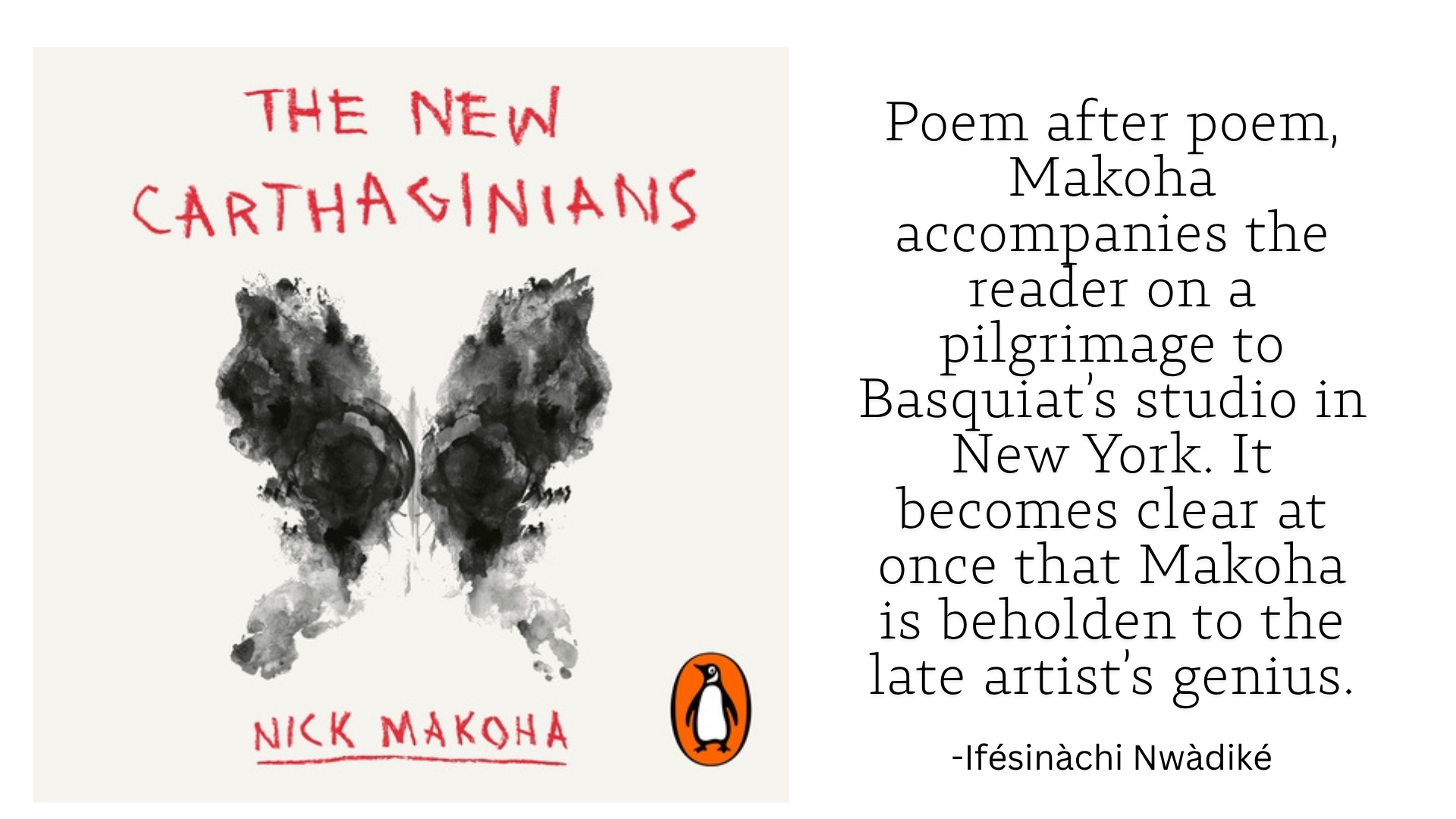
Poem after poem, Makoha accompanies the reader on a pilgrimage to Basquiat’s studio in New York. It becomes clear at once that Makoha is beholden to the late artist’s genius. Hence, Shannon Clinton-Copeland is right to have likened The New Carthaginians to a pastiche of Basquiat’s art. In form and style, Nick Makoha incorporates Basquiat’s concept of ‘exploded collage’ as a poetic device which “allows for multiple codices of information and insight to be displayed all at once, free of social hierarchies” (87). Makoha uses it to achieve a justifiable outcome. In the paratext, for instance, Makoha discards hierarchy and begins the book with a prologue after which comes the book’s title page, the publication data, and the table of contents. There is no attempt at rhyming, and the metres follow no specific pattern, rather they are determined by the author’s mood and choice of diction–a free verse consistent with Basquiat’s view of art as an unrestricted enterprise.
Exploded collage helps Makoha to invent a different kind of footnote in which the footnote is also poetry. Possibly the best invention in the collection. In most poetry books, footnotes on every page are there to explain less-known intertextualities, personal idiosyncrasies, and cultural particularities. Only that here, Makoha deploys footnotes, not to explain any of the aforementioned but as a continuation of the poem in question, an extension of the main narrative. There are also poems like ‘Basquiat talks to the poet about Light’ (58) where the title comes after the poem; a proper denunciation of artistic standards for which Basquiat was known. There are two different poems eponymous to the collection, and Makoha makes no attempt to explain them away, all of which are invitations to the reader to join the poet to rethink creativity.
The exploded collage as a poetic device reaches its apogee in the language. Makoha did not just model his works after Basquiat’s. He did with words what Basquiat did with painting. Where Basquiat is lavish with neo-expressionism, energetic brushwork and bold colours, Makoha responds with mesmeric metaphors and audacious contemporary lightheartedness through expressions like “he is a prick” (9), “fuck it” (26), “rolls himself a smoke” (29), “motherfucker” (54) etc. Where Basquiat privileges a dense layering of cryptic texts, symbols, and expressive figures, Makoha supplies a vastness of intertextualities, allusions, and reinterpretations that point to his profound brilliance. Historical figures in politics, art, literature, film, sports, and pop culture come alive in Makoha’s delightful collection in which he says he came to “connect history to art the way moonlight connects the sky to the sea” (24). The New Carthaginians qualifies as an ekphrastic poetry, not just because it re-echoes the pop-cultural verve of Basquiat’s works but because it reimagines specific Basquiat’s paintings to convey new meanings. For instance, Icarus Esso, one of Basquiat’s prominent paintings is reinterpreted in the collection as “an equation of the New Theory of Flight” (81). This new Icarus is “Black-winged” and Makoha imagines “he has a microchip for a mouth” (28) with which he bemoans the trauma of exile – “a way of saying… the distance kills me” (17).
The height of Makoha’s linguistic and lyrical ingenuity is achieved in the Codex© series. It’d sound cliché to say he reserved the best for the last, but that was nearly what he did, except that there is also the Eroica series, which came immediately after Codex©. The beauty of the Codex© series issues largely from their brevity. Makoha is not extravagant with words, quite alright, but no word in any of the poems in Codex© was used in vain. Makoha’s intellectual range in The New Carthaginians strikes me as deeply perspicacious. Indeed, “A painter can use a myth to reinvent what happened before” (55), he says, but little did we know that a poet can reimagine paintings by situating them within the context of his country’s exuberant flight to doom. Through the paintings of Basquiat, Makoha allows us to see a plane as a “getaway car” (66) because “…when the earth does not want you, then to the air you go” (39). It lets us see the misfortune of leaving “hot summers” and embracing “a forced migration” (79). In the same breath, it is arguably the first book-length poetry collection that both projects and pays homage to the genius of Jean-Michel Basquiat.
Ifésinàchi Nwàdiké, poet and playwright, is the author of two poetry collections including How We Became Heroes (Noirledge 2025). His debut poetry collection, How Morning Remembers the Night, was Longlisted for the Pan African Writers Association Poetry Prize in 2022. Some of his poems, essays and reviews have appeared in Maroko, Olongo Africa, Nokoko, Kalahari, Brittle Paper, Ake Review, Ngiga Review, and elsewhere. He was an Inaugural Fellow of the Black Orpheus Exploration Residency in 2025.