
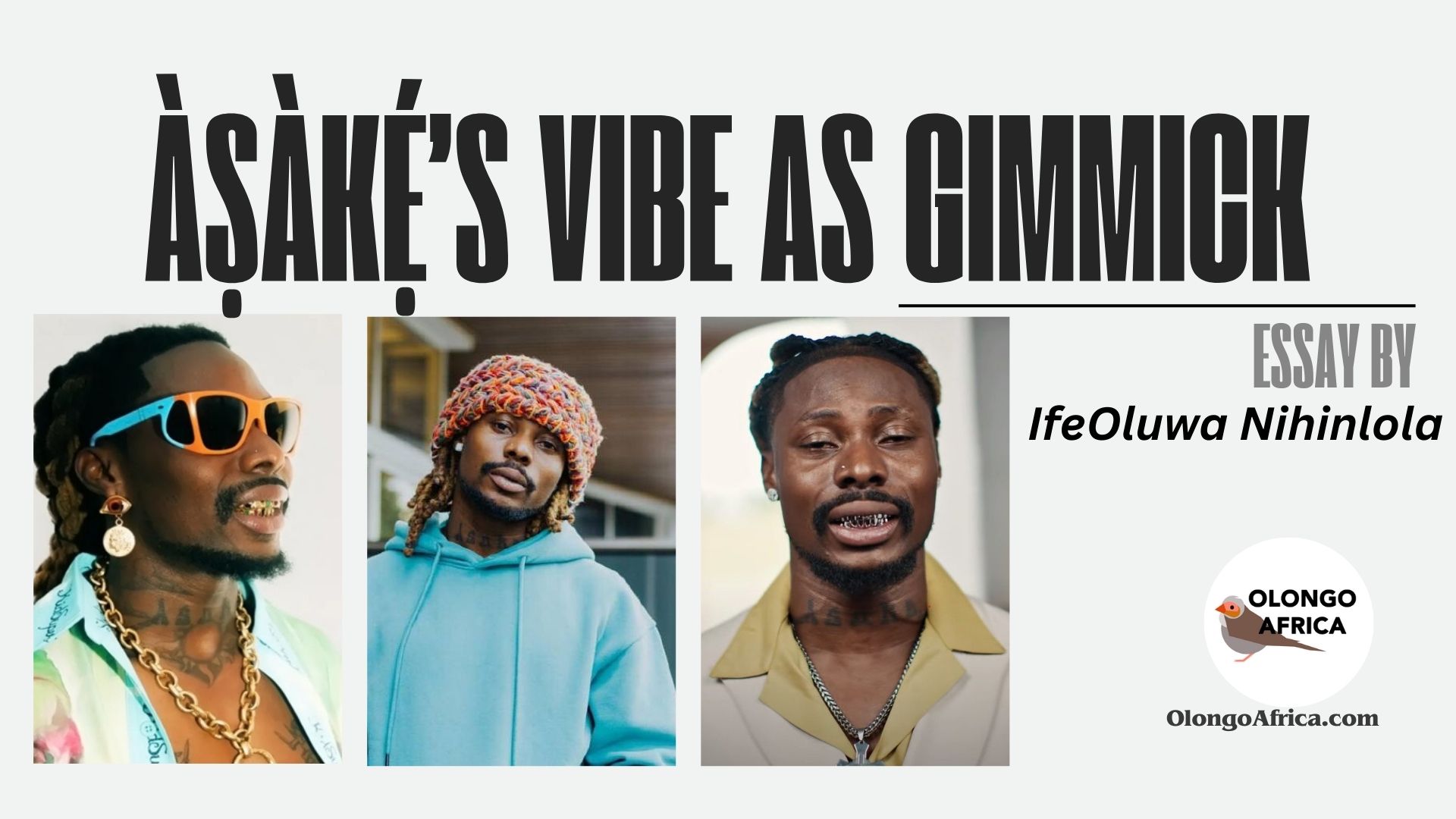
Àṣàkẹ́’s Vibe as Gimmick
It is a common refrain to say Nigerian popular music doesn’t reflect the social issues of contemporary Nigeria, and yet frame its global rise as an emblem of Nigerian triumph and dysfunction. This disconnect between our claims that the music lacks sociopolitical substance and its overwhelming cultural influence leads to a state of critical coma, where, rather than the music, we focus on the personal lives of artists (see responses to the Naira Marley phenomenon, or the general valorization of cybercrime concurrent with the age of Afrobeats-to-the-world). Critics and audiences alike seem eager to enjoy the music without considering the noxious nature of the words that constitute its content, to believe Nigerian music devoid of sense-making but the lives of Nigerian artists saturated with meaning. The form of the music has seemingly been sundered from the story of the music-maker’s life, even when lyrics are insistently autobiographical. But form is never separate from content; the style we see in Nigerian music today is already a statement about its substance, a reflection of how we are living. Working artists, even in a supposedly substance-less genre (to echo Burna boy’s misinformed position), are saying something about the world and the constraints under which they fashion their art. My intent in this essay is to use the style of Nigerian pop star Àṣàkẹ́ (Ahmed Ololade) to interrogate what Nigerian popular music can tell us about art and life in the age of algorithms. This process may feel reductive or even offensive, as if we are flaying a frog alive to figure out how it jumps, but is justified by the possibility that we may come away with a new perspective on Nigerian music: one that neither glorifies its ascent in the global marketplace nor derides its textual content as vulgar or mediocre.
1.
The success of Mr. Money with the Vibe, Àṣàkẹ́’s debut album released in September 2022, with his then-label YBNL Nation, felt preordained. It was the culmination of a year-long rise to the top of Nigerian music charts and minds that began with the February 2022 release of his EP, Ololade Àṣàkẹ́, and a string of daisy-chained singles that took turns holding the Nigerian zeitgeist in a vice-grip. In The NATIVE, Uzoma Ihejirika compares Àṣàkẹ́’s annus mirabils in 2022 to “2Face Idibia in ‘04, Asa back in ‘07, Wizkid in 2010 and 2011 and Mr Eazi in 2016,” fixing the grill-toothed star in a firmament of Nigerian wonders. That Mr. Money with the Vibe became Billboard’s highest charting debut album by a Nigerian and the fourth highest ever by any Nigerian at the time was a case of numbers affirming felt reality.
Following that coronation, the critical reception of Work of Art, Àṣàkẹ́’s second full-length album, released eight months after the debut, was mixed. Some critics, such as Joshua Minsoo Kim in Pitchfork, saw Àṣàkẹ́’s repeated use of his signature sound—the blend of Fuji, Amapiano, and choral chants debuted in Mr. Money with the Vibe—as product of the innovative instincts that led to the success of his debut and subsequent global stardom, while other critics declared its sameness a crude attempt to capitalize on the popularity of his first album. “Work of Art is a project that was supposed to hoist Asake to even higher heights propped up by this Fuji-fused Amapiano sound that he developed and popularised,” writes Yinka Olowofoyeku in Afrocritik. “Yet for some reason, as this project drags on, those melodies begin to be re-used, cadences are recycled, and the same tricks are relied on a few times too many.” Reviews of Lungu Boy, Àṣàkẹ́’s third album, released in August 2024, less than two years after the first, were decidedly negative. In his newsletter London Listening Sessions, Dami Ajayi writes: “For the Asake stans, the diagnosis is easy to clinch: this music is facing out; Asake’s superpower is his interiority. Also, the subject matter, the miraculous meteoric rise to the top, is no longer novel or pursued in novel ways. There are no smooth detours. No elegant turns of phrase; Asake’s penmanship is easily at its weakest…. It gets worse. Lungu Boy hardly rewards further replays. The record’s gems– ‘Active’ and ‘Fuji Vibe’–are few and far between. On the more introspective records, the songwriting is hackneyed.” Àsàkẹ́ was at the top of Nigerian pop culture, lonely by his admission, wealthy as he had foresaw, and, as far as we can tell, creatively spent.
2.
The evolution of Nigerian sounds necessarily carries a story about their form and content. In Arrest the Music!: Fela and His Rebel Art and Politics, scholar Tejumola Olaniyan situates Fela Kuti’s music in its cultural, artistic, and historical context, and by doing so offers a model for thinking through contradictions inherent in the interplay between the form and content of Nigerian music, which we will follow to think about Àsàkẹ́’s repetitive style. Olaniyan writes: “At the level of sound, there could hardly be a better convergence of form and content than Fela’s hard, gruff voice that gave distinctive articulation to both the profundities and inanities of Lagos life as the poor—who were considered loud and uncouth—experienced it.” Olaniyan’s refusal to separate form from content allows him to analyze how the conditions under which Fela produced his work influenced its nature and composition—which in turn gives us a claim we can interrogate, to agree with or to refute. That we can pay attention to Fela’s music and glimpse something of his life is the beauty of art—even as we understand our conclusions cannot be definitive, or that someone somewhere has made choices to shape the art in ways that are obscure to us. There is value in teasing out the connections between the form of contemporary Nigerian popular music and its meaning. We may never fully reveal the hidden digital and financial forces that determine the texture of our cultural lives, but by critically attending to what artists have made through and despite these forces, we gain a better understanding of our present state.
3.
The formal elements of Àṣàkẹ́’s style, which for much of this essay we will equate to his vibe, are already fully formed in the four songs of his eponymous EP, Ololade Àṣàkẹ́. The first, “Trabaye,” takes the choral chants of alujo (well-established in Nigerian gospel juju, especially the music of Ayefele) and energizes them with fuji’s frenetic rhythms and literary style of layering slangs and enthusiastic non-sequiturs, until they sediment into the sensibility we have come to label as “street.” Gospel artists were early adopters of this blend of hip-hop, fuji, and alujo, with Rooftop MC’s “Lagimo” and Midnight Crew’s “This Fuji Thing” standing as proofs of concept that success lies in melding the street and the sacred. In the second and third tracks, “Sungba” and “Omo Ope,” featuring rapper Olamide, he introduces the shaker and log drums of amapiano, a percussive leitmotif that will become the signature intro to most of his songs.
In his debut album, Mr. Money With the Vibe, these formal elements combine with a near-perfect absorption of the preceding three decades of Nigerian popular music, sometimes in lyrical citations and other times explicit stylistic references. Take “Peace Be Unto You (PBUY),” one of the amapiano tracks that make up half the album. In the chorus, Àṣàkẹ́ sings:
As-salam, Alaykum
I get many, many, disciple
Mo taka, òshì dànù
Olúwa shower me your blessings times two (O dẹ̀ jọ̀wọ́ jọ̀wọ́)
O dẹ̀ jọ̀wọ́ jọ̀wọ́ ko dáhùn (ko dáhùn)
In every situation make I no lose (Make I no lose)
Èmi ò shakọmọ́, Ọlọ́run
Jé káwọn pádí mi má bìsà, thank you.
The chorus contains prayers typical of fuji: a rejection of poverty, pleas for blessings, desire to make it alongside his friends. But sandwiched in that mix is the line “Èmi ò shakọmọ́, Ọlọ́run” a lyrical syncopation that references “Shako Mo,” a 1999 song by the group The Remedies, a call back to the early days of the dominant form of Nigerian popular music in the twenty-first century. “Shako Mo” rips off American rapper MC Lyte’s “Keep on Keeping on,” released in 1996, in line with the then prevalent practice among Nigerian pop acts to make Nigerian versions of hip hop tracks. By the time Àṣàkẹ́ arrived on the musical scene, Nigerian artists no longer raided American music charts with impunity, yet something of that tendency towards pastiche remains. Rather than snatching other people’s songs to make his own, Àṣàkẹ́ scatters references across his debut album to produce a postmodern jukebox of Nigerian popular music.
Since the time of The Remedies, Nigerian popular music has undergone many transformations. An abridged version of that history is that, following the era of looking to the United States for models, artists like 9ice made an abrupt turn to Yoruba music, especially Fuji for lyrics and sonic form, a template that rappers like Olamide (head of Àṣàkẹ́’s former record label, YBNL Nation) would eventually perfect in their embrace of the appellation “Local Rappers.” The mid-2010s saw another foray outside the country’s borders, first to Ghana, via the adoption of the slower beats per minute (bpm) of Ghanaian hip life, through the work of the producer Juls and artist Mr. Eazi, and later through the wholesale adoption of that catchy form of South African house music, amapiano. The lower bpms of Ghanaian hiplife became a valuable factor in the proliferation of the music we now call Afrobeats: On one hand, the slower music was more danceable, but it also produced “chill vibes.”
4.
The novelist Elif Batuman, writing about musician Ezra Koenig’s blog titled Internet Vibes, describes vibe as “something like ‘local colour,’ with a historical dimension.” She continues: “What gives a vibe ‘authenticity’ is its ability to evoke – using a small number of disparate elements – a certain time, place and milieu; a certain nexus of historic, geographic and cultural forces.” Àṣàkẹ́’s ability to incorporate elements of Nigerian popular music, which already existed in various states of fusion, into a sound that feels both new and deeply familiar is at the core of his vibe—an undeniable historical marker of inventiveness in an era of music-making where following trends remains key to success. Now more than ever, artists depend on finding their audiences through platforms that privilege familiarity over invention.
Sound scholar Robin James sutures the structure of vibes to the state of music platforms by “studying the ways music streaming services Spotify and Apple music use vibes as a category for organizing music. These services push ‘vibes’ over genre in order to get us to hear music the way their algorithms do.” In James’s account, vibes are not just a unit of authenticity but a driver of consumption patterns on digital media platforms. It is not preposterous to say we consume music as vibes because platforms recognize our desire for familiarity and have encoded this into algorithms that feed us more of the same in an unending loop that makes our music consumption (and creation) deterministic. Curator Melanie Buhler similarly connects the category of the vibe to the advent of algorithmically-driven social media. She writes: “The current cultural moment of the vibe is also inextricably linked to Instagram and, above all, TikTok. Vibe is often used in these contexts with reference to images or videos that capture very particular moods through the aggregation of other images. By qualifying something with a vibe, you tap into a specific aggregate and add to it. It’s a type of storytelling that emerges through images and conjures specific, and extending, emotive horizons.” Vibe, therefore, is a way of communicating specific cultural markers, but also a tool for mediating the production and consumption of media.
While the association of vibes with platform capitalism evokes negative affects in this historical moment, it is worth clarifying that vibes are, as an aesthetic descriptor, effectively positive. As Bühler clarifies: “Vibes are primarily positive: they arise as particular moments of connection when experiences emerge as specific sensuous moments. A vibe functions as a connective tissue; it creates a specific feeling, mood, or sensation. If the term vibe is to be used negatively, it needs to be qualified as such. ‘Bad vibes’ indicate disruption; if the vibes are off, the sync is gone.” It is this tendency towards positive feelings that allows vibes to become the driver of consumption, even when it occurs on platforms we intellectually know to be exploitative, or via art whose content we are inclined to reject cognitively. Don’t we all have that questionable friend we continue to invite because they bring such good vibes?
For Àṣàkẹ́, vibes predate his transformation into a global superstar. As the song “Fuji Vibe” from his third album reminds us, before Àṣàkẹ́ was a chart-topper on Spotify, he was an artist on a stage at Obafemi Awolowo University, performing energetically to a familiar audience. “Fújì vibration,” a variation of a coinage in Fuji discourse, well predates Àṣàkẹ́’s entrance into the music industry. Despite this historical precedence, the triumph of Àṣàkẹ́’s vibe allows us to understand his musical style in a historical moment when, according to journalist Liz Pelly in her book Mood Machine: The Rise of Spotify and the cost of the Perfect Playlist, vibes have become synonymous with algorithmically curated platforms that transform art to mere content.
Pelly’s indictment of Spotify, in particular, is profound. Through well-sourced reports, she shows that the Swedish company is not only invested in shaping our musical tastes, but in transforming “music culture” into “platform culture: norms and practices emerging because of specific platform demands rather than because of shared musical affinities or social connections between artists.” The goal of the platform isn’t to direct us into more of what we like, but to completely transform our desires such that we only consume that which can be produced with minimum cost to the platform. In this dynamic, artists and their audiences are an inconvenience to the profit-making directive of music labels and the platforms they have aligned with. The affinity for vibes is, therefore, not just a tendency to be exploited, but an exploit that can deliver a future where humans and their pesky demands for compensation and quality can be eliminated from the platform’s value chain.
5.
It is Àṣàkẹ́ and his collaborator Magicsticks’ repetitive use of his vibe that transforms it from mere style into gimmick. In Mr. Money With the Vibe, the persistence of the shaker and log drum creates an album with the coherence of a DJ set list, each song timed to dovetail into the next. If you isolate and play on loop the first eight bars of six songs on the album—“Terminator,” “Peace Be Unto You (PBUY),” “Dupe,” “Joha,” “Sunmomi,” “Sungba (feat. Burna Boy) Remix”—you get a fine amapiano track that could power a dance party. In Work of Art, the number of tracks with which you can perform the same experiment increases to seven: “Awodi,” “2:30,” “Basquiat,” “Amapiano,” “What’s Up My G,” “I Believe,” “Remember.” Work of Art, however, does not share the seamless transitions of Mr. Money With the Vibe.
In Theory of the Gimmick: Judgement and Capitalist Form, cultural theorist Sianne Ngai describes the gimmick this way:
Always dubious if never entirely unappealing, the gimmick wears multiple faces. It can be a catchy hook, a time-worn joke, a labor-saving contraption…. Gimmicks are fundamentally one thing across these instances: overrated devices that strike us as working too little (labor-saving tricks) but also as working too hard (strained efforts to get our attention). In each case we refer to the aesthetically suspicious object as a “contrivance,” an ambiguous term equally applicable to ideas, techniques, and things.
Gimmick is, therefore, how we may describe Àṣàkẹ́’s choice to turn the repetitions of his fusion into a shortcut, inducing a vibe with minimal effort—that is, into a labor-saving device. However, more than just a descriptor for his style, gimmick also captures our judgment of Àṣàkẹ́’s choice. Judgment here is not only the critical response we arrive at when we think about the music, but our spontaneous reaction to the feeling that, by the second and third albums, Àṣàkẹ́ is not merely producing his vibe but overusing it. We know Àṣàkẹ́ is working hard to keep us as an audience, and suspect this is why he is working too little to build upon his bespoke style, relying instead on repeating that which has already captured our attention. We may not always have the language to articulate that feeling, but we feel it nonetheless.
6.
In many ways, the history of Nigerian popular music from the late twentieth century onwards is a tale of cascading gimmicks: first the rip-off of American sounds, then the viral dances, then the blending of genres borrowed from other African cultures. When dances were the path to popularity, alanta, azonto, etighi, galala, skelewu, shaku shaku, shoki, yahooze, zanku were all devices contrived to get the attention of an audience eager to pursue the next new thing. Artists producing songs would induce those dances, and the form of the dances themselves informed the lyrics and structure of some of the songs. “Azonto” and “Skelewu,” for example, were not just moving you to dance, but also embedded instructions about how to perform the dance and become vectors of their rapid spread: “go ahead move your feet just like this;” “Oya whine your hips like this, like that.”
Some of the aforementioned dances preceded the wide adoption of the internet on the African continent, yet in their ability to induce virality through the social function of gestures that can be decoded, learned, and reproduced within various aesthetic contexts, they anticipated the rise of algorithms and prefigured their function. In other words, Nigerian artists were poised to take advantage of digital platforms and the rise of algorithmically circulated art because they were already deft in the deployment of dance as a gimmick—an attention-seeking contrivance.
We do not need to claim Àṣàkẹ́’s style has always been a gimmick—that would be false. On the contrary, his debut album was so inventive it offered the promise of a transformation of what is possible in Nigerian music. Yet, by the third album, Lungu Boy, his repetitive use of that inventive style had become gimmick par excellence. His perpetual place at the top of the chart of digital platforms in Nigeria is a confirmation that his labor-saving device is working. Àsàkẹ́’s departure from YBNL Nation meant the loss of label boss Olamide’s direction, which Ajayi suggests is probably responsible for Àsàkẹ́’s creative decline. However, Àsàkẹ́’s numerical dominance continues apace: Lungu Boy broke streaming records and has matched the digital success of the first two albums. So, while critics may be troubled by the refusal to transform his style, Àṣàkẹ́ remains vindicated in an industry where a rising number of listeners is the prime marker of success.
7.
If Àṣàkẹ́’s music is emblematic of successful art making in the age of algorithms, this means he has capably integrated his musical influences (fuji, amapiano, alujo, juju), the cultural conditions from which he proceeds (Lagos, the streets), and a secret third thing—the bias of digital platforms through which the music circulates (Spotify, Tik-tok, Instagram). If we restrict our analysis to musical influences and cultural conditions, we are bound to produce erroneous concepts like those articulated by some contemporary Nigerian critics who take the proliferation of plaintive songs of lament in the 2020s as the arrival of a new genre of Nigerian music called Afroadura. Nigerian artists express their desires as prayers (and Àṣàkẹ́ is no exception); that they now seem to do it all the time does not a new genre make. We are getting mired in the wrong questions with no path to finding the right answers.
If we consider the form and content of Nigerian popular music alongside the context of the digital platforms with which artists must now contend, then our engagement with the music can surpass the basic temptation to invent a new genre every time disparate influences are blended—or to pretend the art has nothing to do with the artist. As literary and cultural critic Akin Adeṣọkan asserts in Everything is Sampled: Digital and Print Mediations in African Arts and Letters: “Examining a song through categories such as genre (electronic/jazz) and style (acid jazz) fosters a distinct form of attention.” So does focusing on the digital platforms that mediate our consumption of these genres. If we consider musical style without factoring in the influence of algorithms, we will miss the connection between the persistence of a style like Àṣàkẹ́’s and the rise of curated playlists, which encourage same-sounding tracks that require minimal effort from the listener and discourage artistic experimentation. We will also miss the vital connections between musical collaborations and the desire to amass listeners by expanding into new markets, musical quality and fit notwithstanding.
Of utmost significance to us is the notion that Nigerians who love music are beginning to realize we have a waning impact on our favourite artists. This is not a consequence of the autonomy of artists to make what they want; in reality, it is because any artist who courts financial success understands algorithms are the key to big audiences with better purchasing power. If we ever harbored fantasies that we could object to music we do not like by withholding our attention, we now know such action has next to no impact in a time when riches lie on the other end of a computer’s math assignment. As long as the music agrees with the algorithm’s global demand for flattened, consumable products, local audiences have little chance to shape its form and content. The dwindling cultivation of spaces that host in-person performances where artists can nurture their skill in small crowds amplifies this divide between artists and their local audiences. Increasingly, the message is that digital platforms matter, people don’t. But this need not be the final word.
If we surrender to the genre-averaging inherent to digital platforms, and take fusion as its natural (and sometimes liberatory) form, then the horizons of our analysis are limited to the whims of those who control the platforms, even though their algorithms are not committed to the creative values we seek to preserve. There are other audiences we can turn to for our analysis, more ways to analyze consumption as culture-making without surrendering to the logic of powerful platforms. Afterall, alté culture, to which much of what we now recognize as Nigerian fusion owes its edgier elements, was incubated by young artists desiring music beyond the stale forms of Afrobeats. Some of the artists involved in that scene have gone mainstream while others continue to make compelling music whose artistic success may not be captured by algorithmically-determined metrics. We should turn to those small successes and find language to capture what they mean.
We can produce better analyses of Nigerian music by understanding the formal affordance of the digital structures by which it circulates, and turn that analysis into better consideration of what is worth celebrating. That kind of analysis may approach the “supplementary mode of analysis” Adeṣọkan calls for in Everything is Sampled, where we support our examination of the cultural origins of the music (Lagos, Warri, Benin, London, New York) with an understanding of how the platforms (Spotify, Tik-Tok, Instagram) shape those cultures. In the case of Àṣàkẹ́, we may proceed by the way of asking, as I hope I have done here, why he continues to blend amapiano with fuji to produce his vibe, and what our reaction to the persistent use of that blended vibe says about making music in the age of platform capitalism. We can decide on what basis we consider his music successful without surrendering to the supremacy of numbers. If we cannot stop vibing despite our suspicion that the vibe has become a gimmick, that the style soup has become stale, then that loss of control is a worthy place to begin our critical enquiries.
___
IfeOluwa is a writer from Ògbómọ̀ṣọ́, Nigeria. He is a doctoral candidate in the Art History Department at Emory University.