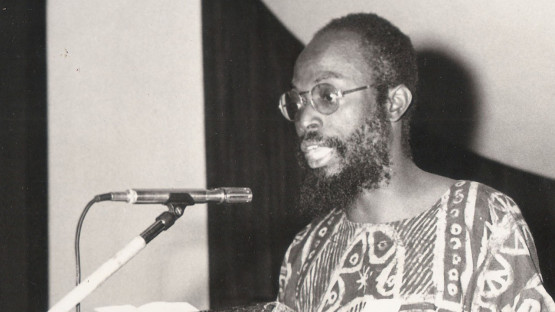
In the early rainy season of 1975, a battered Volkswagen Beetle carrying two young academics crossed the Togo-Ghana border. The car’s owner, a thirty-year-old lecturer at the University of Ìbàdàn named Biodun Jéyǐfò, had embarked on what he would later call a “special mission”—a journey from Ìbàdàn to Accra to persuade Wọlé Ṣóyínká to end his post-Civil War self-exile and return home. Jéyǐfò and his colleague Kọ́lé Ọmọ́tọ́sọ̌ were envoys of the Ìbàdàn-Ifẹ̀ group of socialist intellectuals, emissaries sent to haul a big fish for the movement. They believed Ṣóyínká’s “courage of political activism” could be harnessed to their emerging Marxist framework, that the playwright might be persuaded to integrate class analysis into his unmistakable social vision. Ṣóyínká did return shortly afterwards, but not to join their project. Within months, he and the group would be locked in a ferocious public quarrel—preserved forever in the pages of the group’s Positive Review and Ṣóyínká’s inaugural lecture at Ifẹ̀, ‘Barthes, Leftocracy and Other Mythologies’. The mission would appear like it had failed in its stated purpose. But like all true quests, its meaning lay elsewhere: in what the journey revealed about the quester, and in how the failure itself became an education.
That Beetle, crossing borders—an old protégé in search of a reluctant warrior—is as good an image as any for the career it carried. Bíọ́dún Jéyǐfò, who died in February 2026 at the age of eighty, spent his life in motion—through institutions, across ideologies, between the certainties of youth and the complicating knowledge of age. He was, at thirty-four, the founding president of the Academic Staff Union of Universities (ASUU), a Marxist polemicist in the seventies, Ṣóyínká’s most profound interpreter in maturity, a Harvard professor in later years. But beneath all these roles ran a continuous current: the effort to understand how intellectuals might serve social transformation without being consumed by it, how movements might discipline without imprisoning, how one might remain faithful to a cause without becoming blind to truth. He was, in the deepest sense, an interpreter, not merely of texts, but—petrel-like—of the turbulent passage between idea and action, commitment and clarity, the revolution that beckoned and the one that never came.
Much has been written about Jéyǐfò since his death, often by friends, colleagues and former students who knew him personally. Taken together, one gets the picture of the elephant in the parable, each testament illuminating a part of what becomes a gigantic whole. One such perspective—one, but important—is that of Jéyǐfò as a leading teacher and theorist of literature. So, it is meet to seek the illumination of literature itself for a different survey of his place in our intellectual history.
Movement as Character, Discourse as Narrative
There exists a recognisable strain of African writing that is best approached not through a single protagonist but through an ensemble of characters whose interactions form the true centre of the narrative. An early, basic archetype appears in D.O. Fágúnwà’s Ògbójú Ọdẹ nínú Igbó Irúnmọlẹ̀ (1938), where a band of hunters journeys in search of a rare panacea for the fatherland. In more complex, modernist works—say, Wole Soyinka’s The Interpreters or Akin Adéṣọ̀kàn’s Roots in the Sky—the ensemble becomes a community of minds engaged in dialogue with one another and, ultimately, with their society. That dialogue, never confined to a single ideological script, circles the quest for meaning in an ethically inchoate world and the choices the characters make in response. Their fraught relationship with the larger society’s drift distinguishes their motive from the uncomplicated patriot-ese of Fágúnwà’s questers. In their most ideological version, they may even form literal communes—Aiyétòrò in Ṣóyínká’s Season of Anomy, Miracle City in Adéṣọ̀kàn’s novel—spaces the poet Níran Òkéwọlé once called “communities of resistance.” Across the broad spectrum I described above, I prefer to call their cohorts the interpreters.
These ensembles are bound not by a single ideology but by argument itself. Their dialogue, with all its contradictions and tensions, becomes a kind of narrative in its own right—almost, in Bruno Latour’s sense, a social interaction that acquires the solidity of a thing outside the constituent actors and their bare aggregates. Over time, the trails left by these debates—Latour’s “traces”—form their own character arc. And because the interpreters almost always operate within the long run of postcolonial deformation, that arc tends toward tragedy: in frustration of unfulfillment, often through quiet attrition, occasionally in more dramatic eruptions.
It was within such an ensemble that Jéyǐfò emerged as an intellectual presence in the years following the Civil War. Military rule was consolidating and raising the stakes for the democratisation of choices. Mismanagement of oil wealth made the society the worse for the wear. Older intellectuals—many of them involved one way or another in the crises of the previous decade—were either in retreat or repose. Among younger thinkers, however, there was a sense that the crisis presented an opportunity for reordering society. Jéyǐfò stood at the arrowhead of this generation, helping to articulate an intellectual framework—often Marxist in orientation—for understanding the society’s contradictions and imagining its transformation.
What distinguished him even at this early stage was that he worked across communities of debate. His intellectual life unfolded not as a single trajectory but as a series of journeys across overlapping networks of interpretation—literary criticism, union building, and practical movement work. Even in the politics of broad-based platforms, he sought to channel the era’s contending forces toward radical transformation.
Critique as a Journey of Understanding
The poet Níyì Ọ̀ṣúndáre once mused:
Poetry is
No oracle’s kernel
For a sole philosopher’s stone
Jéyǐfò’s introduction to Ọ̀ṣúndáre’s Songs of the Market Place famously ordained ‘Poetry Is’, the poem from which these lines are drawn, as a poetic manifesto—a rejection of hermetic art in favour of poetry that walked among the people. Even then, in that same essay, he already called for moving beyond the normative parameters of commitment and engagement towards “a different order of discourse” that would attend to form and technique—a task that requires consideration of the poet’s own subjective choices. That call went well-nigh unheeded in the bare revolutionary brushes that continued to rule Ọ̀ṣúndáre critique for a very long time. It is therefore no surprise that Ọ̀ṣúndáre would later appear to give his traditional exponents grief when his verse grew more recondite, as in Waiting Laughters (1990), or when he wrote, in ‘Every Good Poem’ (2017):
Every good poem
Is a jungle of non-sense
A patent madness waiting
For its hidden method.
This was the pattern of Jéyǐfò’s intellectual life: a capacity to hold positions with conviction while remaining open to their complication. In this specific case, as his own critical practice came to embody a productive tension between intellectual curiosity and political commitment, he acknowledged that manifesto alone could not mediate the relation between poetry and politics.
In its long arc, the Ṣóyínká ‘quarrel’ came to exemplify similar intellectual honesty. Looking back in his 2004 book Wọlé Ṣóyínká: Politics, Poetics and Postcolonialism, Jéyǐfò acknowledged what had been missing from the Positive Review critiques: attention to “the subjective dimensions of artistic creativity and cultural politics.” The young Marxist who had faulted Ṣóyínká for insufficient class consciousness had become, over decades of engagement, the most profound expository scholar of Ṣóyínká’s oeuvre. This was not a renunciation of earlier convictions but a deepening of them. Society might need changing, as the Marxian maxim insists, but understanding remained the necessary beginning of change. Interpretation and transformation were not opposing tasks but stages in the same process. It was an education enacted in public—a lesson for everyone who paid attention.
Revolution as a Journey of Negotiations
If Jéyǐfò’s intellectual development unfolded through critical debates, it was equally shaped by practical engagements in the politics of academic unions and the broader society. His journeys across Nigeria in that Volkswagen Beetle mobilising for the establishment of ASUU is already the stuff of legend. As its founding president, he gave the union a distinctly radical orientation that would define its role in national debates for decades.
These efforts often ran against the dominant currents within the socialist movement itself. Some activists preferred to concentrate on building pure revolutionary platforms rather than working within broad-based organisations. Jéyǐfò’s choice to invest his energies in unionism reflected an instinct for negotiation rather than doctrinal purity—a recognition that lasting change required engagement with broader constituencies.
The atmosphere of the 1970s nonetheless inspired more ambitious experiments. Across the Third World, there was a widespread sense that revolution might be imminent. Students no longer went on strike merely to reverse a policy on feeding or fee subsidy—even where that was the originating event. They wanted to overthrow the system. In a time of military rule, it often ended in tragedy. Fẹmi Olúgbilé’s novel, Batolica! (1995) dramatised one such tragedy, using the Ifẹ̀ university campus as a setting.
As in Adéṣọ̀kàn’s Roots in the Sky in which young idealistic graduates resolved, in their choices, against “the society’s ways of ‘rising in life’,” socialist cadres made ethical and pragmatic choices in anticipation of a transformed society. Some abandoned professional careers to become organisers and peasant mobilisers. Some others sought refuge in communes that promised both ideological clarity and a measure of distance from the compromises of ordinary life. In Roots in the Sky, Adéṣọ̀kàn has the character Muṣin reflect on that dubious, victim-victimiser, identity of unconscientised citizens, when he calls them “the children of those who queue up for everything and would jump the queue if no one was watching failed to act.” The suspicion is mutual. In the same novel, Kilanko, a veteran organiser, is dismissed by impervious locals who will rather forage for leavings in the margins of the very disaster imposed upon them, than be talked into an uprising: “You stay in Lagos for seven months and come back for two days to accuse us of being docile… You have no stake in this village.”
Jéyǐfò participated in one such experiment at Ọdẹ Òmu, a village on the outskirts of Ifẹ̀ where a small group of activists attempted to build a model of agrarian socialist community in 1976-77. As Edwin Madunagu, a leading resident noted of the experiment, it was an attempt to transform “mere revolutionary intellectuals” into “proletarian revolutionaries” embedded in the peasantry. They wanted to forge “an unalienated and non-exploiting revolutionary agency,” and to “conscientise the rural population” through shared life rather than distant agitation.
The experiment lasted barely a year. Records about the cause of its early death perhaps lies in movement archives—the participants, some of Nigeria’s most prolific public intellectuals, have shown unusual reticence about what went wrong. But in his 2022 obituary to Sẹ̀ìndé Arígbẹdẹ, a doctor whose family hosted the Ọdẹ Òmu commune, Jéyǐfò reflected on what the experience had bequeathed to Nigerian literature. Nearly every major work of the following decades, he noted—Fẹ́mi Ọ̀sọ́fisan’s The Chattering and the Song, Ọmọ́tọ́ṣọ̌’s Shadows in the Horizon, Isidore Okpewho’s Tides, Bọ̀dé Ṣówándé’s Farewell to Babylon, Chinua Achebe’s Anthills of the Savannah, Ọ̀ṣúndáre’s Songs of the Marketplace, Ofeimun’s The Poet Lied, Rotimi’s If—drew on the Ode Omu example for its fictional characters and concerns: “men and women who left their middle class jobs, became full time activists, moved to rural communities, or took it upon themselves to create new patterns of personal and collective identities.”
One remains curious about the cause of the collapse of the Ọdẹ Òmu experiment since it could also provide a window on how it has shaped its participants. In later reflections, Jéyǐfò would emphasise the value of patience and negotiation over the urgency and certitude of earlier revolutionary hopes—what he once described, in his tribute Dr. Arígbẹdẹ, as the importance of “making haste slowly for human equity.”
Perhaps, that is window enough. Maybe what the Ọdẹ Òmu veterans carried away from the village was not the revolution they had sought but a different kind of knowledge: about the patience actual transformation requires, about the distance between theory and lived reality. Jéyǐfò denied the messianic impulse usually ascribed to their retreating party in its literary archetypes. Whatever might have been the case, what came out was a more chastened appreciation of the demands of movement-building. In this respect, Jéyǐfò’s early bet on broad-based organising, against the purists who insisted on only separate socialist platforms, had been vindicated not by the revolution that didn’t come but by the institutions that endured. ASUU, which he had helped found at thirty-four, outlasted every prophecy of its irrelevance.
A Win Unsung
Measured against the ambitions of a socialist revolution, the achievements of the Nigerian leftist movements of the 1970s and 1980s may appear modest. Yet once we step back from those moonshot expectations, their contributions become easier to see. At a time when public policy retreated in the face of fiscal austerity, socialist intellectuals argued consistently for investment in education and health, and global concert against illicit flow of funds—positions that have since become part of the mainstream vocabulary of international development. The transformation they envisioned did not occur in the form they expected, but the debates they shaped left enduring traces.
Jéyǐfò’s career followed a similar arc. The certainties of early ideological commitment gave way to a more capacious intellectual practice, one that retained its moral seriousness while embracing the complexities of interpretation. He remained throughout his life a participant in communities of debate, a figure defined less by solitary pronouncements than by sustained engagement with others.
Seen from this perspective, the ensemble narrative provides the most illuminating metaphor for his life’s work. The interpreters who animated Nigeria’s post-independence intellectual history were bound together by argument and aspiration, and their collective journey forms a story of its own—marked by hopes deferred, insights gained, and energies dispersed across institutions and generations. Among them, Bíọ́dún Jéyǐfò stood as one of the most restless and searching spirits. Like the petrel that rides the storm winds over open water, he moved across the turbulent currents of his time, tracing paths that only become visible in retrospect. The storms through which he travelled have not entirely passed, and the questions that animated his journeys remain unsettled. But in the traces left by those journeys—in institutions built, debates shaped, and students moulded—we may still discern the arc of a life devoted to the difficult work of interpretation.
Tóyè is currently writing a book on the potentially revitalising contributions of the poetry and the thoughts of Niyi Osundare to ecocritical theory.