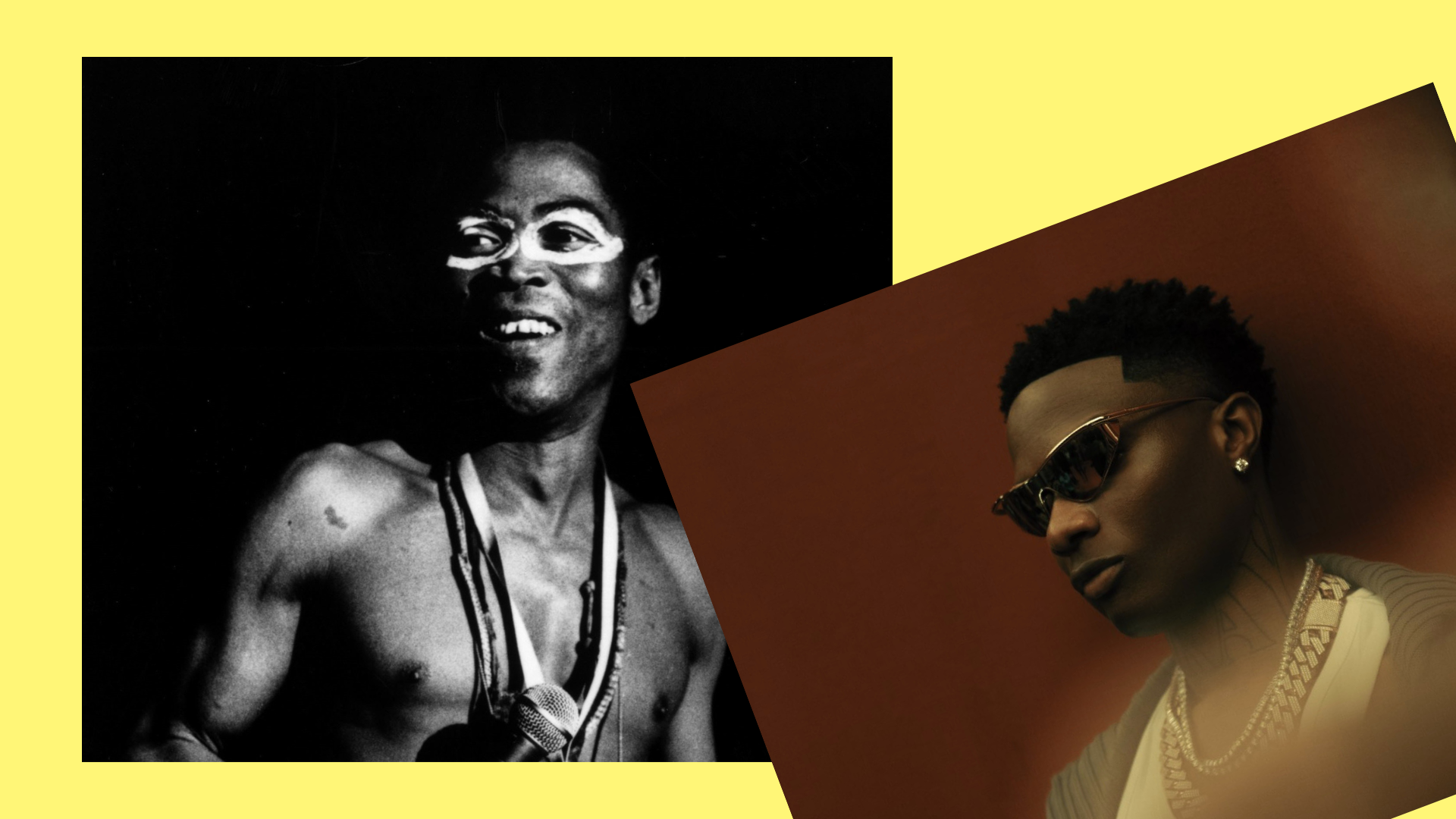
The digital media space in Nigeria is an unrelenting arena of attention-grabbing spectacle, as hardly does an issue surface before others pull you to them. Digital netizens understand this economy of attention well and try to maximize visibility through a range of tactics. The recent online exchange between Nigerian music stars Ayo Balogun (Wizkid) and Seun Kuti has definitely given content creators plenty to work with. This exchange has largely been framed as a celebrity quarrel, or as another instance of Nigerian social media excess. The intensity of the reactions it has generated, however, suggests it is about more than online drama. Once you peel away the outer layer of ego talk, what you find is a dispute over how African musical legacy should be judged today.
At the center of the dispute is Fela Anikulapo Kuti, the pioneer of Afrobeat, whose music has long served as a moral and political reference point in Nigerian and Black cultural life. His son, Seun Kuti, an accomplished Afrobeat artist in his own right, felt compelled to defend his father’s legacy out of both family loyalty and a sense of historical responsibility. It was the comparison of Wizkid to Fela that set off Seun’s reactions. To understand what is at stake, Fela’s music and legacy have to be placed in the moment that shaped them. Afrobeat grew out of direct confrontation with the Nigerian state, military rule, and imperial power. Fela’s performances, lyrics, and public persona all revolved around treating the state as a central target of critique. This is why the late cultural scholar Tejumola Olaniyan described Fela as a cultural biographer of postcolonial Nigeria. an artist whose music recorded the country’s political contradictions, violence, and aspirations as they played out.
Wizkid’s music, and more broadly that of the Afrobeats generation (remember Afrobeats is different from Fela’s Afrobeat), has developed in a very different political and economic climate from the one that shaped Fela’s sound. As one of the most globally visible Afrobeats artists, Wizkid is often seen as a symbol of contemporary African success. His career has grown in a period defined less by open political struggle with the state and more by austerity, global mobility, and the weakened ability of postcolonial governments to provide basic social goods. While Fela’s music confronted a failing state that still saw itself as the center of national life, Wizkid and his peers make music in a time when the state has largely stepped back from that role. This retreat began with the era of structural adjustment and has only deepened since. These conditions have not just shaped the sound and spread of popular music in Nigeria today, but also what people expect artists to represent.
However, this distinction has often been overlooked, and you see it most clearly in the repeated demand that Wizkid and his peers be judged by Fela’s model of politically committed music. This way of thinking assumes that music only counts as political when it openly resists state power, and that it is only legitimate when it directly confronts political leaders. While that assumption fit the political realities of Fela’s era, it does not quite fit the world we live in now. The Nigerian state Fela confronted tried to shape culture, citizenship, and the national imagination, riding on the false confidence of the oil boom. That confidence collapsed with the oil crisis and the turn to austerity. Contemporary artists work in the long aftermath of that shift, at a time when the state no longer has the means or the will to place itself at the center of cultural life.
If Afrobeats has therefore operated in a different historical climate than Fela’s, we must properly parse its orientation toward pleasure, “soft life”, and good vibe as carrying its own political weight. What does this mean? Afrobeats reflects a political economy in which aspiration increasingly moves outward toward platforms, diasporic publics, and global recognition. Rather than organizing politics through direct confrontation, Afrobeats structures desire, belonging, and survival through visibility. However, this orientation is frequently misread as depoliticization– a reading that assumes politics only shows up as open resistance to power.
The cultural theorist Matthew H. Brown’s concept of indirect subjectivity provides a useful framework for understanding the political and economic climate in which Afrobeats has flourished. Brown argues that Nigerian media have long spoken to people through the promises of liberal modernity while offering little material security in return. Through stories about progress, citizenship, and global belonging, audiences are invited to imagine a better life even when access to that life remains uncertain and uneven. He calls the broader condition shaping this dynamic periliberalism, a situation in which African societies are drawn into the liberal world order as sites of value and visibility without enjoying its protections. For Brown, this pattern stretches back to the colonial era of indirect rule and runs through every phase of Nigerian media, from colonial documentaries to state broadcasting and now private media. Across these periods, media have helped cultivate a desire for modernity, for what many imagine as the good life, among citizens who are largely denied it in practice. While the Nigerian state once directed this story through its control of media, it gradually stepped back as part of the broader push to liberalize the economy and the media landscape.
Nollywood was arguably the first major media industry in Nigeria to grow outside direct state control while still taking on the role of shaping how audiences imagined progress and modern life. Its films have consistently fed audiences images of prosperous living even as the majority of its viewers can only imagine such conditions from a distance. Afrobeats operates within this same environment, and its much-criticized emphasis on pleasure is a way of coping with exclusion from the prosperity modernity seems to promise. As the Nollywood critic Paul Ugor argues, enjoyment and leisure in contemporary Nigerian popular culture are ways people live with structural constraint rather than signs of disengagement from politics. Through sound and performance, Afrobeats builds forms of connection that stretch beyond the nation-state even as they remain shaped by its failures. Therefore, the intimacy Afrobeats creates between artists and audiences carries real emotional weight because it offers brief but powerful glimpses of what access to global prosperity might look like. In this sense, the global success of Wizkid and his peers becomes a visible sign of what feels possible in a time when many Nigerians no longer look to the state to change their lives.
Within this context, Wizkid’s exchange with Seun Kuti cannot be understood simply as a matter of legacy or sacrilege. What stirred such strong reactions was not only Wizkid’s refusal to reject comparisons with Fela, but his willingness to stand with his listeners, many of whom see his music as tied to their sense of belonging and possibility. Dismissing this attachment as irreverent or as empty noise misses the historical conditions that have shaped it. Wizkid and his peers hold this kind of emotional pull because their music resonates with a generation that grew up watching their parents expect very little from the government. They came of age seeing families provide their own electricity, security, schooling, and daily needs, and learned early on that looking beyond the Nigerian state, whether by leaving the country or turning to the digital world, was often the most reliable way to build a life.
I believe that the tendency to frame Wizkid’s response to Seun as sacrilegious rests on a way of judging music that treats Fela’s Afrobeat as the ultimate measure of African musical seriousness. This framework diminishes the still-forming legacies of contemporary artists and also misunderstands the kind of political work their music is doing. Wizkid’s willingness to echo his fans’ claims was less a rejection of Fela than a refusal to accept a hierarchy that judges artists from very different eras by the same standard. Fela remains central to Nigeria’s musical and political history, but that centrality should not erase the conditions under which today’s music is made and experienced.
My point is not about Wizkid’s measuring up to Fela as much as asking that we pay attention to the different times they come from. The debates that have trailed Wizkid and Seun Kuti’s mutual online digs have really shown how confused our standards for judging African cultural value have become. It often shows up in the expectation that artists must carry political hopes that governments have failed to meet. I believe the task of criticism is not to police comparisons or defend sanctity, but to pay close attention to context and to how cultural meaning changes over time.
Tobi Idowu is a scholar of African popular culture, digital media, and global Black literatures, and a PhD candidate in African Cultural Studies at the University of Wisconsin–Madison.