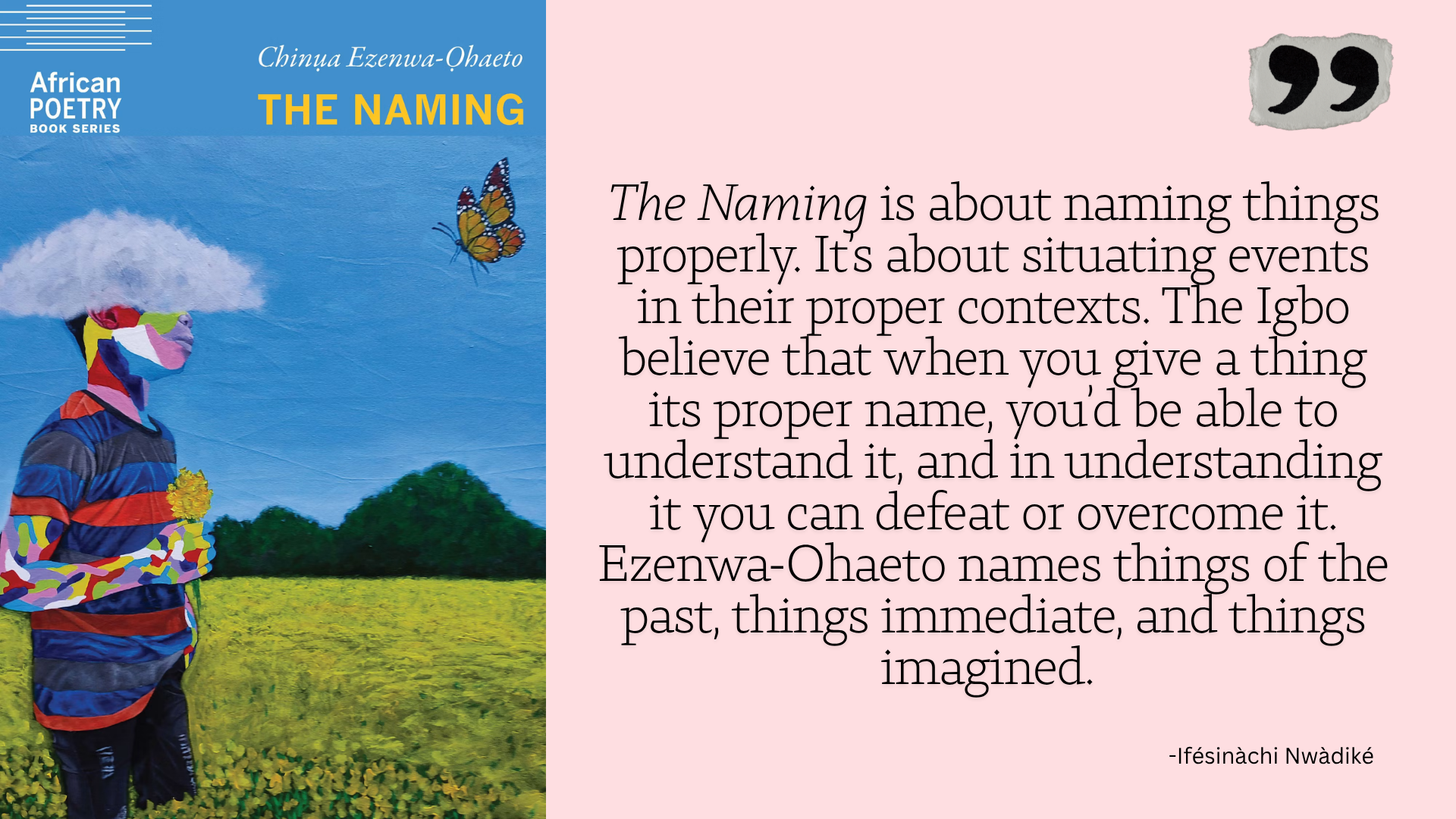
How can one become a worthy citizen of the world, a patriot of his country, and an active member of his community if he or she has no knowledge of his or her ancestry? This appears to be the implied question which Chinua Ezenwa-Ohaeto’s full-length poetry collection, The Naming (University of Nebraska Press, 2025) profoundly answers in a bristling collection of three sections, and spanning 81 pages.
We do not often see sons of great men toeing the path of their fathers, but for a child who once dreamt of becoming an inventor, Chinua, in his award-winning writings, has justified why he chose the ways of his father. For context, Chinua Ezenwa-Ohaeto is the son of the late remarkable poet Ezenwa Ohaeto who, in addition to being a cerebral thinker and essayist, authored Chinua Achebe’s authorized biography in 1997. It makes then, to see a poetry collection tracing the genealogy of his ancestry, celebrating the gallantry of the men in his past, and transforming their ontological perspectives into the compass of his own journey. Indeed, how can a child get lost, if he knows the ways of his fathers? “I have said many things about people I love / so that I can be found easily whenever I get lost,” he writes in the titular poem, ‘Naming’ (10). This is the central message, the thematic crux of The Naming.
An Igbo anecdote says that a child who does not know what killed his father, what killed his father will kill him. Another also says that a person who does not know where the rain began to beat him, cannot tell where he dried his body. These sayings are axiomatic of how the Igbo perceive historical knowledge, of how the Igbo encourage themselves to always remember to look back to understand the way forward. Chinua Ezenwa-Ohaeto, in The Naming, demonstrates an appreciable knowledge of the Igbo collective history, of his ancestry and their interaction with the larger world. The saying is true that a person who is given a broom to sweep his community must begin from his father’s house, when Ezenwa-Ohaeto writes, “I carry your name, our fathers’ fathers, everywhere I go / because it means to live with purpose, together, and with love” (61). The poet shows, here, that an understanding of one’s familial and communal ideals is paramount to good citizenry.
The Naming excels in projecting family intimacies, dreams, ancestral recollections, childhood mischievousness, bravado, and insecurities as in the poems, ‘Once Upon a Time the Teeth’ (20), ‘The Actual Story About the Keloid on Chinụalụmọgụ’s Left Arm’ (23), and ‘The Navel’ (21) which begins as a child’s constant worry about the size of his navel, but eventually morphs, with hindsight, into a cartography of belonging, when he writes:
I must confess, our fathers’ fathers, that these are navels in the glories.
Navels of the holies. Navels with the stories.
There’s no better period to be born than the period I was born;
no better way to be born than this way.
My navel is yes yes yes to the family that made me from love;
is yes yes to the goodbyes in cupcakes and masks;
and is yes to the bad words terrified of my kindness and elegance (21).
Born with a protruding navel, the poet admits how it made him insecure as a child. That he is able to look at it now and feel proud stems from his understanding of the navel, known in the poet’s culture as otube or otume, as a primordial source, as the portal of divinity through which one can underscore his existence, destiny and bodily connection to the land of his birth. There is a sense of grounding in the above excerpt, reflected in the Igbo ritual of burying a newborn’s umbilical cord in his or her father’s compound immediately after birth. I am tempted to liken the poem, to reread it as a masterclass on patriotism, in a way that suggests loyalty and love for one’s country despite its imperfections.
The Naming is about naming things properly. It’s about situating events in their proper contexts. The Igbo believe that when you give a thing its proper name, you’d be able to understand it, and in understanding it you can defeat or overcome it. Ezenwa-Ohaeto names things of the past, things immediate, and things imagined. He names the slave trade and how some Igbo captives refused to be wrongly named, leading them to commit mass suicide. He names Unknown Gunmen, Boko Haram, #Endsars, Biafra war, Aba Women’s protest (not war, please!), and the long British colonial history of social disruptions, citing the Uga example. The Naming is a poet searching to know “where it hurts the most” so he “can take care of it” the way his ancestors had taught him, because “When a thing deems itself difficult, the child looks for the father” (5). The child, indeed, looks for the father in the poet persona’s constant beseech of his ancestors in ‘A Call at Dawn’ (3), Appraisal’ (6), Unfurling’ (8), etc., and in his appreciation of the weight of his father’s legacy in ‘Memorabilia’ (17). This appreciation is manifested in the insights he received from the gifts of a jar and a coat from his maternal and paternal grandmothers, gifts that transcend their thingification to become insights, insignia of identity.
The Naming is also an allegory of sorts–an allegory of Nigeria, a country in full bloom of dementia. Ezenwa-Ohaeto compels Nigeria to reexamine itself, its nationhood following his own examples. The poet invites Nigeria to look back and do some naming to understand what is wrong with it. Perhaps, an appraisal of the ways and means of the various regions that make up Nigeria before the catastrophe of colonization and its attendant postcolonial depravities might offer new insights on how to revitalize the nation and turn it to the country its people truly deserve.
In a collection that is replete with Igbo expressions and idiosyncrasies, what then is the essence of going through the troubles of decorating kola with Igbo tonal marks, thereby rendering the word in Engligbo–the fond way we refer to code-switching and code-mixing Igbo and English expressions in one sentence? I have a slight disagreement with how he replaces oji–Igbo for kola nut–with kola, the shortened English form. However, that disagreement quickly dissipates when you encounter even more stubborn usage of Igbo, English, and Pidgin at once in subsequent poems. They make, sometimes, for a beautiful read, and at other times, for a humorous read, as in the final poem ‘A Call’s Dusk’ (78). I like to refer to it as a form of stylistic defiance–pure, in its reenactment of the speaking mannerism of Igbo millennials–the way Chinua Ezenwa-Ohaeto names things, the way he asserts his place in the tradition of the new-generation African voices gifted with the oral cadence of the old.
Ifésinàchi Nwàdiké, poet and playwright, is the author of two poetry collections including How We Became Heroes (Noirledge 2025). His debut poetry collection, How Morning Remembers the Night, was Longlisted for the Pan African Writers Association Poetry Prize in 2022. Some of his poems, essays and reviews have appeared in Maroko, Olongo Africa, Nokoko, Kalahari, Brittle Paper, Ake Review, Ngiga Review, and elsewhere. He was an Inaugural Fellow of the Black Orpheus Exploration Residency in 2025.