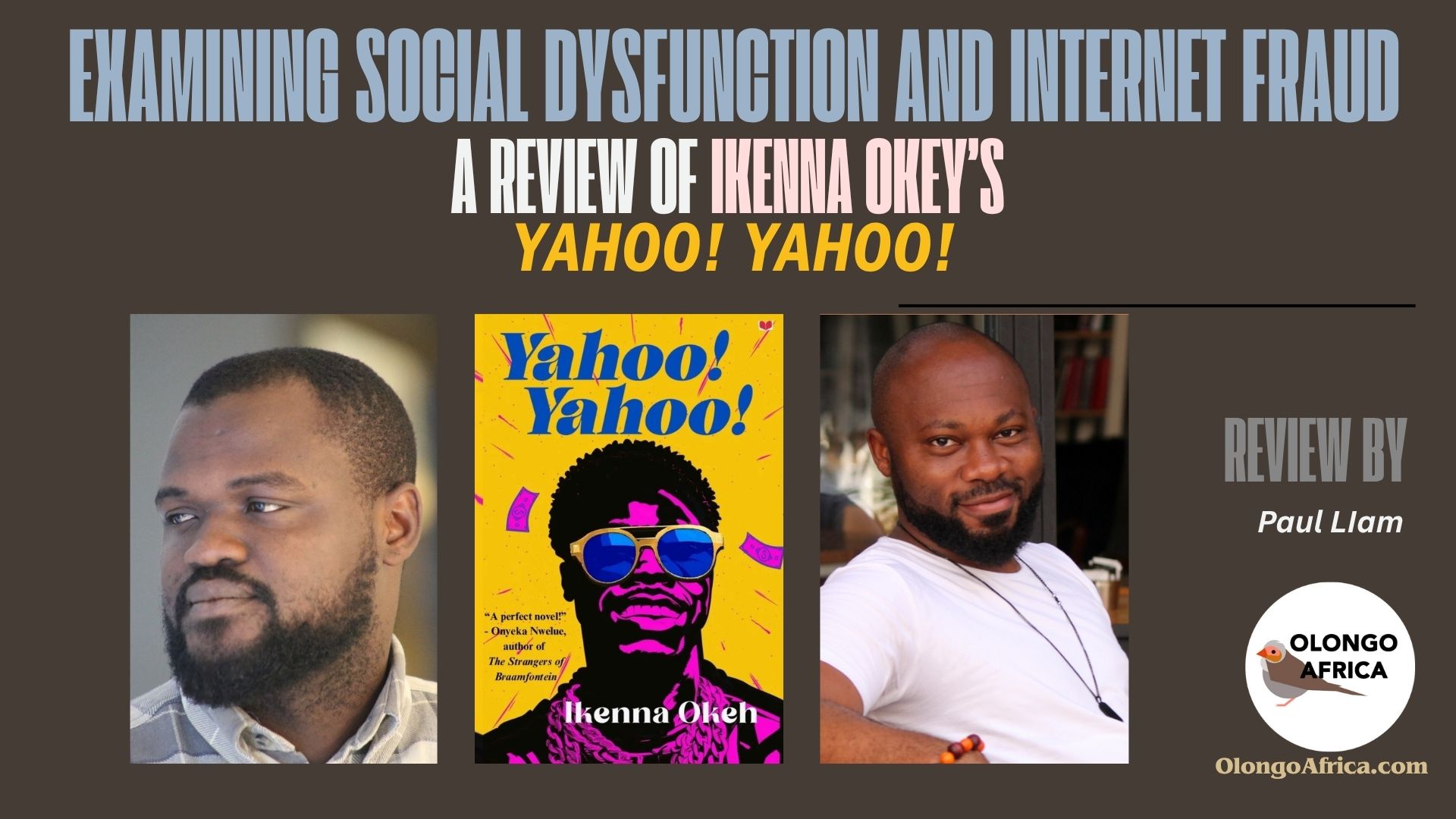
Nigeria’s battered global reputation has been attributed to the nefarious activities of internet fraudsters and corruption perpetuated by unscrupulous political leaders who embezzle public funds and store them in offshore accounts abroad. These unfortunate social vices have led to the global victimization of innocent and hardworking Nigerians in legitimate businesses around the world. Nigeria suffers from the scourge of social dysfunction that permeates all facets of its national life, from failed and corrupt leadership to pervasive insecurity, a dearth of family values and systems, corrupt security operatives, and religious and moral decay. It is against this backdrop that Ikenna Okeh’s novel, Yahoo! Yahoo!, derives its narrative agency. Okeh offers an unpretentious examination of the cankerworms eating away at the soul of Nigerian society. Its greatest victims are the youth who are often regarded as perpetrators of the dastardly acts of internet fraud, which, upon a holistic examination of the root causes of the social decadence of internet scam, could be traced to the overarching consequences of leadership failure, social injustices, and inequality.
A society that provides functional social systems and equal opportunities for its citizens, especially its youth, cannot be bedeviled by atrocious acts of criminality, such as some Nigerian youth have become famous for in the world today. At least this is the perception of the lead character, Chidi, and his acolytes, who find economic agency through internet fraud. While society is quick to condemn young people involved in internet fraud, less attention is paid to the social factors that enable such unprincipled practices, such as failed family and equitable social systems. Thus, Okeh’s novel is an instructive portrayal of the social decadence that cuts across the spectrum of society. For example, Chidi’s proceeds of internet fraud become the lifeline of his family, who benefit from his exploits without ever demanding how he makes his money, especially since they cannot establish his source of income, yet they receive the money that he gives to them and even pray for him to continue to thrive. Awele is an eighteen-year-old girl who leaves home to hustle in Lagos. What is an 18-year-old girl doing in Lagos without her parents and relatives? A girl from a functional home would not leave her family to move to Lagos in the name of hustling only to end up depending on a Yahoo boy to support herself and her family. This shows that the failure of the family system is a major factor that supports the illicit behaviour of many young people.
Similarly, operatives of the Nigeria Police Force, Economic and Financial Crimes Commission, and the Department of State Security would not arrest fraudsters only to collect money from them and release them. Okeh highlights the encompassing nature of corruption and greed and how it has become a norm in society. He suggests that everyone is guilty; it is not only Yahoo boys who are criminals, the entire system is riddled with criminality and corruption. This pervasive sense of decay is conveyed through the postulations by Chidi, who doubles as the narrator of the story. For example, when he is accosted by the police and they discover a laptop hidden under the driver’s seat, they threaten to arrest him and take him to the police. He ends up negotiating with them and parting with one hundred thousand naira for his freedom. The passage below illustrates the above assertion:
“Officer, make we talk well abeg,” I plead. I get out of my car, pocketing my key, and begin to talk with the officer. An hour later, we agree on a hundred thousand naira, I transfer it into his Access Bank account and now I am back on the road, praying in my heart not to encounter any of them for the rest of the way.” (p.86)
The defunct SARS, now transformed to SWAT by the narrator, are renowned for their criminal activities and harassment of young boys suspected of being Yahoo boys for their own material gains. Another instance in the novel of the unprofessional behaviour of security men is stressed in Chapter Fifteen when Chidi and other suspected Yahoo boys were arrested in a club by EFCC operatives. Chidi recounts how he paid five million naira to be released, while those who couldn’t produce the same amount were paraded on national television as internet fraudsters. Reflecting on the rot among law enforcement officers saddled with the responsibility of curtailing criminality in society, the narrator remarks:
“EFCC na armed robbers wey government give gun and uniform. Abi you no know? Them and SARS, all of them na armed robbers them be.” (p.103)
A perceptive reader cannot help but connect the systemic corruption of law enforcement officers and their reinforcement of criminality, especially internet fraud in the country. If criminals can buy their freedom with money, there is no gainsaying that crime control will remain elusive. The role of the failed family system as a major contributory factor in the ablation of criminality among young people is succinctly highlighted in the text, such as in Chapter Eleven, when Chidi recounts the homily reception he received from his family when he first made money from his scamming foreigners on the internet and bought foodstuffs for his family, and gave his parents money. They never questioned how he got the money, and this behaviour reinforced his confidence in his criminal activities. His family’s reassuring hospitality boosted his confidence that he was on the right track. He recounts thus:
“I leave everyone at home excited as I return to the Island. And that is my reward – that feeling that I can spread love and warmth at home, for that is the usefulness of a man to his home and to everyone whom he calls his own.” (p.76)
Chidi’s philosophical reflection on the satisfaction he derived from using criminal proceeds to support his family buttresses the socioeconomic drivers of internet fraud and criminality in society. Everyone attempts to justify his or her criminal acts by indulging in acts of kindness or being responsible for their families, thereby validating their life of criminality, especially when no one questions their source of income. Some even go as far as making huge donations to religious institutions and to the less privileged in society to justify their criminality. To further buttress the complacency of his family in his nefarious way of life, Chidi recounts an episode when he visited his family’s house in Ikorodo in the mainland, and after buying foodstuffs for his family, he gave his parents five hundred thousand naira each, and to his younger sister, he gave three hundred thousand naira. He notes that his usually stern-faced father put up a smile upon receiving money from him. The passage is recreated below for emphasis:
“Even my stern-faced father breaks into a smile, so wide that it reduces his eyes to mere slits, accentuating the wrinkles around his eyes and reminding me of the havocs of age and ageing.” (p.73-74)
The passage above highlights the consequences of poverty, which turns a man into a dependent who looks to his son for financial support without investigating his son’s source of wealth. If Chidi’s father were to be economically independent, he would not be excited about receiving money from his son. Indeed, it is common to hear Yahoo boys claiming that their indulgence in fraud was driven by the desire to change the economic fortunes of their families. Although internet fraud is not the only means of escaping poverty, however, a child raised in abject poverty is willing to do anything to ensure that he does not end up like his poor poverty. This highlights the role of poverty as an enabler of criminal activities among young people. For example, Chidi and his acolytes are university graduates who couldn’t find legitimate employment to fend for themselves and their families.
The novel achieves significant success in portraying the lifestyle of Yahoo boys through its careful creation of relatable events and realistic representation of their flamboyant living characterized by flashy clothes and cars, clubbing, betrayal, hedonism, cultism, and constant encounters with law enforcement. For example, Big Naira, a notorious Yahoo boy, betrays his apprentice and ends up in prison after his boy exposes him to law enforcement. Ola Money, on the other hand, finds himself in a precarious situation when his Aza woman in Germany refuses to release the funds, which he helped a group of Yahoo boys to secure from their victim through her account. This conflict degenerates into a fraternity war that claims Ola Money’s life. Chidi himself suffers from harassment by law enforcement and the fear of the doom that he is certain might become his fate someday. The narration takes an interesting twist when Chidi’s mother becomes a victim of the MMM scam, after she invested the two million naira, he gave her to keep for him in case he finds himself in an emergency or hard times, he would use it to escape. It so happens that the death of his partner, Ola Money, forces him to seek refuge in Abuja, but his sister calls to inform him that his mother and father are on the verge of committing suicide after his mother invested his two million naira in MMM, which crashed. He becomes stranded, having exhausted his own savings. The heavy use of pidgin English in the narration validates its thematic focus on internet fraud.
However, the novel is not without its shortcomings, mainly concerning editorial lapses, an inconsistent narrative pattern, and a poor conclusion. The ending of the novel does not portray a concrete standpoint on whether internet fraud is bad or good, and the consequences for Chidi’s crime by virtue of his losing the two million naira he gave his mother to save for him are inadequate in compensating for the pains and trauma his criminal activities caused his victims and society in general. A graver punishment would have sufficed, but it is not always that criminals get the justice that they deserve, especially in a society like Nigeria, riddled with criminality and weak institutions. In conclusion, Ikenna Okeh deserves to be commended for highlighting the implications of social dysfunction for the overall development of the larger society.