There abound varied reasons why people chronicle their life experiences. Some seek to reflect aloud and take stock on notable junctures in their lives. There are those who write because they believe their pasts contain the seeds of invaluable lessons from which others may glean useful nuggets of wisdom. For some it is to exorcise the demons of torturing and traumatizing encounters. Yet there are others who seek to inform and entertain. Others seek to construct bridges that will connect their times to future generations, and the need to preserve certain cultural practices may also account for why some humans diarize and memorialize, gifting the reading publics with memoirs, autobiographies, and biographies that weave complex, contentious, contradictory, concerning, entertaining, educative, didactic, exaggerated, ambiguous, nuanced, and bitter-sweet stories of lives in fathomable and imponderable circumstances.
In Benjamin Maiangwa’s lucidly and humorously penned life account, One Boy!: A Boarding School Memoir (2026), some of the foregoing reasons for writing what Sidonie Smith has dubbed true or true enough stories manifest. Aided by vivid recalls, inflected of course with the fickleness of memory, Maiangwa tells the story of his boarding school experience at St. Joseph’s Minor Seminary (SJS), one of the boys-only Catholic boarding schools in Northwestern Nigeria, where young boys came of age in notably contradictory ways. He expertly threads for the reader the pivotal occurrences at SJS that adulterated his and other boys’ innocence and began to shape their understanding of what it means to be human. As the reader learns about the regimented nature of life at SJS, they are also informed about how the young Maiangwa made sense of “sectarian divides while grappling with the contradictions of [his] boyhood, cultural and religious upbringing, and the fragile bonds of friendship in a world that often felt both sacred and hostile” (xii). This riling, ribbing, and revealing saga of growing up amalgamates life-shaping happenings within and beyond “the unbreakable walls of SJS” (5), showing their nodes of convergence and divergence. At the end of its unevenly short but linked 24 chapters the reader gains more than a glimpse of the cores, contents, and contours of the education the boyish Maiangwa – and his peers – received at SJS as they molted childhood coverings and morphed into early adulthood.
In this piece I organize my thoughts on One Boy! around its paratexts, comprising preface, dedication, epigraph, and title; and its contents, specifically its portrayals of school and schooling and the ways in which SJS students forge identities through nicknaming. In this manner I parse the memoir, teasing out some of its narratological fundaments. As the reader may already be aware, this form of discussion means that there are aspects of the book that come alive more to me than others.
By paratexts I refer to a book’s accompanying elements such as title, dedication, acknowledgements, introduction, preface, afterword, epigraph, foreword, and footnotes and endnotes, in the manner that Gerard Genette, Philippe Lejeune, and Beth McCoy individually theorize them. I share these scholars separate but related conclusions that paratextual elements are salient features of a book requiring thorough scholarly consideration.
The paratexts of “Preface,” “Dedication,” and “Epigraph” in One Boy! are not mere accompaniments of the book. They are significant given what they say and presage about the main kernel of Maiangwa’s childhood and schooling experiences as narrated in the book. It is through these paratextual elements that the reader first begins to get useful hints about the book’s thematic emphases. For instance, in reading the Preface, one gets immediately informed about (a) what inspires the different yet related stories in the book; (b) its uneasy themes of the loss of innocence, the imponderable contradictions in the church’s school system, the complexity of the supposedly innocent human person, the joys of learning, the heavy-handedness of teachers and the thuggery of senior students, the initiation of agency and survival mechanisms by the inmates of the highly regulated learning space, the pernicious holds of traditions and institutions, among many others; (c) the entertaining quality of the textured and euphonous prose through which this growing-up account is organized; and (d) the fact that the account is a sensible melange of the absurd and the gory, as well as the astonishing and the fascinating.
The significance of the memoir’s Preface is also evident in the chilling rhetorical questions it raises in its penultimate paragraph:
“What could have fuelled this disturbing phenomenon [that is, the disconcerting juvenile cruelty and violence that defined SJS]? Was it a lack of proper home training? The influence of our peers? The rigid, often punitive traditions of the boarding school system? Or perhaps the deeper, more insidious legacy of colonialism and its inherited violence? Were we simply mirroring the dysfunctions of the larger society, or were we casualties of it: young boys shaped by a culture too absorbed in its own superiority and religious piety to see the fractures within?” (xi-ii).
These questions indicate that the book is about looking back and reflecting. The questions also provoke thoughts about the discourse on childhood, young people and conflict, and children and precarious, inhumane conditions. This discourse, shaped heavily by Big International Non-Governmental Organizations (BINGOs) concerned with children in varied situations, stresses the notions of childhood innocence and blameless victimhood. At its core is the questionable conclusion that children, regardless of their actions, are absolutely innocent, and as such are incapable of the cruelty and sheer daredevilry that Maiangwa recalls graphically from his boarding-school experience. Given the horrific acts of his young contemporaries at SJS and the above mind-concentrating questions he poses in the Preface, Maiangwa invites us to rethink the conception of childhood innocence. He prods us to be mindful of children’s agency in all contexts, reminding us of Alcinda Honwana and Filip de Boeck’s conclusion that “[y]oung people constantly cross the frontier between childhood and adulthood. As they actively create and recreate their roles in the face of changing conditions, they blur that social divide” (4). Moreover, Maiangwa’s rhetorical questions challenge us to come to terms with the stubborn fact that children are conscious social agents capable of calling their minds theirs, especially in situations where adults are barely present or are not dictating the rules of engagement. The posers signpost the point that some people like to avoid – that children are never clean slates; they have capacity for good and evil. One Boy! affirms this view prominently. In my book-length analyses of literary depictions of children and warfare, I robustly engage this discomforting reality. I maintain that “innocence—whether viewed as moral purity or inexperience—does not presuppose the absence of an inherent capacity for malevolence or malfeasance, especially in children at war” (74). One Boy! teaches that childhood, even when conceived as a disability, does not preclude ability.
The paratextual element of Dedication in One Boy! also proves meaningful for the attention it calls to the archive of memories that defines life writings. The book’s Dedication dispels any doubts that its author seeks to both invoke memories and memorialize family members, friends, and acquaintances encountered during his maturation years at SJS. Some of these people are deceased. Attention to the list of these dead individuals, which one may style a “Memorialization Wall,” shows that it is preceded by an epigraph from the writer Ta-Nehisi Coates. This epigraph provides the evidence that the Memorialization Wall in this Dedication matters seriously to the fully adult Maiangwa, and it features importantly in the book. The reader learns, following Coates’ mind-bending words, that the memorialized people occupied a “warm place” in Maiangwa’s heart, and that their respective eternal absences from here leave an unhealing “wound” there. The reader does not discover this discomfiting fact in the chapters of the book, particularly in chapter 24; they learn of it first through the Dedication. Therefore, the paratextual spaces of One Boy! foretell what the reader will find within the 148 pages housing the author’s chequered remembrances of defining childhood and schooling experiences amidst other indelible encounters. In other words, the paratexts of Preface and Dedication are crucial components of the story of One Boy!
The title of the book as a paratextual attribute deserves attention too. As Maiangwa explains it in chapter five, “One Boy!” is how senior students at SJS summon their junior peers to undertake (questionable) errands for them, “issuing the call like heralds of authority,” or make them present themselves for outrageous punishments for real and fabricated offences. “‘Wani Yaro,’” the author informs, is “a Hausa phrase loosely translated as ‘Any Boy or Some Boy’” that in the years “morphed into its agreed English form: ‘One boy!’” (29). Apart from indicating the boys-only character of SJS, the phrase immediately highlights the tyranny that the seniors favor and represent. The attendant exclamatory mark therein plays an effective complementary role which enables the reader to think of an unignorable military command. One only needs to imagine the tone in which the seniors issued the command. It is not a surprise, therefore, to know that the seniors derive “satisfaction” from having many juniors who are at their beck and call. If “One Boy!” gives senior students pleasure, its targets endure mental affliction. Hear Maiangwa: “for juniors, it was the dread of being chosen as the one boy, which often meant gruesome tasks awaited” (30). The deadly phrase encapsulates the militarized zone that SJS partly is. As I will underline later in this essay when I discuss the many mind-boggling sobriquets successive generations of SJS students invent for themselves, the chosen nicknames and several other things confirm this Catholic school as a sordid military barracks. The other readerly function that “One Boy!” as the title of this book performs is one of suspense. It inspires in the reader the curiosity to know what it means. As if he wants to sink the knife of this suspense deeper into the reader, Maiangwa delays the explication and context of this phrase to chapter five. In this manner he increases the amperage of suspense and cranks up the reader’s curiosity.
Epigraph is another notably meaningful paratextual feature in One Boy! It appears on the Dedication page and remains constant from chapters two to the last chapter. What is notable about these short quotes placed at the beginnings of the said places in the book is that they are (i) carefully sought and reveal the author as a scholar who reads widely and wisely, and (ii) relevant to the focus of the chapters they accompany in the ways they meaningfully foreshow the themes to be engaged and invitingly summarize them. I am making the point that epigraphs in this book are not frivolously deployed. They are functional. They also tell the reader that the author thinks methodically about what he wants to accomplish in each chapter. He painstakingly enacts a symphony between the epigraphs and the contents they thematize aptly. More, the epigraphs invite reflection on the part of the reader. A careful reader pauses to ponder them, keep them in mind as they read, and possibly return to them at the end of reading each of their chapters.
But the absence of an epigraph in chapter one is a foregrounded one. This glaring absence reveals a defect in the architecture of the book. As any disciplined reader would observe, the chapter stands out from the rest. It is the chapter that most informs the reader of the reason the author scripts the story. In fact, it is the chapter that most vividly presents the theme of trauma that both the author and other SJS alumna bear as an afflicting mental scarlet mark. If SJS shapes the author and others into “strong, disciplined, and resolute” men, it also sears into them “the cruel marks of the system” (5, 33). Some students did not return after leaving for termly breaks. After all, as the author informs us, “life at SJS was never all rosy” (96). This training of “a boy to become a man” burdens the adult Maiangwa with nightmares. In chapter one he relays a dream of his time at that Catholic school. In the final paragraph therein, like a troubled parishioner before a confessor, the author exhales thusly: “I have been experiencing recurring variations of this dream since leaving SJS” (2). If this is what chapter one entails, then the question becomes pertinent: why is it not set up as a prologue? It would have structurally worked well as a prologue given the properly scripted traumatizing dream the author shares. Similarly, chapter 24, even though it has an epigraph, would have been more useful as an epilogue. I make this point in view of what the chapter underlines, a useful piece of information and reflections that none of the preceding chapters host. Additionally, the chapter hints at something unfinished: “This book is not a catalogue of pain, loss, and death; it is a window into tomorrow. It is a search for the boy still lurking within me […] It is a refusal to allow that boy to be silenced by institutions that claimed to shape him” (147).
While we do not need to distract ourselves with what the author claims the book is not, it makes sense to note that this book does not show that the “search” for “the boy still lurking within” the author is successful. That is, the search continues and it may take other book(s) to discover what the former SJS boy has become. The chapter only wraps up the SJS journey of the boy. It is why this chapter merits being an epilogue. The shortness of this chapter, à la chapter one, is another evidence why it should be an epilogue – both chapters are the shortest of the chapters. Perhaps this structural defect is the making of the book’s editor. Whoever’s error it is, it reminds the reader of something about SJS – a Christian school not always in adherence to scriptural precepts. Does one of its priests not volunteer a paradoxical truth to his listeners thus: “Seminarians are the worst crooks out there […] Ordination does not change a crook into a saint”? (89). In all, it suffices to note that the inelegance of this book’s structure does not detract from its quality as a well-conceived and masterful memoir on childhood, schooling, and coming of age.
Now I come to the depictions of school and schooling in One Boy! Although the SJS that the young Maiangwa’s family lobby to enroll him in at age 12 is not managed by White missionaries as was largely the case in the colonial era, its colonial origins cannot be ignored. It was founded four years after Nigeria’s flag independence from Britain by Archbishop John McCarthy (9-10). First, the very idea of “school” has specific cultural and colonial origins as formalized institutions of learning envisioned and developed in Western Europe, beginning in the seventeenth century. There is a lot to learn from Chinua Achebe, Ngugi wa Thiong’o, and Simon Gikandi about the colonial school and how they and others who passed through its heavily restricted universe experienced it. These accounts are diligently documented and analyzed here: Achebe’s The Education of a British-Protected Child: Essays (2009); Ngugi’s autobiographical memoirs trilogy, Dreams in a Time of War: A Childhood Memoir (2010), In the House of the Interpreter: A Memoir (2012); and Birth of a Dream Weaver: A Writer’s Awakening (2016); and Gikandi’s book of essay, African Literature in the World (2026). Second, the eight dormitories at SJS are mostly christened after White priests (65). Only two of them are named after a non-White priest (Bishop Abba) and the mother of Jesus (St. Mary’s).
The third evidence for classifying SJS as a colonial school is present in its motto, “Ut omnia unum sint – That all may be one.” It is derived from “the Gospel of John 12:21” (7, 10). This dictum is instructive. Its positive surface intent has something radically and disturbingly different beneath it that outlines the vision of the school – homogeneity. The school seeks to make boys into men in a uniform sense. The epistemic “truth” its favors is the absolute “Truth,” which the speaker in the poem “The Truth and truth,” from my book of poetry, thinks of as “malevolent and mendacious” (72). This “Truth” is regarded as infallible. It promotes identitarian fragmentation and cultural alienation, especially in its unyielding promotion of English as a determinant of intelligence. The “Truth” of this education digs a gulf between the students and their culture, drawing them further and further to the side of a culture considered supreme. It incorrectly elevates one knowledge system as the ultimate. As One Boy! shows, things within the school are done in the same bothersome manner that leaves nearly no room for individual creative expression. In its classes, answers to questions and reasonings are expected to be the same, or those that the instructors privilege. There are grave consequences for anyone who think differently. Rote learning supervenes there (Achebe says “the cramming which often passed for education in the colonies was in fact education’s greatest enemy” 20). The school also demonizes the questioning habits, thus foreclosing one of the major pathways by which humans learn. Differences across several areas of life are gravely punished. SJS manifests the character of the colonial school in its abjuring of differences. For the school, differences are diseases. The students imbibe this noxious weltanschauung. They enforce it and give no quarter, whether or not it is “the Week of Grace” when the suspension of violence masqueraded as discipline is expected.
However, SJS, like other colonial school before it has its paradox. Despite its epistemic narrowness and one-sidedness, its graduates, like Maiangwa, turn out to be critical thinkers who value epistemic and cultural differences. The school’s Euro-Western curricula unintentionally give the students some functional tools to engage the world. Maiangwa’s love of reading and capacity to write intelligently are forged in the smithery of SJS. Teachers like Dr. Smith culture his mind towards effective communication and critical thinking (chapter eight). The testimony the memoir bears about this aspect of SJS is analogous to what both Ngugi and Achebe say of their individual colonial education at Alliance High School and Government College Umuahia. Ngugi captures the paradox in In the House of the Interpreter in this way: “But contrary to the conscious intentions of its founders, Alliance had also birthed a radical anticolonial nationalist fever. Ironically, in its very structure, Alliance actually subverted the colonial system it was meant to serve,” adding that through the work of its principal the school “produced self-confident, college-prepared, intellectual minds. By the time I left Alliance, I felt that academically I could go toe to toe with the best that any European or Asian schools could produce” (12-3). On his part, Achebe explains that while his own school was by design limited in what it could teach its students, teaching only what it knew as one of its instructors was quoted as saying, the school still produced some of the finest creative and critical thinkers (22-3). The school threw up many of the fine writers who would be instrumental to the emergence of modern African literature (20-1). Gikandi underscores this claim in his fine analysis of the language of African literature and the role of colonial education in fashioning it (44, 53). Taken together, it can be argued that colonial schools such as SJS simultaneously empowered and disempowered its students.
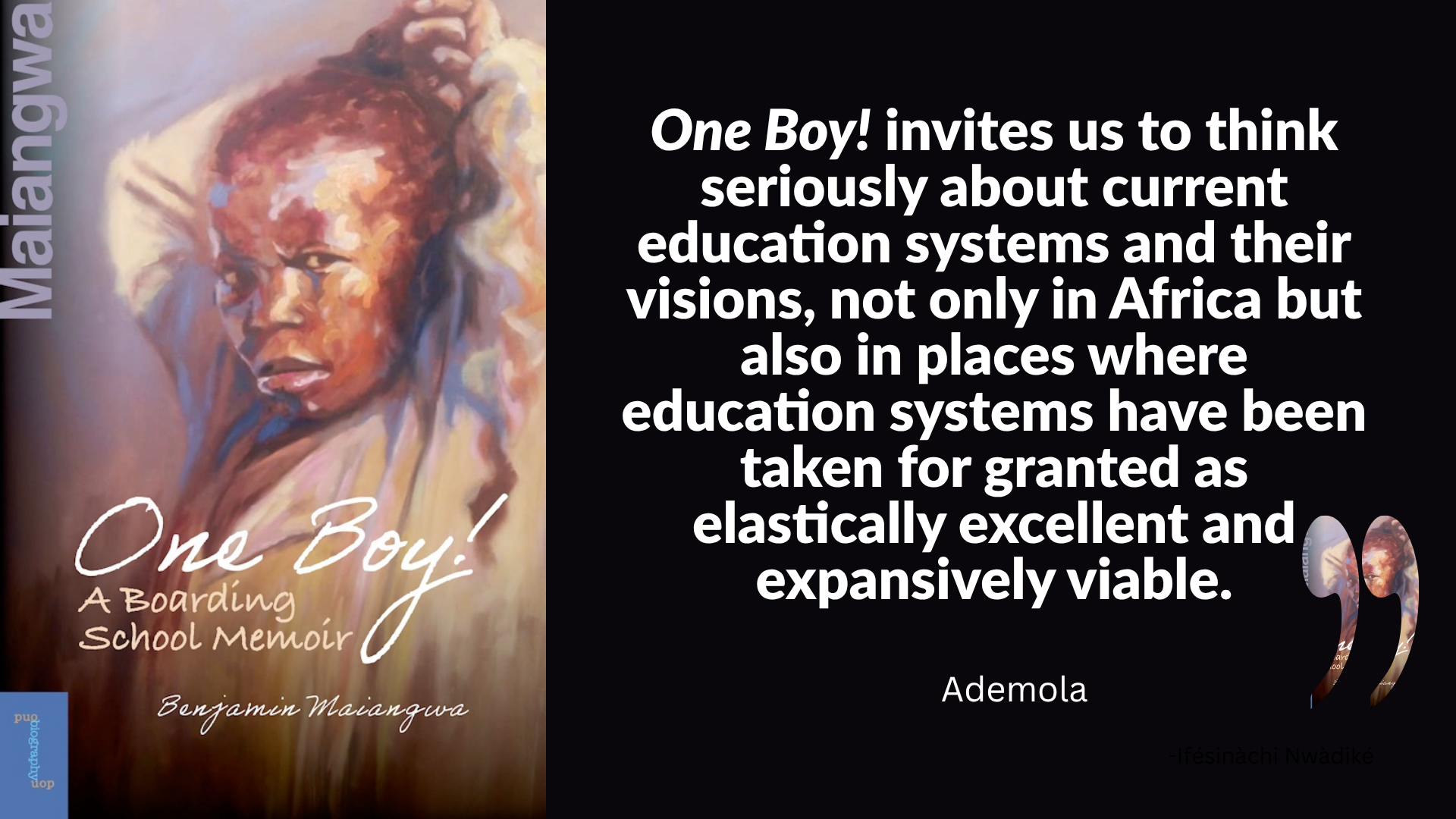
In view of the foregoing discussion of the colonial school and its education system, it is vital to acknowledge that One Boy! invites us to think seriously about current education systems and their visions, not only in Africa but also in places where education systems have been taken for granted as elastically excellent and expansively viable. The memoir inspires one to advocate more favorably for the continual development of education systems that are attuned to protean current realities, embrace multiple ways of knowing, and prioritize humanistic values. I think Ngugi speaks eloquently about this kind of education system: “Balanced and inclusive education calls for a new slogan: network, not hierarchy… Education should never lead to linguistic and cultural self isolation… the goal of education is knowledge that empowers, that shows our real connections to the world, but from our base. From our base, we explore the world, we bring back that which enriches our base” (2022/2025).
My closing thought on One Boy! forms around the humorous and the weird nicknames successive generations of SJS students invent for themselves and for others. These hilarious and strange names create reading delights (see chapter nine for an example). Students and teachers create such comedic and fearsome sobriquets as “O Sacrament Most Holy” (the author’s father, 4), “Recti,” “Terminator” or “Termi” (6), “Kazzy Boy,” “Mad Tiger” (8), “Madam Koi Koi” (12), “The Voice of God” (a bell, 13), “Duncan Mighty” (a food flask, 16), “Holy Knock,” “Power Boy” (22), “Abacha,” “Shakespeare” (43), “John-the-Baptist” (44), “High Tower” (51), “Gwandilalas” (53), “Thermocool” (54), “Lion Share” (63), “Emcee Zawo” (68), “Pure, Gee-Pee” (82), “Antelope” or “Ante,” “Dan Waku,” “Oliver Twist” (83), “Men-of-God” or “MOGs,” “Pope,” “Bishop,” “Eldeeno-Eldorado” (87), “Madam M” (125), “Money-for-Ground” (129), “Scatter” (139), and more.The frequent invention of monikers constitutes another avenue through which the young, but increasingly worldly SJS students cope with and mitigate the torturing everyday vicissitudes within the walled boarding school. The creations allow them to momentarily dull the sharp edges of their existence as boarders. The funnily deprecating names add mirth and color to the commonplace intolerable and superfluous comeuppance that attends real, exaggerated, or imagined infractions. Since some of the strict teachers and vicious senior students do not allow these children to be children, the students at the receiving end of their cruelty and domination respond by giving them denigrating names. Teachers too create nicknames for their students. For SJS students and teachers there are no limits to what can inspire nicknames.
I should add that aliases such as “Mad Tiger,” “Soul Taker,” and “Scatter” (8, 86, 54, 139) that the students curate in response to diverse happenings show that hostile environments and conditions of precarity can catalyze dark and terrible consciousness in their inhabitants. It does not matter if the space is a seminary where the boys becoming men are taught to dread and worship God. Such a space can subvert this teaching, as is the case with SJS picaresque characters who lie through their teeth, cut corners, compromise school security, flout regulations, sodomize, and pilfer things scandalously. Some of these reprehensible acts are initiated (un)consciously to either evade punishments, test the limits of boundaries, or in surreptitious response to the pangs of privation. In my book on child soldiers, I give analytical attention to the war names that child soldiers construct for themselves to reflect on their changing circumstances and so forge new identities (153-156). Among others, the common ground the SJS boys share with child soldiers regarding the generation of nom de guerre is that it is another means by which they exercise agency. Naming themselves or rechristening others gives them a strong sense of power and being in control. It allows them to construct new identities that reflect how they think of themselves and others, or how they want to be perceived. And frivolous as some of the nicknames are, there is method in their construction. One other positive thing about these naming rituals that the adverse social conditions that characterize SJS activate in the students is that alluring friendships are also enacted through them. Indeed, this fact lends validity to the view that in every bad thing there is a degree of good. As a scholar of African and Black diaspora literatures, and one invested in representations of children/young humans in (dis)similar precarious existential conditions, Maiangwa’s One Boy! gives me something to wrestle with intellectually. I consider it a relevant addition to African and Black life writings. I have enjoyed reading it. It tells difficult stories entertainingly without trivializing them (as Sidonie Smith and Julia Watson posit, life narratives are never easy to write, 1). It is a book that weds substance with style. Texts are supplemented with photos, although the black-and-white appearances of the photos are less visually exciting. Doubtlessly, it gives me absolute pleasure to write about it. Its variegated depictions of life in an all-boys Catholic-run boarding school raise several socially relevant questions. In it is the clarion call to rethink education systems, how we understand young people, the importance of sex education for young people, and the place of religion-inflected education. Surely, there is something in the book for educators and all minders of children/young people everywhere.
Ademola is an assistant professor in the Department of English, Languages, and Cultures at Mount Royal University, Calgary, Canada.